IN Brief:
- Blackwood Plant Hire has become the first UK contractor to deploy Trimble dozer steering technology.
- The system uses 3D design data, GNSS, and onboard sensors to guide machines during grading.
- The deployment reflects growing use of machine control to improve accuracy, productivity, and operator support.
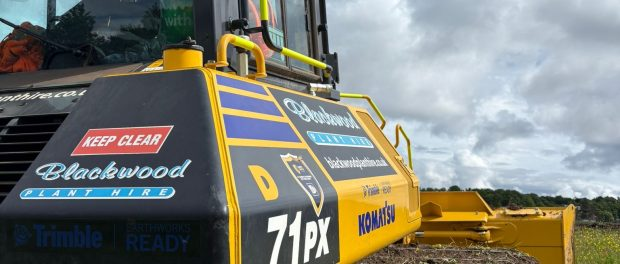
Blackwood Plant Hire has become the first UK contractor to deploy dozers fitted with Trimble Earthworks Horizontal Steering Control.
The technology, supplied and supported by SITECH UK & Ireland, automatically steers dozers along 3D design alignments during grading operations. It uses GNSS, onboard sensors, and project models to guide machines more consistently, helping operators reduce overlap and maintain the correct path.
Operators remain responsible for the machine and the site environment, while the system supports steering alignment during repetitive grading work. By holding the dozer to the model, it is designed to improve pass consistency, reduce rework, and support operators across different experience levels.
Blackwood operates from depots in Inverness and Aberdeen and runs a fleet of more than 500 machines. Around 80 are GPS-enabled, including 14-tonne to 50-tonne excavators, long-reach machines, and dozers.
The dozer steering deployment builds on an established relationship between Blackwood and SITECH, which has supported the contractor’s use of machine control and GPS-enabled plant. The latest system extends that approach from grade indication into more active steering support.
Machine control has moved from being a specialist productivity tool to a more central feature of modern earthworks delivery. Contractors are under pressure to improve accuracy, reduce material movement, limit rework, and make better use of operators while skilled plant labour remains tight.
Automated steering changes the operator’s task rather than removing it. On repetitive grading work, maintaining alignment over repeated passes can be tiring and inconsistent, particularly across long platforms or embankments. With the machine following the model, the operator can concentrate more closely on production, safety, changing ground conditions, and blade performance.
The approach is particularly useful on infrastructure, housing-enabling works, industrial platforms, and large commercial sites where earthworks tolerances affect downstream construction. Poor formation accuracy can lead to unnecessary material import, delays to drainage and pavement works, additional survey checks, and cost disputes. Better first-time accuracy reduces those pressures before they move through the programme.
Plant strategy is also broadening beyond diesel machines and attachments. As contractors look again at how sites are powered and monitored, mobile charging systems for construction sites are entering the same conversation as machine control, telematics, and lower-emission equipment.
For plant hirers, machine control is becoming a differentiator. Contractors increasingly expect hired equipment to arrive ready for digital workflows, with compatible sensors, receivers, displays, calibration, and support. The commercial proposition now extends beyond machine availability into software, technical assistance, and operator familiarity.
The skills angle is just as important. Construction’s labour shortage is not limited to management and trades; experienced plant operators are also difficult to replace quickly. Technologies that help less experienced operators work more consistently can support productivity, but only when backed by training and clear site processes.
Survey teams sit at the centre of that workflow. Machine control depends on accurate models, reliable data transfer, and strong control networks. If design data is wrong, outdated, or poorly managed, automated systems can repeat errors efficiently. Productivity gains therefore rely on coordination between designers, engineers, surveyors, supervisors, and operators.
Blackwood’s adoption of Trimble’s dozer steering system shows where earthmoving is heading. The next step in plant productivity will come from tighter integration between digital design, site data, operator support, and machine movement, rather than from machine size alone.