IN Brief:
- Fusion Student has lodged plans for a 39-storey student accommodation tower in Manchester.
- The Whitworth Street West scheme would provide 818 beds close to Deansgate Locks.
- Domis Construction is advising on planning, construction, and logistics for the project.
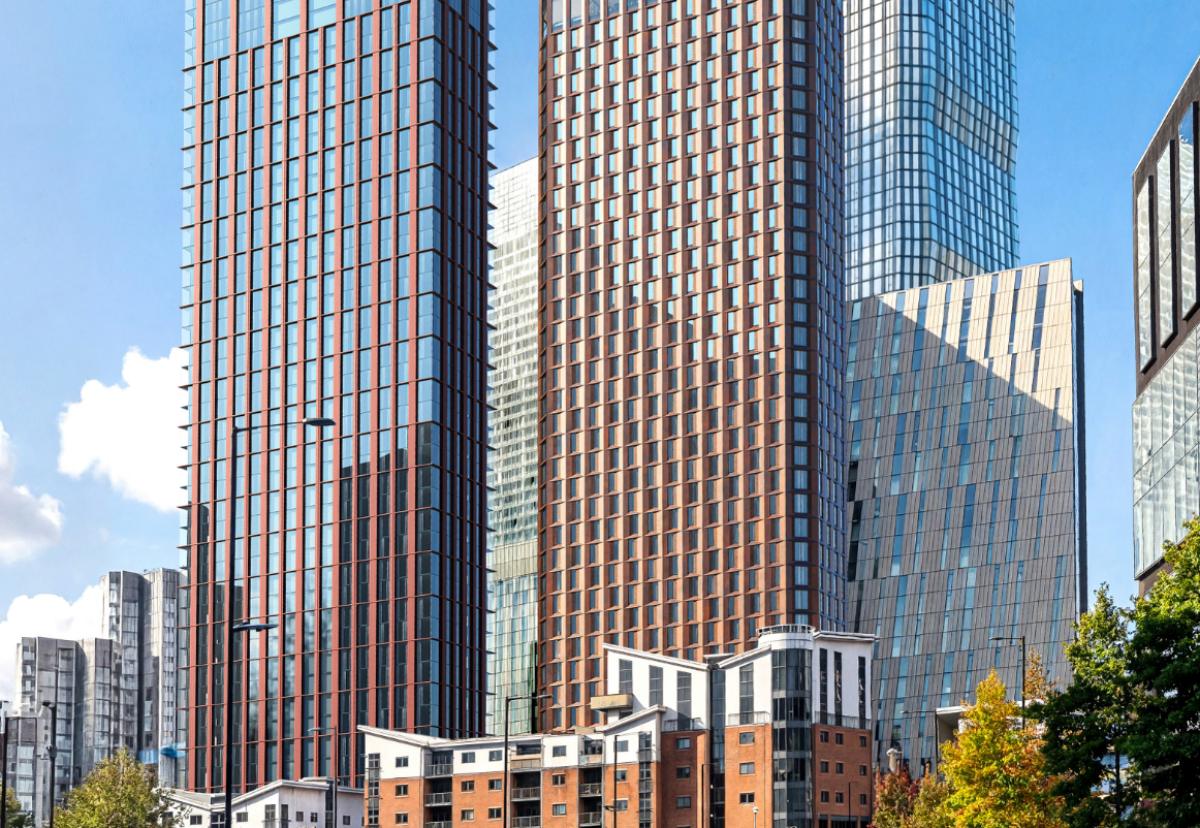
Fusion Student has submitted plans for a 39-storey student accommodation tower on a long-stalled Manchester city-centre site.
The developer is seeking to build an 818-bed scheme at 10-12 Whitworth Street West, close to Deansgate Locks. The proposal would bring forward a prominent vacant plot that has already seen two earlier consented schemes fail to reach delivery.
Domis Construction is advising Fusion on planning, construction, and logistics, while Gardiner & Theobald is acting as cost manager. Amber is providing MEP engineering support and Shear Design is handling structural design. Corstorphine & Wright has designed the tower, which is planned with a bronze and copper-coloured exterior.
The site previously had consent for an 18-storey hotel in 2009, followed by approval in 2016 for the £125m Vision Manchester build-to-rent tower. That later 35-storey scheme, planned with 327 flats, stalled after the previous site owner entered administration. Tri7, now part of Fusion, bought the site for £16m in 2024.
The new proposal would deliver studios and cluster flats, supported by shared amenity space including a rooftop gym, wellness space, café, lounges, bars, and external terraces. The car-free scheme sits near several other high-rise residential and mixed-use developments, including the Axis tower, Glenbrook’s planned 44-storey block, and Salboy’s Viadux cluster.
Purpose-built student accommodation remains one of the more active parts of the UK development market. Student numbers, international demand, and pressure on private rented housing continue to support investor appetite, particularly in major university cities where supply remains constrained.
Manchester is one of the clearest examples of that pressure. The city has a large student population spread across major universities, while central land availability is limited and planning scrutiny around height, design, amenity, and local infrastructure continues to rise. Tall student accommodation schemes therefore need to make a detailed case on urban form, public realm, transport, servicing, and management.
High-rise student accommodation brings a distinct delivery profile for contractors. Bedroom layouts are repetitive, which can support standardisation, but towers still require complex cores, facade systems, vertical logistics, fire strategy, MEP distribution, and tight commissioning periods ahead of academic-year occupation. City-centre plots add further pressure through restricted storage, constrained access, and neighbouring construction activity.
Fusion has been building a wider student accommodation pipeline, with major student housing schemes in London and Glasgow moving through contractor appointment. The Manchester plan would extend that activity into another dense urban market where student housing remains a significant source of work for design teams and main contractors.
The project also shows how stalled residential sites are being repositioned. Build-to-rent proposals across several UK cities have been affected by financing, viability, and construction cost pressures. Student accommodation can sometimes offer a clearer operational model, especially where demand is supported by large universities and long-term investor appetite.
The tower’s location close to rail, tram, leisure, and university routes supports the car-free strategy, but it also raises the importance of construction logistics. Delivering a tall building near busy city-centre routes requires careful sequencing of deliveries, craneage, waste movement, and facade installation. Domis’s early involvement on logistics suggests those constraints are already central to the planning case.
If approved, the scheme would add to Manchester’s continuing vertical development around Deansgate, Castlefield, and the southern edge of the city centre. Its progress will test how the city balances student housing demand, skyline change, and the reuse of sites left undeveloped through earlier market cycles.