IN Brief:
- Skanska has signed a £282m contract to build 55 Old Broad Street in the City of London.
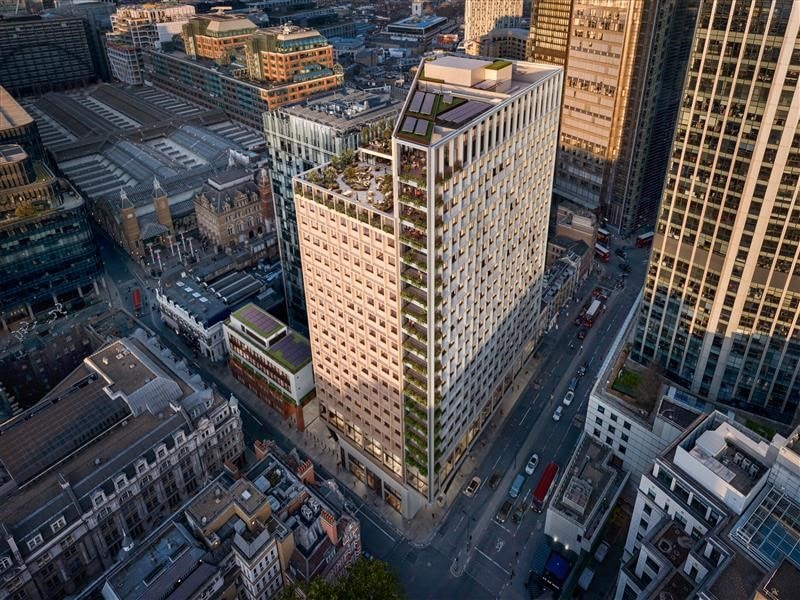
- The scheme will deliver 270,000 sq ft of office space across 23 storeys.
- The project includes MEPH, Cat A fit-out, public realm, retail, and listed-building refurbishment.
Skanska will begin main construction in October on 55 Old Broad Street, after signing a £282m contract to deliver AshbyCapital’s commercial office scheme in the City of London.
The development will provide 270,000 sq ft of office accommodation across 23 storeys, alongside retail space and public realm improvements. The contract also covers mechanical, electrical, public health, and Cat A fit-out works, giving Skanska a broad role across the main build and technical delivery package.
Close to Liverpool Street Station, the scheme sits within one of London’s most active commercial redevelopment zones. Landsec is acting as development manager, while AshbyCapital is progressing the consented project following planning approval in 2023.
Skanska will also refurbish the Grade II-listed Bishopsgate Victorian Bath House and 65 Old Broad Street as part of the wider development. That mix of new-build commercial space, public realm, retail, and heritage work gives the scheme a more complex construction profile than a straightforward office tower.
The project is targeting BREEAM Outstanding and NABERS 5*, with an all-electric operating strategy based on air-source heat pumps and renewable electricity. Those targets reflect the direction of London’s prime office market, where energy performance, carbon reporting, and operational efficiency are increasingly built into long-term asset value.
London office construction remains active at the top end of the market, despite a more selective occupier environment. Demand has concentrated around efficient, well-connected buildings that can offer high environmental performance, strong amenities, and flexible floorplates. Older commercial stock without a credible upgrade route faces a much harder leasing and investment climate.
Cost control remains difficult on dense urban office schemes. Building services, facade performance, structural efficiency, fire strategy, public realm, and fit-out requirements all interact with restricted logistics and demanding programme expectations. In the City, those pressures are intensified by live neighbouring buildings, heavy pedestrian flows, transport interfaces, and limited space for storage or staging.
Heritage work adds another delivery layer. Refurbishing listed fabric alongside a major new office building requires careful sequencing, structural assessment, conservation input, and temporary works planning. London planning decisions increasingly expect commercial redevelopment to retain and improve historic assets where possible, rather than clearing sites for wholly new construction.
The all-electric strategy also shifts the technical burden toward early MEP coordination. Heat pump plant, electrical capacity, controls, metering, resilience, and operational performance modelling have to be integrated before construction decisions close down later options. NABERS targets place further pressure on performance after handover, where design intent has to stand up under real operating conditions.
For contractors, schemes such as 55 Old Broad Street offer valuable workload visibility but demand disciplined coordination across structure, services, fit-out, facade, and conservation packages. Prime office clients are asking for buildings that perform commercially and environmentally, while contractors remain exposed to supply-chain availability, inflation, and productivity risk.
The scheme also reflects how central London development is being reshaped around transport-led locations. Liverpool Street’s Elizabeth line connectivity has strengthened demand around the eastern City, encouraging developers to bring forward dense commercial projects with strong public transport access and limited reliance on car use.
Completion is expected in late 2029. The project adds another substantial London scheme to Skanska’s workload and gives the City a further example of office development combining prime workspace, operational energy targets, public realm, and heritage retention on a constrained site.