IN Brief:
- Domis will begin construction on the Vivere Residences scheme in Manchester in July.
- The project will deliver 237 flats, an 88-key aparthotel, commercial space, and resident amenities.
- The approval adds momentum to Manchester’s high-rise pipeline under the Building Safety Act regime.
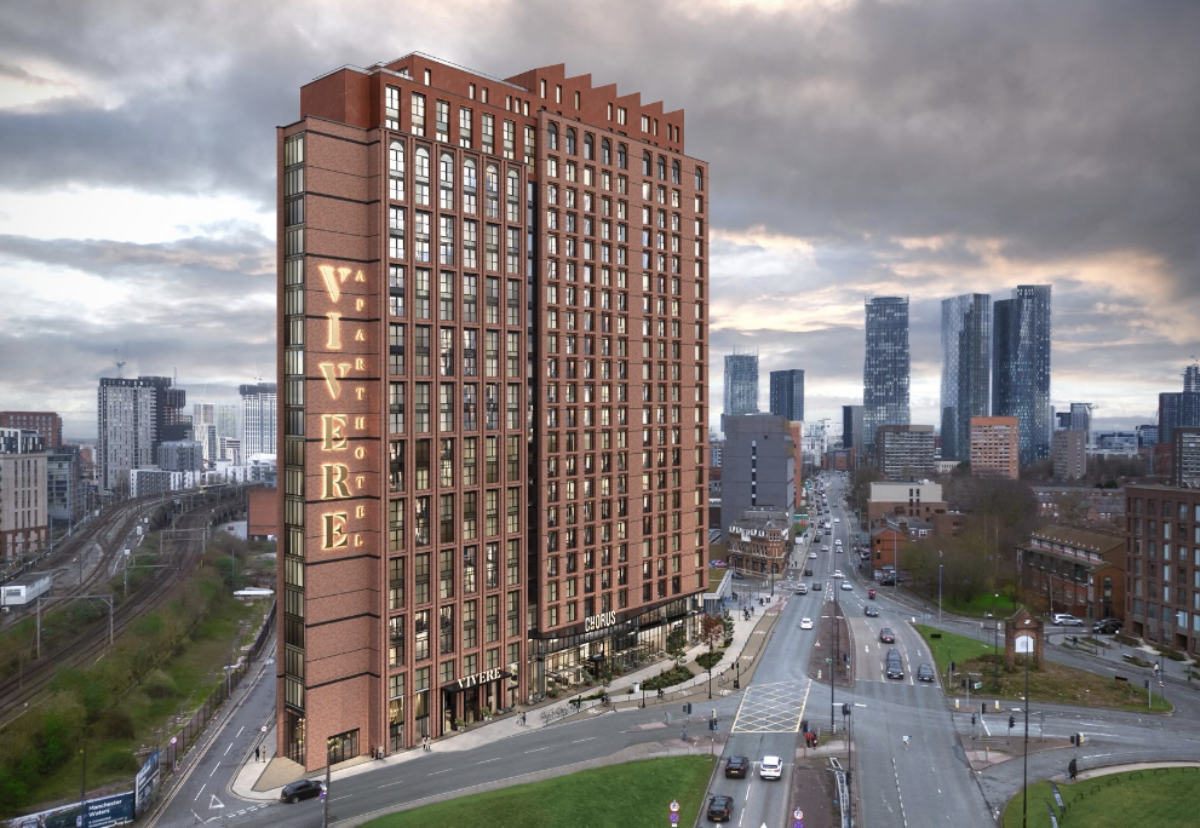
Domis is set to begin construction next month on a 24-storey residential and aparthotel tower in Manchester after the project secured Building Safety Regulator Gateway 2 approval.
The Vivere Residences scheme at Cornbrook will deliver 237 flats alongside an 88-key aparthotel, ground-floor commercial space, and resident amenities. The project is being developed by Forshaw Land & Property Group on a prominent site next to Cornbrook Metrolink station.
Part of the wider Manchester Waters regeneration area, the scheme sits at the entrance to the emerging Pomona Island neighbourhood. Main contractor Domis is expected to start on site in July, following completion of a £64.2m development finance package from Maslow Capital.
The development secured planning approval from Manchester City Council in 2024 but was delayed while progressing through the Building Safety Act approval process. Design changes were required to introduce a second staircase to the four-storey hotel element, while the residential tower already incorporated dual stair cores.
Designed by Leach Rhodes Walker, the scheme will include 74 one-bedroom flats, 158 two-bedroom flats, and five penthouses. Residents will have access to a gym, coworking lounge, meeting rooms, private dining facilities, and a cinema.
Gateway 2 approval gives the project a route into construction at a point when Manchester’s residential pipeline is adapting to the higher-risk building regime. The approval stage now sits alongside planning consent, development finance, and contractor appointment as one of the main determinants of when high-rise schemes can start.
The Building Safety Regulator process has pushed more design responsibility into the preconstruction phase. Fire strategy, structural coordination, MEP design, access, dutyholder competence, and supporting evidence all need to be developed in greater detail before work can begin.
That shift has been visible across Manchester’s city-centre residential market. JRL’s Sparkle Street scheme entered the same approval environment earlier this year, showing how building safety submissions now shape project programmes well beyond the planning process.
For Cornbrook, the delivery challenge will be amplified by site context. The development sits close to transport infrastructure and within a regeneration zone where logistics, pedestrian movement, public realm, and neighbouring development activity must be managed carefully.
The mixed residential and aparthotel brief also adds technical complexity. Different occupancy types require careful coordination around fire strategy, services, access, acoustics, security, maintenance, and operational separation. Those interfaces need to hold through detailed design, procurement, installation, commissioning, and handover.
Manchester’s rental and hospitality-backed residential market remains active despite higher finance costs and regulatory delay. Well-located city-centre schemes with funding in place and Gateway 2 approval secured are still capable of moving forward, especially where they sit close to transport links and wider regeneration areas.
Domis now moves into the phase where the approved design has to be protected through construction. As more high-rise schemes move from Gateway 2 into delivery, the sector’s attention will shift from approval timelines to how effectively project teams maintain regulatory compliance, cost discipline, and programme certainty on site.