IN Brief:
- Yanmar has launched the 740mm-wide SV10 mini excavator for confined-access work.
- The model is aimed at urban construction, internal demolition, rental, and municipal applications.
- The release shows how OEMs are tightening their focus on the smallest, fastest-growing machine classes.
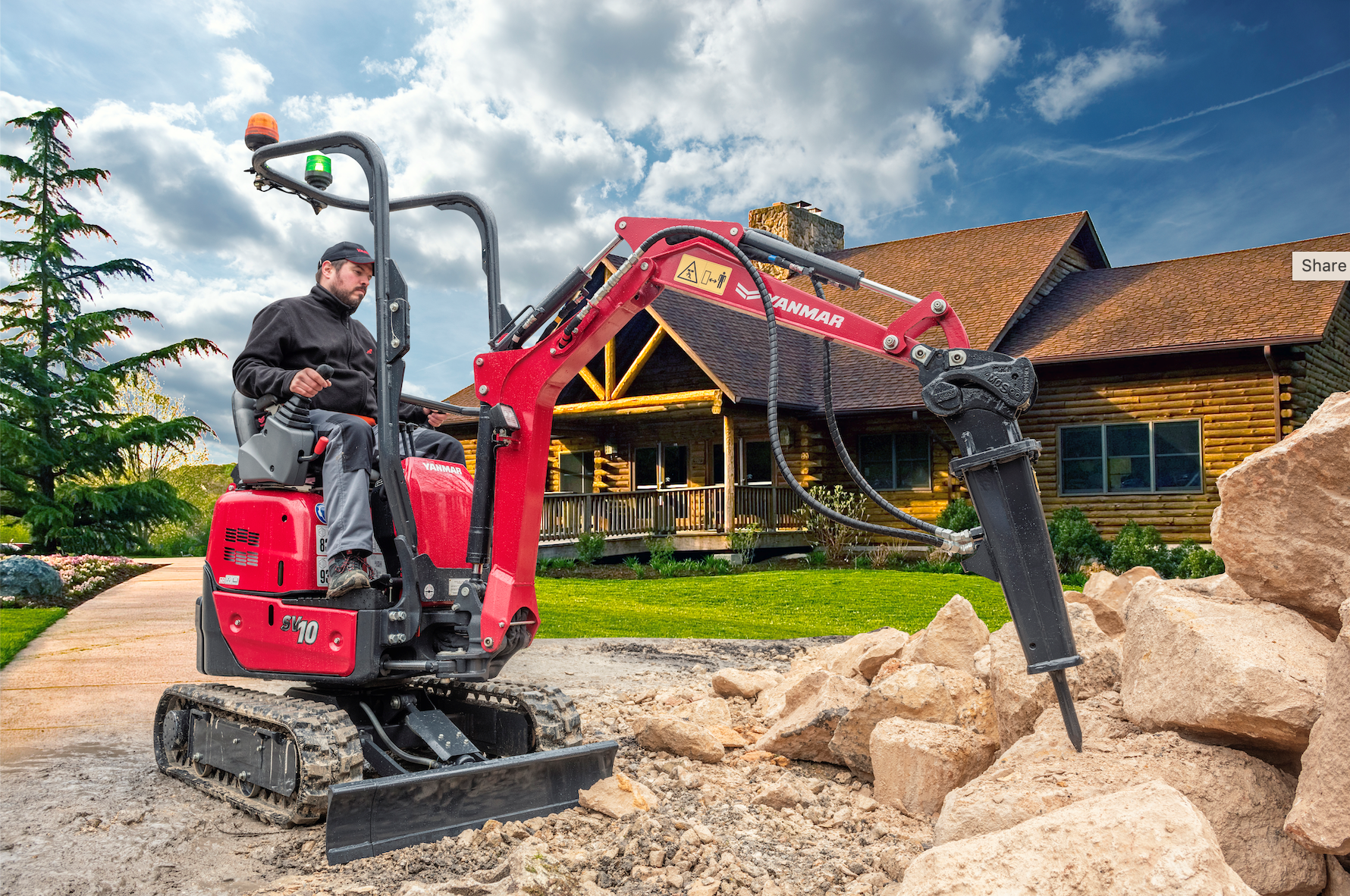
Yanmar Compact Equipment has launched the SV10, a 1-tonne mini excavator designed for the tightest site conditions and positioned squarely at a European market segment that continues to grow. At 740mm wide in transport mode, the machine is narrow enough to pass through standard door openings and is targeted at urban works, indoor renovation and demolition, municipal jobs, landscaping, and rental fleets that need compact equipment capable of working where larger excavators simply cannot fit.
The machine’s basic proposition is straightforward: small footprint, low disruption, and enough performance to handle genuine construction tasks rather than merely light finishing work. Yanmar says the SV10 has an operating weight of 1,180kg, a digging depth of up to 1,800mm, and an undercarriage that can be extended from 740mm to 990mm to improve stability once in position. It is powered by a 3-cylinder engine and designed around a simplified control layout intended to shorten familiarisation time, an increasingly important point in fleets where hired-in operators and mixed-experience users are common.
That rental angle is central to the launch. The company has described the 0-to-2-tonne category as one of the fastest-growing parts of the European market, and trade reporting around the launch said the segment now accounts for 39% of the construction machinery market in unit terms. That is a striking number, but the reasons behind it are not hard to see. Urban sites are tighter, access rules are stricter, external works are often sequenced around occupied buildings, and smaller packages of civil, drainage, landscaping, fit-out enabling, and remediation work have become a persistent source of demand. Contractors and hire companies do not always need more iron. Often they need less machine, but more precisely targeted capability.
In that respect, the SV10 is part of a broader equipment trend rather than an isolated release. OEMs have spent years improving the usefulness of very small machines by refining hydraulics, attachments, ergonomics, transportability, and service support, which has made micro and mini equipment a more realistic option for revenue-generating work. The more interesting shift now is that these machines are no longer just secondary assets kept on hand for occasional awkward jobs. On many sites they have become the first-choice option for constrained-access works because they help contractors avoid rework, reduce damage risk, and keep smaller packages moving without heavy logistics overheads.
Yanmar’s wider European footprint also matters here. The manufacturer has more than 900 staff across Europe and works through an extensive dealer network covering 37 countries. That support structure is one reason launches in this class are commercially important. A compact machine is only as useful as the service, parts, finance, and attachment ecosystem around it. Contractors may like the dimensions and specifications, but fleets buy on uptime and residual confidence as much as headline capability. Yanmar is clearly pitching the SV10 as a machine that can sit comfortably within that full operating model.
The timing is also well judged. As the market recalibrates around productivity, urban constraints, and equipment utilisation rather than simple fleet expansion, compact machines that can deliver real site value without introducing transport, access, or operator complexity are likely to remain in demand. The SV10 does not try to reinvent the mini excavator. It sharpens the category’s core argument: on enough modern sites, compactness is no longer a compromise. It is the requirement.