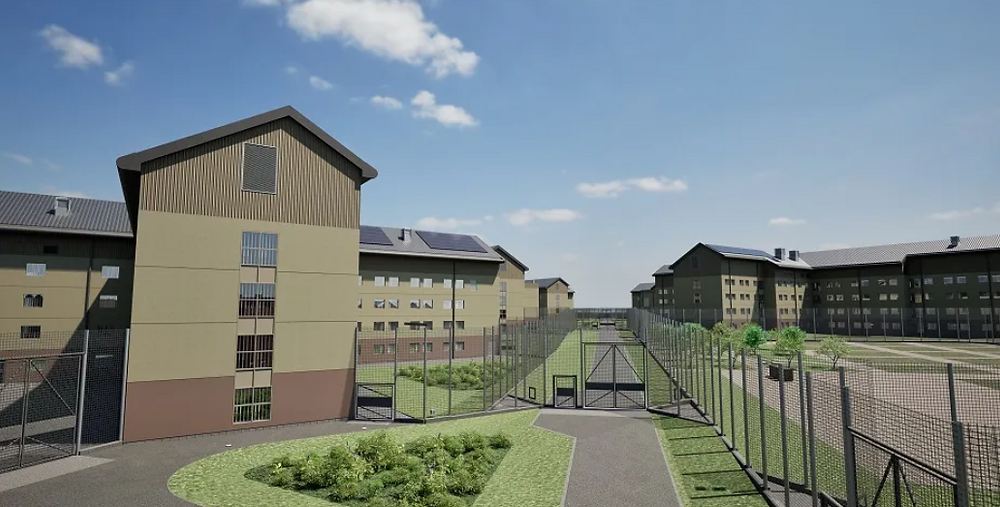
IN Brief:
- The final structural beam has been installed at the Category B prison under construction near Market Harborough.
- The prison will contain seven houseblocks, two large workshops and a dedicated education facility.
- The Ministry of Justice reports £269m of project spending within 50 miles of the site by September 2026.
Wates Construction has completed the final structural works at HMP Welland Oaks, a new Category B prison for approximately 1,700 men near Market Harborough in Leicestershire. Installation of the last building beam marks the transition from the principal structural phase towards security infrastructure, internal construction and facilities required before the prison can open.
The Ministry of Justice confirmed the milestone on 13 November, with the first prisoners currently expected at the start of 2029. The development is being built close to the existing HMP Gartree and forms part of the government’s programme to increase prison capacity. Structural completion does not mean the buildings are ready for occupation: substantial installation, testing and commissioning work remains.
According to Wates, the new establishment will contain seven houseblocks, two large workshops and a dedicated education facility. The layout is intended to combine secure accommodation with space for training and rehabilitation activities. Delivering those different functions within one secured site requires the building programme to accommodate the separate operational needs of residential areas, workshops and teaching spaces.
The next construction activities will include installation and integration of physical and electronic security systems. The Ministry of Justice has identified counter-drone technology and measures to block illicit mobile telephone communications among the planned protections. Their exact specification has not been released, and the department has not provided a detailed completion programme for individual systems.
Security engineering must be coordinated with building services and the finished structures rather than treated as a final standalone addition. Specialist equipment may require power, communications links, protected routes and suitable maintenance access. The final locations and interfaces of such systems are determined through design and installation, followed by testing to establish that the completed installation meets the prison’s operating requirements.
The two planned workshops and dedicated education building must also be fitted out to support their different functions, with service connections, circulation routes and equipment installations coordinated with the wider site. Wates says the spaces are intended to help prisoners gain skills and qualifications, but the construction update does not specify individual workshop machines or the final education programme. Those details should not be inferred from the structural milestone.
Offsite manufacturing is being used extensively to produce core building components, according to the contractor. The approach allows parts of the building to be manufactured in a controlled environment before delivery and assembly on site. It can reduce the amount of fabrication and material handling required at the construction location, but it also places importance on dimensional accuracy, transport arrangements and coordination between manufacturing and the site programme. Wates has not published a quantified carbon saving attributable to this project.
Construction activity has generated substantial regional procurement and employment. By September 2026, the Ministry of Justice said £269m, equivalent to 85.5% of recorded project spending, had gone to businesses within 50 miles of the site. The department also reported 501 jobs created on site, with 29 apprentices involved and 36 prison leavers upskilled. Those figures describe performance to that date rather than final totals for the project.
Wates’ project commitments include at least six months of employment for 30 prison leavers, construction skills training for 50 people and the creation of 50 apprenticeships over the programme. These are contractor commitments, not a statement that every place has already been delivered. They sit alongside the Ministry of Justice’s September totals for 29 apprentices involved and 36 prison leavers upskilled, which measure progress at a particular point in the programme.
The new prison is being delivered through the Alliance 4 New Prisons programme. HMP Welland Oaks is part of the wider target to create 14,000 additional prison places by 2031, alongside further new prisons, extensions and conversions of existing accommodation. The government’s latest capacity planning also identifies a proposed new establishment in Buckinghamshire near HMPs Grendon and Springhill, where enabling works are being taken forward for approximately 1,468 places.
The Ministry of Justice has also brought forward £110m to convert unused offices, laundries, storage areas and other available space into additional prison places. Such conversions involve smaller, existing-estate projects rather than a new establishment on the scale of Welland Oaks. Both programmes require coordination of building services, security requirements and operational handover, though their construction scopes and delivery timetables differ.
Installation of the final beam closes the principal structural phase at Welland Oaks, while security equipment, building services and the workshop and education facilities remain to be completed and commissioned. The Ministry of Justice expects the first prisoners at the start of 2029. That operational date remains distinct from the November 2026 construction milestone.