IN Brief:
- The UK produces around 9.9 million tonnes of straw every year.
- Researchers calculate that available supply could support up to 300,000 low-rise buildings annually.
- Scaling construction will depend on stronger supply chains, regulation, skills, finance, and market acceptance.
The UK produces enough straw to support construction of up to 300,000 low-rise buildings a year without exhausting the available agricultural resource, according to new University of Bath research. The findings place the principal constraints on greater use of straw elsewhere — in construction supply chains, regulation, specialist skills, finance, insurance, and market acceptance.
University of Bath researchers analysed how the country’s straw supply is currently used and modelled several scenarios for redirecting part of it into construction. Britain produces around 9.9 million tonnes annually, with the material already used for livestock bedding and feed, returned to fields, consumed by energy generation, and supplied to horticultural and other industrial markets.
The study found that diverting straw from activities including bioenergy and industrial use could make enough material available for as many as 300,000 low-rise buildings. An alternative scenario found that around 60% of the straw currently left in fields would be sufficient to meet that level of construction demand, while growing additional straw on unused land could provide material for approximately 163,000 homes.
Those calculations contrast sharply with present construction volumes. Fewer than 20 new UK homes a year are currently built using straw, leaving a considerable gap between the theoretical resource available and the capacity of the construction industry to design, procure, certify, finance, and deliver buildings around it.
The material itself offers several characteristics relevant to low-rise construction. Straw can be incorporated into highly insulated wall systems and stores carbon absorbed during crop growth for as long as the material remains within the building. The Bath research estimates that wider use could lock away between 1.8 million and 3.1 million tonnes of carbon dioxide each year over the service lives of the resulting buildings.
The resource calculation does not, however, turn straw automatically into a mainstream construction product. Agricultural production is seasonal, geographically uneven, and already connected to several competing markets. A substantially larger building sector would require dependable routes for aggregation, grading, storage, transport, processing, and delivery so that contractors receive material of consistent specification when the programme requires it rather than when crops happen to be harvested.
Storage is particularly important because housebuilding continues throughout the year. Straw occupies considerable volume relative to its value, and long transport distances can increase cost and reduce the environmental advantage claimed for a locally available agricultural product. Regional processing and storage infrastructure would therefore be needed if volumes were to rise beyond specialist projects.
Construction skills present a similar constraint. Straw systems are established technically, but expertise remains concentrated among a relatively small group of designers, manufacturers, and installers. Increasing output would require a larger workforce familiar with moisture control, detailing, installation, interfaces, and the protection of natural materials during construction rather than relying on project teams learning the system afresh on individual developments.
The research also identifies lenders, insurers, and mainstream builders as part of the adoption problem. Alternative materials have to satisfy more than structural and thermal performance requirements before they can support large housing programmes. Developers require predictable warranties and procurement routes, lenders need acceptable security, and insurers need sufficient evidence to price risk without treating each project as an unusual exception.
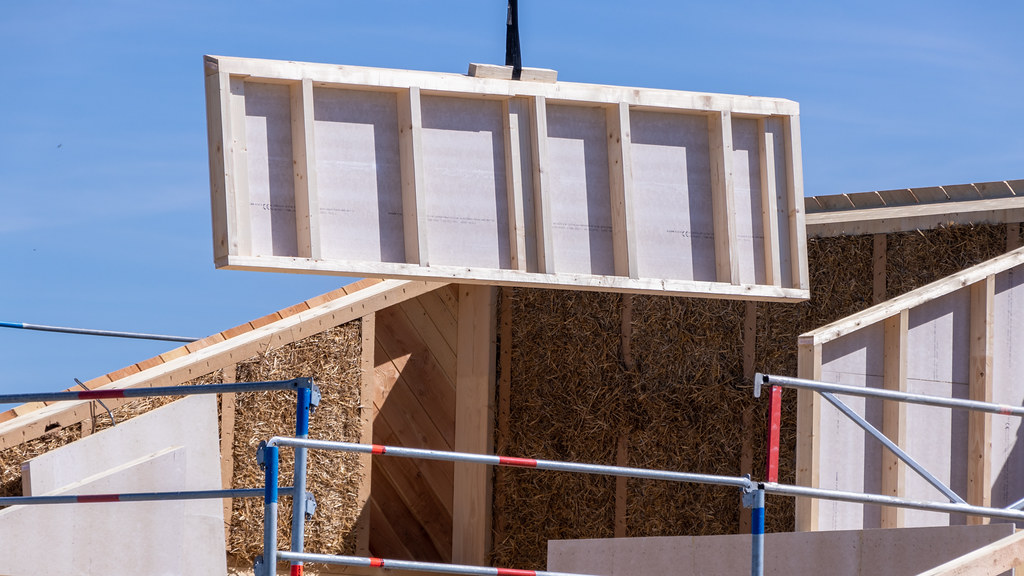
Previous Bath work has helped establish technical evidence around straw construction, including testing of prefabricated timber-frame panels incorporating straw insulation. The newer study approaches the issue from the opposite end of the process by asking whether the raw material would remain available if demand increased dramatically. Its answer is that national supply is not likely to be the limiting factor.
Construction economics remain less settled. The university notes that some straw-building methods are still less efficient than conventional approaches, which matters in a market where contractors and housebuilders are already operating under tight programme and cost constraints. Volume production would have to reduce handling and installation costs while maintaining the quality controls expected of standardised building systems.
The findings therefore point towards gradual industrialisation rather than an immediate material substitution across the housing market. Prefabrication, regional processing, clearer regulation, repeatable technical details, and a broader installer base could allow straw systems to expand without requiring every contractor to develop a bespoke method.
For housebuilding, the distinction is useful. Britain does not need to create a new raw-material resource before straw construction can grow; it needs a construction system capable of consuming an existing one consistently. The 300,000-building figure establishes the scale of the theoretical supply. Whether actual output moves much beyond today’s handful of projects will depend on the much less tidy work of building the commercial and technical infrastructure around it.