IN Brief:
- Work has started on a £20 million Staycity aparthotel development at the former Beaufort House in Belfast.
- The nine-storey conversion will deliver 98 studio and one-bedroom units, with guest amenities including a gym, bar, restaurant, and retail space.
- The scheme adds to a wider pipeline of city-centre reuse projects as older office stock is repositioned for new demand.
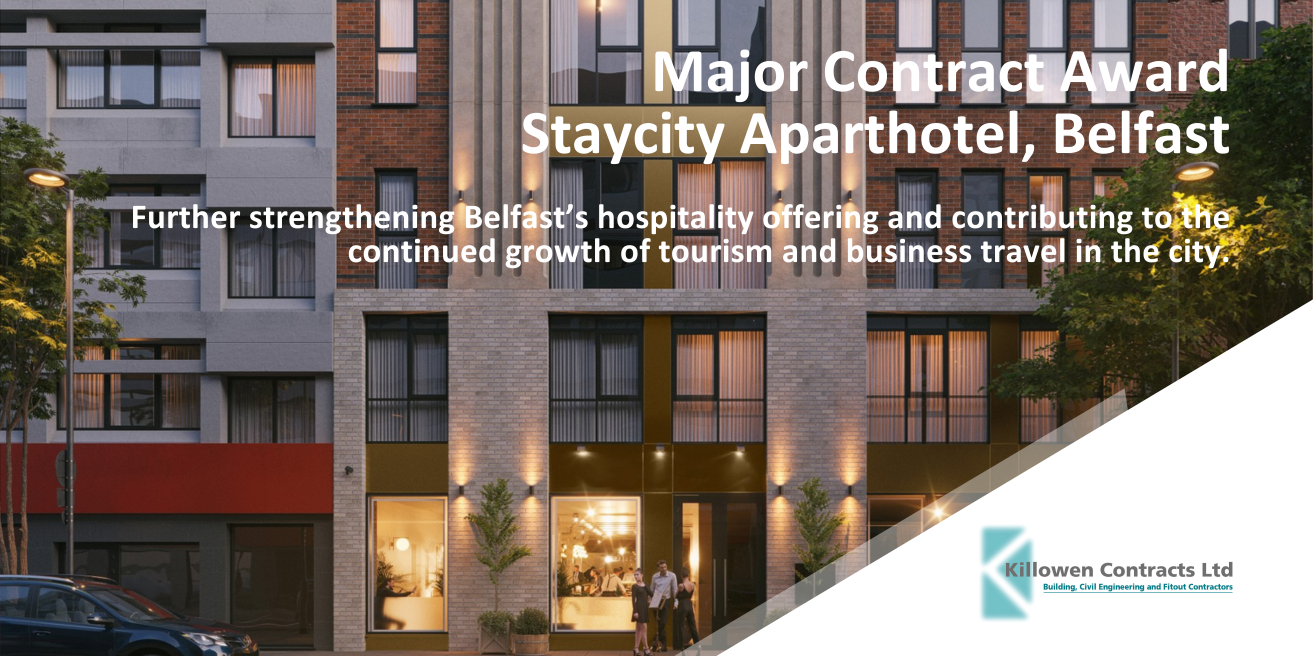
Staycity Group has moved on site with its first Northern Ireland aparthotel, with construction now under way on a £20 million conversion of Beaufort House in Belfast city centre. The project will transform the former office building on Wellington Place into a 98-key aparthotel, marking a further step in the steady reshaping of central Belfast property stock as older commercial space is brought back into active use through hospitality-led redevelopment.
The scheme centres on the repurposing of a nine-storey, 46,000 sq ft office block that previously housed HMRC operations. Once complete, it will provide a mix of studio and one-bedroom units alongside a reception area, guest lounge, gym, bar, restaurant, and retail space. Construction is being delivered by Killowen Contracts, with Lotus Property leading the development and Danske Bank backing the project. Current timelines point to an opening in 2027.
For Staycity, the Belfast development is significant for more than geography. It is the operator’s first move into the Northern Ireland market and is also being positioned as an early showcase for the group’s refreshed brand direction. That gives the project a second layer of interest from a construction standpoint, because it is not simply a straight change-of-use job. It is also a branded product rollout, where building fabric, internal layout, guest amenity mix, and operational model all need to align with a wider expansion strategy.
The physical challenge is a familiar one in city-centre development, but no less demanding for that. Converting older office stock into aparthotel accommodation typically requires more than a cosmetic refit. Floorplate geometry, servicing, acoustic performance, fire strategy, vertical circulation, and façade treatment all need careful adjustment if the finished building is to work as short-stay accommodation rather than conventional workspace. The presence of kitchens, longer-stay functionality, and guest amenity areas adds another level of design and MEP coordination.
Belfast is also a useful place to watch this trend play out. The city has continued to attract hospitality investment while balancing a more uneven office market, and that makes adaptive reuse more compelling on well-located secondary assets. Wellington Place sits within a part of the city centre that benefits from transport access and growing visitor activity, and the project arrives as developers continue to look for viable reuse strategies that can preserve location value without depending on a full return of traditional office demand.
That repositioning story is becoming more common across UK and Irish cities. Construction work generated by office-to-hotel or office-to-aparthotel conversions is often less visible than a ground-up scheme, but it can be technically intensive and commercially important. Existing structures bring programme advantages and embodied carbon benefits, yet they also impose constraints that test project teams on sequencing, structural intervention, and building services integration. For contractors and consultants, that has made retrofit and reuse one of the more active parts of the urban building market.
There is a wider operating backdrop as well. Aparthotels have continued to gain traction where business travel, event demand, and longer-stay leisure trips overlap, particularly in cities that need flexible accommodation formats rather than purely traditional hotel stock. That helps explain why operators are willing to back conversions that create kitchen-equipped units with shared amenities, especially in central locations with strong transport links and a broad mix of weekday and weekend demand.
Beaufort House adds another visible redevelopment to the Belfast city-centre pipeline and another signal that reuse is becoming a more practical route to delivery where legacy office buildings still occupy strong addresses. It is the kind of scheme that sits squarely in the current market — less about speculative scale, more about targeted repositioning, careful technical execution, and finding productive new life for buildings that no longer fit their original brief.