IN Brief:
- Siderise has introduced PC-FS Firestop and PC-CB Cavity Barrier systems for precast cladding.
- The products are designed around precast façade interfaces, narrow cavities, and restricted-access conditions.
- The launch reflects continued product development around façade compliance and buildability.
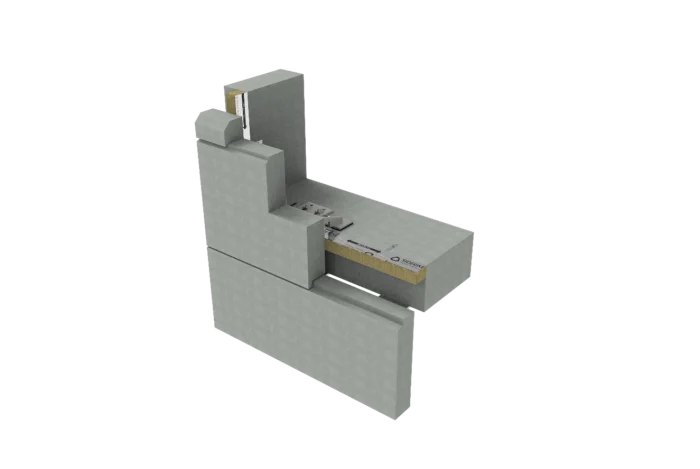
Siderise has launched a new passive fire protection offer for precast concrete cladding systems, bringing to market a dedicated PC-FS Firestop and PC-CB Cavity Barrier range intended to address the more awkward conditions often found at façade interfaces. The systems are designed for the junctions between compartment floors or walls and the external concrete façade, where concealed cavities, tight tolerances, limited access, and sequencing constraints can complicate both design and installation.
The new range includes PC-FS60 and PC-FS120 firestop variants, certified for one hour and two hours of fire resistance respectively, alongside the PC-CB30 cavity barrier, which is certified for up to 30 minutes. The company says the products are third-party certified, tested to EN 1366-4, and supported by supplementary test evidence intended to help design teams and fire engineers assess a wider range of project conditions. The launch is not simply another addition to a product catalogue; it is clearly targeted at a very specific construction problem where compliance requirements intersect with the practical difficulty of getting materials installed correctly on site.
That site condition point matters. Siderise has positioned the range around installation flexibility, including fitment from above or below the slab, and bracket-free installation in narrow cavities where access is limited. In precast systems, that can make a material difference to sequencing and labour on live projects, particularly where façade packages are moving quickly and interface details have to be resolved against structural tolerances, support systems, fixings, and adjacent fire-stopping requirements. The company has also said the products have undergone accelerated ageing tests to support a 60-year design life, which places durability and long-term performance firmly alongside initial compliance.
Precast concrete cladding is hardly a niche topic in the current market. It remains attractive for residential, mixed-use, logistics, and commercial projects where speed, quality control, and repeatability are valued, and it continues to feature prominently on schemes that want a more manufactured route to envelope delivery. But precast systems also intensify the importance of interface design. Once a façade solution becomes more standardised, any weakness in a recurrent joint condition can repeat itself at scale. That is why product development in this area has become more granular. Manufacturers are no longer just selling a compliant material. They are increasingly being asked to show how that material performs in the real geometries, tolerances, and installation conditions found on site.
The broader backdrop remains a construction environment in which façade design and fire performance are under sustained scrutiny. That scrutiny does not only affect combustible products or high-profile remediation projects. It also shapes how new products are brought forward, how technical data is presented, how system testing is interpreted, and how responsibility is shared between specifier, contractor, specialist installer, and fire engineer. In that context, the commercial value of a product launch increasingly rests on clarity: what condition the product is intended for, what evidence supports it, and how readily it can be installed without creating new site risks or programme delays.
Siderise’s precast range lands squarely within that shift. It speaks to a market that is still building at pace, but is far less willing to accept vague system descriptions or awkward-to-install details as the price of progress. The pressure now is for products that can satisfy compliance expectations and keep pace with modern delivery methods. That is a stricter test, but probably a healthier one.