IN Brief:
- North Somerset Council has proposed retendering five A38 improvement locations after the previous contractor price exceeded its funding assumptions.
- The revised construction benchmark is £23.7m; forecast delivery spending including other costs and contingency is £33.4m.
- The replacement NEC4 Option A tender is planned for January 2027, subject to the council decision and subsequent procurement.
North Somerset Council is preparing to retender the construction element of five A38 highway improvement locations after failing to agree an acceptable price with Octavius under an earlier two-stage design and build arrangement. A proposed change to the procurement method would move the works to a fixed-price NEC4 Option A contract and delay the expected start of construction until summer 2027.
A full council meeting scheduled for 6pm on 10 November is due to consider the new procurement plan. Before that decision, a new construction contract has neither been approved nor awarded. Octavius was appointed in 2025 to develop the design and negotiate a second-stage construction price, with an agreed break mechanism allowing the council to reopen the competition if the resulting price was unacceptable.
The council’s original tender assumptions allowed approximately £18m for construction. Its latest independent benchmark places the construction work at £23.7m, while the overall forecast for delivery is £33.4m after additional items are included. These figures describe different cost categories: the £23.7m construction benchmark should not be presented as the entire council programme cost, and the £33.4m total is not the value of a newly awarded contract.
The forecast comprises proposed construction packages of £11.2m and £12.5m, which together total £23.7m. A further £4.9m for utilities, £0.9m for council staffing, £0.9m for project management and surveying, and £3.0m for contingency bring the forecast delivery expenditure to £33.4m. Those non-construction items remain part of project expenditure even if the contractor’s principal works are let at a fixed price.
Cost consultant Rider Levett Bucknall compared the contractor’s submitted price with market benchmarks. Council reporting says inflation, utilities, traffic management, design development and supply chain conditions did not fully explain the variance. It does not publish enough of the contractor’s underlying pricing build-up to quantify each cause independently, and the council has chosen to seek a competitive construction price rather than simply accept the earlier submission.
Under NEC4 Engineering and Construction Contract Option A, payment is linked to a priced activity schedule. Agreeing that schedule for a defined scope at contract award differs from the previous two-stage route, which sought to settle the construction price after design development. Compensation events and changes to agreed scope can still affect the amount paid, so the proposed contract form shifts the pricing approach without eliminating all programme and cost risk.
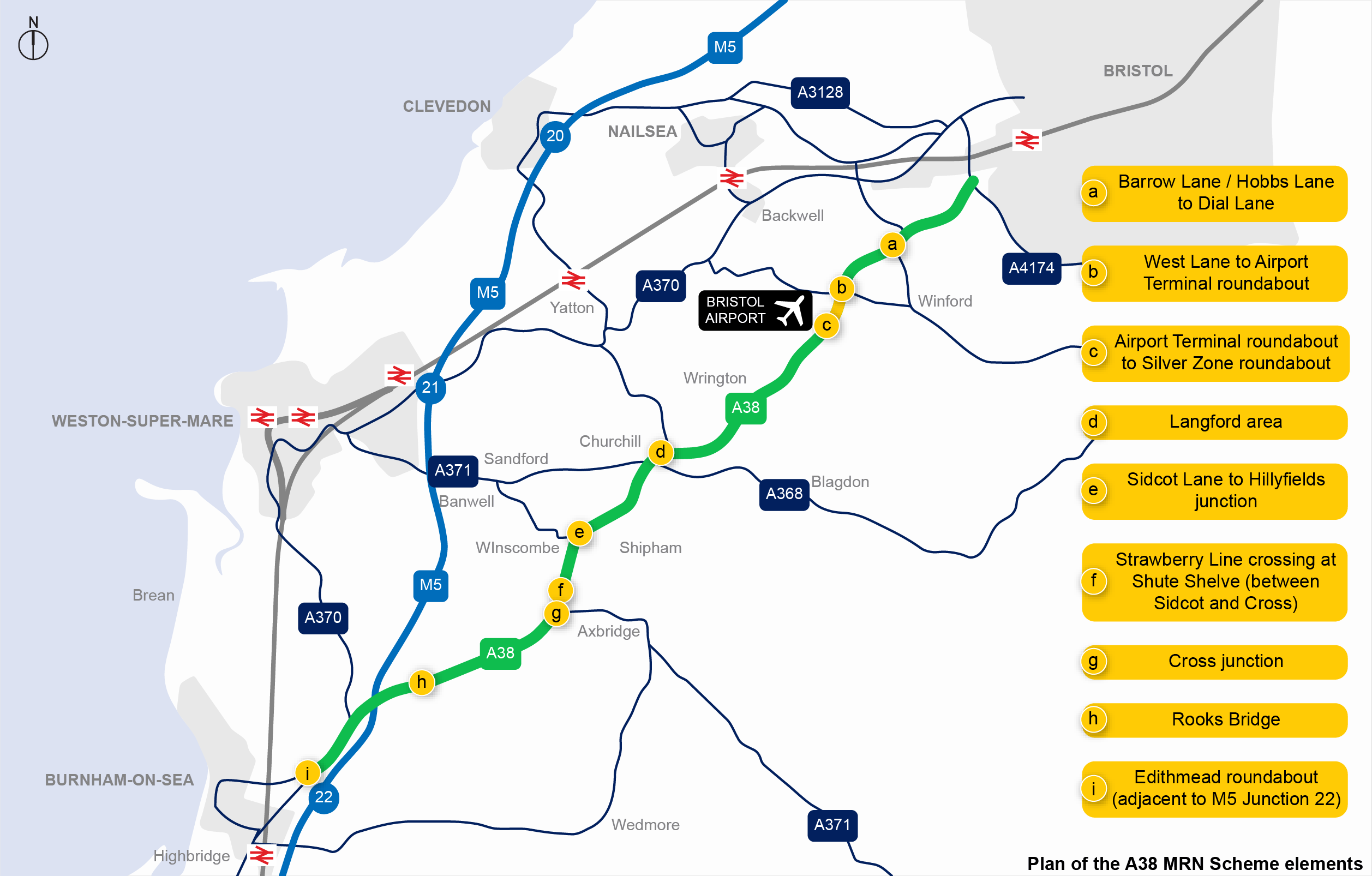
The five North Somerset sections include road and active-travel improvements near Bristol Airport, Langford and Sidcot. The wider A38 Major Road Network scheme covers nine locations stretching towards Edithmead Roundabout near the M5, with four other sites falling under Somerset Council. The North Somerset retender should therefore not be interpreted as applying automatically to every site in the jointly funded corridor programme.
The works include a mixture of junction improvements, carriageway alterations, walking and cycling provision, bus priority and drainage upgrades. Near the airport, the plans identify revised approaches to the terminal roundabout and associated active-travel routes. Other locations involve adapting the available verge, highway and footway space to accommodate revised pedestrian and cycle movements, which can require detailed coordination with existing road geometry and buried services.
Construction on a live strategic road involves sequencing temporary traffic arrangements with underground service protection, drainage excavations, pavement works and junction commissioning. The placement of utility diversions ahead of principal construction can alter the critical path, particularly where services are not fully mapped or must remain available. The council’s existing project information lists a timetable from an earlier stage; the proposed retender changes the expected construction start and should take precedence for this specific North Somerset package.
The Department for Transport has separately confirmed more than £26m of government funding towards the nine-location A38 programme, which the two local authorities will deliver. That business-case approval does not resolve the construction price dispute in North Somerset. The four locations managed by Somerset Council are outside the North Somerset retender, and their construction arrangements should not be assumed to change with it.
The report’s proposed timetable provides for procurement-plan approval in December 2026, issue of tender documents in January 2027, evaluation in April, and a contractor appointment in May or June. Main works would begin in summer 2027, approximately six months later than the earlier programme. The council expects the works could still meet the March 2030 expenditure deadline, subject to delivery and procurement progress.
The council meeting on 10 November is the immediate decision point. If members approve the new route, the next competition will test bids for five locations against the updated £23.7m construction benchmark and the specified risk allocation. Neither the identity of a replacement contractor nor the final agreed construction price has been established.