IN Brief:
- The first A57 cropping phase covers 331 closely spaced CFA piles, each 1,350mm in diameter.
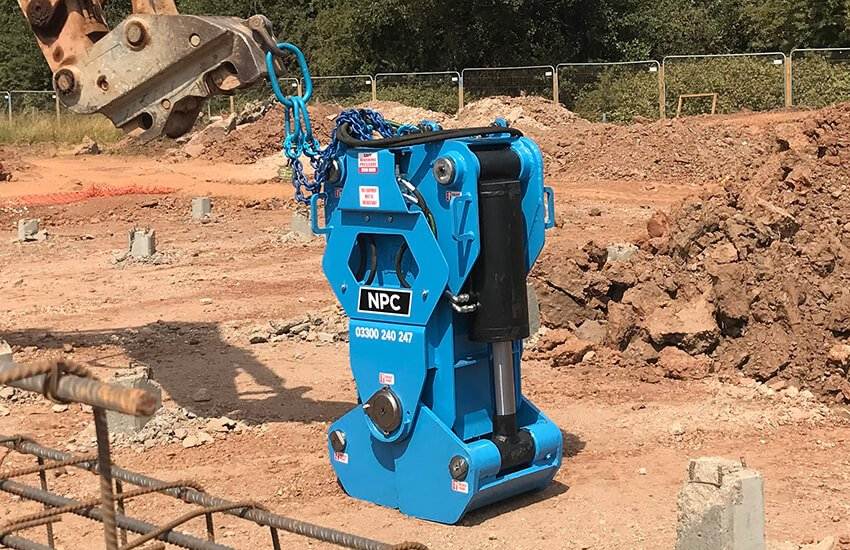
- National Pile Croppers supplied specialist links for a hydraulic attachment trialled around the reinforcement.
- The pile heads must be prepared for the underpass capping structure as the link road scheme progresses.
Kilnbridge is reducing concrete pile heads on National Highways’ A57 Link Roads project near Mottram, using a modified hydraulic cropper to prepare a retaining structure for the planned underpass. The first phase involves 331 contiguous piles constructed using the continuous flight auger (CFA) method, each measuring 1,350mm in diameter. Close spacing between the piles and the need to retain projecting reinforcement have dictated the attachment’s configuration.
Working for main contractor Balfour Beatty, Kilnbridge is delivering reinforced concrete works and pile reduction on the scheme. National Pile Croppers has supplied a heavy-duty CFA cropping attachment fitted with specially developed links that accommodate the geometry of the first 331 piles. Further along the route, 1,080mm-diameter piles will also need cropping, using a different attachment arrangement.
Continuous flight auger piles are formed by boring with a continuous auger, placing concrete as the auger is withdrawn, and installing reinforcement in the fresh concrete. The completed pile extends above its intended structural cut-off level so that the weaker or contaminated upper concrete can be removed before the permanent capping structure is constructed. That reduction has to leave the sound concrete and required reinforcement in an appropriate condition for the next stage.
Contiguous pile walls leave narrow gaps between adjacent pile heads, restricting the space available for cropping jaws and hydraulic components. The A57 attachment uses specialist links to increase contact points within that clearance while working around the steel reinforcement. National Pile Croppers says its modular link system can be adjusted in 100mm increments, allowing the equipment to be configured for different pile diameters. The bespoke setup was trialled for the A57 geometry rather than assumed suitable from pile diameter alone.
Lee Aston, a director at National Pile Croppers, confirmed that the specialist links were trialled for the 331 large-diameter piles. He also identified the NPC Quad XXL for the subsequent 1,080mm piles. The two sections present different attachment requirements because the available clearance and reinforcement arrangement influence how the cropping forces can be applied, while excavator capacity and access determine how the equipment can be positioned.
The cropping work forms one part of the A57 Link Roads programme, which will provide a route between the M67 and the A57 near Mottram, together with a connection towards Woolley Bridge. National Highways has previously confirmed piling operations at the Mottram underpass and River Etherow bridge areas. The underpass requires the construction of substantial retaining structures alongside highway excavation and changes to local traffic arrangements.
The Mottram underpass is approximately 130m long, with the road alignment descending to around 11m below existing ground level. Its design uses contiguous piles together with a capping beam and diaphragm integrated into the upper slab. Once the piles have been formed, the tops are reduced to the required cut-off level so that the reinforced concrete elements above can be connected into the retaining-wall arrangement.
The design of the underpass was revised from an earlier secant-piled watertight box after detailed hydrogeological modelling. The reported solution uses contiguous piling and passive drainage, reducing the quantity of concrete required compared with the original arrangement. That adjustment changes the relationship between the retaining system and groundwater management. The piles provide the structural boundary, while water handling is addressed separately rather than relying entirely on an interlocking watertight pile wall.
Removing surplus concrete from the pile heads is necessary before reinforcement can be connected into the capping beam. Uncontrolled breaking can damage projecting bars or leave unsound concrete at the structural interface, whereas a correctly configured hydraulic cropper applies force around the head to separate the unwanted section. No measured cropping rate or comparative productivity figure has been released for the A57 operation, so the specialist configuration should not be described as a quantified efficiency improvement.
Pile depths, concrete strengths, reinforcement schedules, and final cut-off levels have not been disclosed. These details govern where the cropping head is positioned, the condition of the exposed reinforcement, and the checks required before the capping beam is cast. The number of pile heads alone does not establish production rates, particularly where contiguous walls limit access for the lifting plant and excavators handling the attachment.
Once the 331 pile heads are reduced and checked, the next structural stage is to complete the capping beam and connected reinforced concrete elements of the underpass. The revised retaining-wall design relies on the prepared pile heads transferring loads into that structure while passive drainage manages groundwater. National Highways is continuing piling and associated traffic-management work across the A57 route as the underpass takes shape.