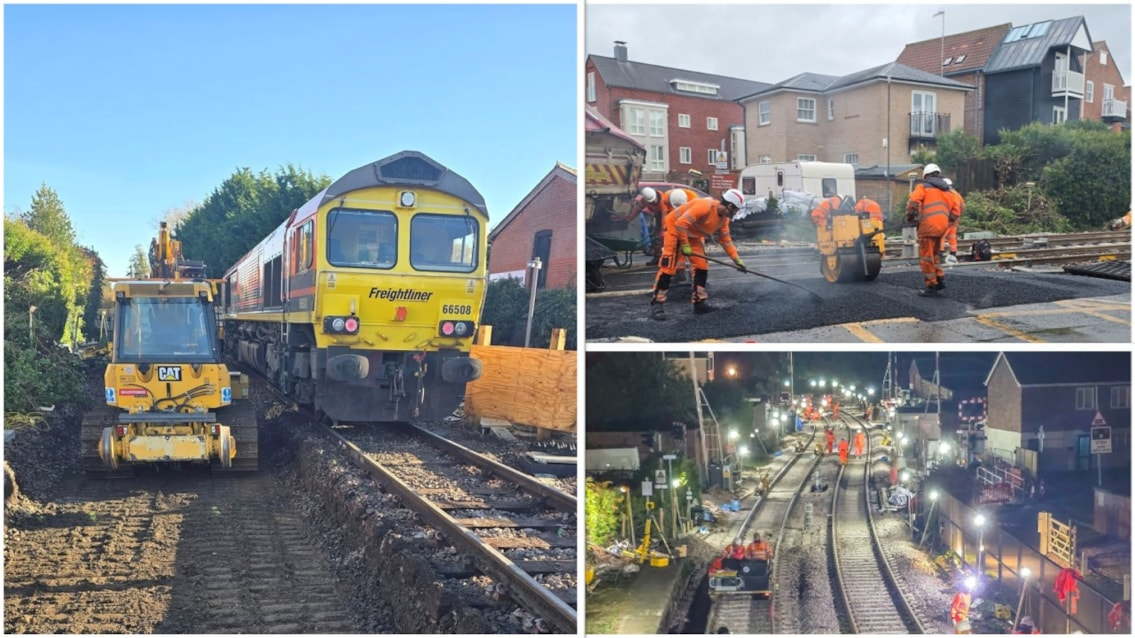
IN Brief:
- Network Rail is investing £1.5m to renew almost 1.2km of life-expired track near Snelland in Lincolnshire.
- Nine engineering trains, road-rail vehicles and other specialist equipment will be used during the 17–18 October works.
- Snelland level crossing will close from late 16 October until early 19 October while the railway is handed over for engineering access.
Network Rail will invest £1.5m renewing almost 1.2km of life-expired railway track near Snelland in Lincolnshire during a weekend engineering possession later this month.
The work is scheduled for Saturday 17 and Sunday 18 October on the route between Lincoln and Cleethorpes. Nine engineering trains, road-rail vehicles and other specialist equipment will support the renewal while passenger services are suspended through the affected section.
Network Rail says replacing the life-expired infrastructure will reduce future maintenance requirements and lower the risk of deteriorating track leading to temporary speed restrictions. The announcement does not itemise every rail, sleeper, fastening or ballast component included in the Snelland scope, so the programme is best treated as a defined track-renewal package rather than a complete reconstruction of every layer along the 1.2km section.
Railway track functions as a structural system. Rails transfer wheel loads through sleepers into the ballast and formation beneath, while fastenings maintain the relationship between the components and help hold the rails to the required gauge. Wear or deterioration within that system can affect alignment, level and the amount of maintenance required to keep trains running at the permitted speed.
Renewal becomes necessary where repeated maintenance is no longer the preferred long-term intervention. Removing life-expired components and installing replacements can restore asset condition and reduce repeated corrective work, although the exact treatment varies according to inspection data and the condition of each section.
The Snelland programme will require a concentrated engineering operation because almost 1.2km of railway has to be addressed during a controlled possession. Network Rail has identified nine engineering trains alongside road-rail vehicles and other specialist equipment, allowing materials, machinery and construction teams to reach the worksite while normal train movements are excluded.
Engineering trains can deliver rails, sleepers, ballast and other materials directly along the railway, reducing dependence on road access beside the line. Road-rail vehicles provide another means of reaching the workface because suitably equipped machines can move over ordinary ground before operating on rail under controlled conditions.
That combination is particularly useful where highway access is limited. Railway corridors can pass through cuttings, agricultural land and areas with few suitable access points, making the railway itself an important logistics route during renewals.
Network Rail operates specialist high-output renewal equipment elsewhere on the national network, including systems capable of replacing track components and cleaning ballast in continuous production sequences. The Snelland announcement does not identify a specific high-output system for this project, so no particular renewal train or method can be attributed to the work.
Access arrangements will affect both rail passengers and local road users. Buses will replace trains between Cleethorpes and Lincoln or Barton-on-Humber during the 17–18 October works, while Snelland level crossing on Station Road will close to vehicles and pedestrians from 22:00 on Friday 16 October until 05:30 on Monday 19 October.
A signed diversion will operate via the B1202, B1399 and A158. Closing the crossing removes the normal road and pedestrian interface from the worksite while engineering trains, road-rail vehicles and construction personnel are operating within the possession.
The closure also creates a fixed handback point. Renewal, adjustment, inspection and testing have to be completed in time for the railway and crossing to return to service once engineering access ends. Delays in removing old components, installing new material or completing final checks can reduce the time available for subsequent activities within the same possession.
Track geometry is one of the critical controls before handback. Renewal work can disturb the ballast and supporting track bed while components are removed and repositioned, requiring the completed track to be brought back to the specified alignment and level before normal operation resumes.
Tamping and ballast-regulating machinery is used across the network to position track and consolidate the stone supporting sleepers. Other stabilisation methods can also be used depending on the renewal method and required handback conditions. Network Rail has not specified the equipment or permitted handback speed for Snelland.
The £1.5m investment follows a separate Lincolnshire renewal programme near Swineshead. Network Rail announced £1.4m of works there to replace more than 730 metres of track during 10–11 October, one weekend before the Snelland possession.
The two projects are separate. Swineshead affects the route between Sleaford and Boston, while the latest package concerns almost 1.2km near Snelland and services running between Lincoln and Cleethorpes. Each has its own engineering scope, access arrangements and possession dates.
Planned renewal is one part of Network Rail’s wider asset-management programme as rails, sleepers, ballast and supporting infrastructure deteriorate under repeated traffic loading and environmental exposure. Inspections establish where maintenance remains suitable and where replacement provides the more appropriate intervention.
Temporary speed restrictions can be imposed where infrastructure condition no longer supports the normal operating speed. They protect the railway while defects are monitored or repaired, but slower trains can extend journey times and reduce timetable resilience. Replacing life-expired track before that point reduces the likelihood that deteriorating condition develops into a more disruptive operational constraint.
The Snelland possession is due to begin after the railway and level crossing close on 16 October, with the main engineering work taking place across the following weekend. Network Rail has until early Monday 19 October to complete the planned £1.5m renewal, carry out the required checks and return the route and crossing to normal operation.