
IN Brief:
- The Defence Infrastructure Organisation estimates the Fountain Lake Jetty main works contract at £500m excluding VAT.
- Four proposed phases cover enabling works, demolition, replacement construction and dredging across eastern and western jetty sections.
- Preliminary market engagement runs towards February 2027, with the main tender provisionally expected in June 2027.
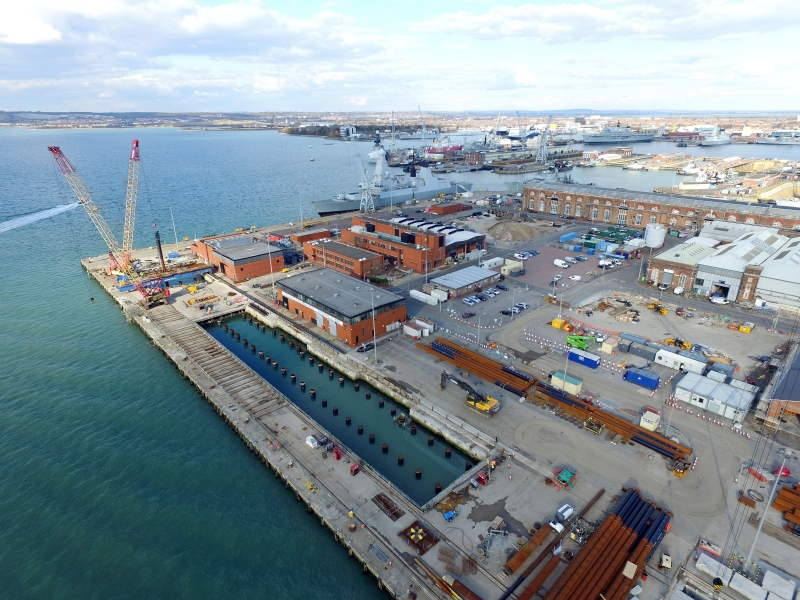
The Defence Infrastructure Organisation (DIO) has begun preliminary market engagement for a programme to replace Fountain Lake Jetty at HM Naval Base Portsmouth, outlining marine construction works with an indicative contract value of £500m excluding VAT. The proposed works are divided into four phases covering approximately 375 metres of the eastern section and 275 metres of the western section.
Published on 12 November, the preliminary market engagement notice seeks evidence of industry capacity and possible delivery arrangements. It is not a tender invitation or a contract award. DIO has put the estimated value at £500m excluding VAT, or £600m including VAT; both figures are planning estimates rather than an agreed construction price. The resulting feedback is expected to inform procurement strategy, contract packaging and the allocation of delivery risks.
The eastern section would be tackled first under the proposed phasing. Phase one covers the diversion of existing services, strengthening of the impounding wall, raising its height and establishing an access route. These activities would prepare the site for phase two, which comprises demolition of the existing jetty, construction of its replacement and associated dredging. The distinction between preparatory work and marine construction is important because access, existing services and the retaining structures must be addressed before major elements of the waterfront can be removed.
The western section would follow the same broad sequence. Its third phase covers enabling work, while phase four would involve demolition, replacement construction and dredging across approximately 275 metres. DIO has not yet published a detailed construction sequence, vessel movement plan or dredging quantities in the market notice. The eventual contractor will therefore need to develop a practical method around the design and operational constraints established during the next stages of planning.
DIO expects the eventual contractor to support the project manager in evaluating engineering solutions and preparing designs before each phase. The proposed role also includes securing the marine licence that would allow work to begin on the western section. This combines early technical appraisal with construction delivery, making the design of temporary access and the sequence of demolition, replacement and dredging relevant to how the contract is structured.
Dredging and work to the waterfront will need to be planned within the applicable marine consent conditions. A marine licence can determine the permitted activities and conditions for carrying them out; the planning notice does not identify an approved dredging method or state that consent has been obtained. Contractors will need to reconcile the proposed construction sequence with the outcome of design and statutory assessment, rather than infer an established method from the indicative contract value.
The programme sits within an operating naval base, which makes interfaces between permanent construction, temporary access and the site’s continuing activities part of the planning challenge. The notice itself does not establish which berths would be unavailable or when, so an interruption to naval operations cannot be assumed. The proposed separation into eastern and western sections does, however, give DIO and interested contractors a framework within which to assess safe access, temporary works and possible sequencing options.
Under the notice, preliminary market engagement will examine industry capacity, delivery models, competition, risk allocation and potential contract packaging. DIO intends to issue a questionnaire and supporting information towards the end of 2026, with responses reviewed in early 2027. An industry day is also anticipated during the first quarter of 2027, although its format has not been finalised.
The stated engagement deadline is 26 February 2027. Publication of the main tender notice is provisionally scheduled for 30 June 2027, meaning a formal competition is not yet under way. The eventual procedure will fall under the defence and security regime, with the notice stating that the procurement will be open to contractors from NATO member countries under the NCB+ approach. Eligibility and any further requirements will need to be assessed against the final tender documents.
Indicative contract dates run from 30 March 2028 to 31 December 2037, a period of just under ten years. That extended timeframe reflects the proposed procurement’s current planning assumptions and should not be read as a confirmed construction programme for each jetty section. Timing may change as design, consent and procurement decisions progress.
The four-phase scope establishes the intended order of enabling works, demolition, jetty replacement and dredging, but neither the final engineering solution nor the detailed construction methodology has been selected. Interested contractors are being asked to contribute to that early assessment before the proposed June 2027 tender. No award, marine licence or confirmed construction start follows from the market engagement notice alone.