IN Brief:
- Miami’s Signature Bridge project has resumed after a fatal site incident, but OSHA scrutiny and legal disputes continue.
- FDOT now lists estimated completion in December 2029, with the wider project carrying an $866 million construction cost.
- The scheme illustrates how design-build complexity, safety events, and defect claims can reshape programme and cost on major urban works.
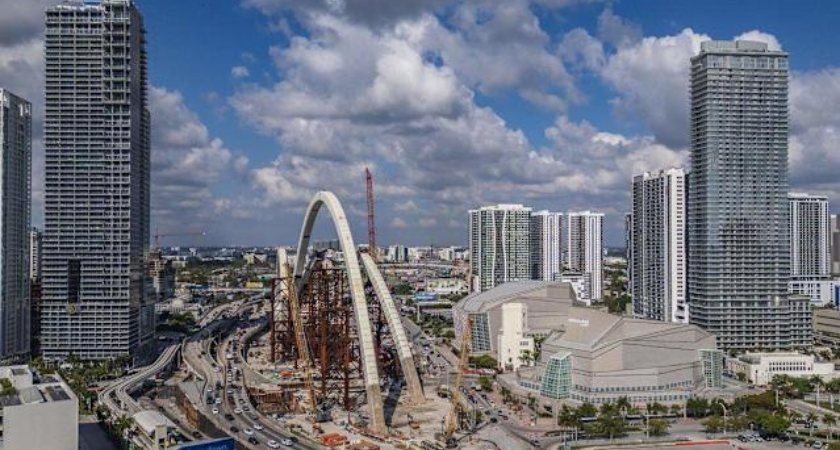
Delays around Miami’s Signature Bridge project have deepened again, with renewed attention on safety, design risk, and delivery control as work continues on one of the most high-profile infrastructure jobs in the city. The wider I-395/SR 836/I-95 design-build scheme is now listed by the Florida Department of Transportation with an estimated completion date of December 2029 and a construction cost of $866 million, extending the timeline on a project that was intended to transform a critical highway interchange and create a new signature structure on the downtown skyline.
The immediate pressure point is safety. Construction resumed after a worker died in a fall from an overpass in late March, with the incident now under investigation by the Occupational Safety and Health Administration. That followed another serious event earlier in the year involving a toppled concrete beam that injured six workers. On a project of this scale, those incidents do not sit in isolation. They shape public confidence, intensify scrutiny on work methods and sequencing, and raise difficult questions about how risk is being managed under programme pressure.
The delivery picture is further complicated by ongoing legal disputes tied to the bridge’s design and construction. The Archer Western–de Moya joint venture has alleged that design flaws and construction issues drove major delay and cost escalation, including claims that wind-force calculations for the bridge’s signature arches were flawed and that subsequent redesign work added years to the programme. Separate claims over defective concrete have added another layer of dispute, alongside the cost and disruption that demolition and replacement work can bring once defects surface on a live megaproject.
Those allegations go to the heart of how complex urban design-build projects succeed or fail. Signature structures are often promoted as symbols of engineering ambition, but the technical demands can be unforgiving when visual form, structural behaviour, staging, traffic management, and live urban constraints all converge. In Miami, the bridge is part of a much larger corridor reconstruction that spans multiple highways and interchanges, which means the engineering challenge is compounded by phasing, access, public interface, and the need to keep a dense transport network functioning through prolonged construction activity.
Independent engineering commentary has added to the concern. Jean-Pierre Bardet, former dean of the University of Miami College of Engineering, described the bridge as “one of the most challenging” projects after reviewing court documents, noting that the square-edged arch form increases wind resistance and structural demands. Whether the legal claims ultimately succeed or not, the public fact pattern is already uncomfortable enough: repeated delay, safety incidents, cost pressure, and technical dispute on a flagship civic project.
That combination is not unique to Miami. Across major infrastructure programmes, the hardest problems often emerge not from a single catastrophic error, but from the interaction of design ambition, fragmented responsibility, late-stage technical change, and limited tolerance for disruption. Urban megaprojects are especially vulnerable because every adjustment ripples into traffic planning, stakeholder management, work windows, and cost exposure. Once that cycle starts, recovery becomes harder and more expensive.
The Signature Bridge is also a reminder that programme dashboards rarely tell the whole story. A headline completion date can slip only after months of cumulative technical friction, contractual dispute, and site disruption. By the time those pressures become visible outside the job team, the schedule reset is often already baked in. That is why projects of this kind increasingly depend on early technical challenge, strong interface management, and credible independent oversight, rather than confidence that complexity can simply be absorbed as the work progresses.
Miami will still get a new highway connection and a landmark bridge if the project reaches completion as planned. But the route there has become far longer and more difficult than originally expected. The scheme now stands less as a simple symbol of civic ambition than as a live lesson in what can happen when engineering complexity, safety risk, and delivery strain converge on a project that was never going to be routine in the first place.