IN Brief:
- McLaughlin & Harvey has secured a £45.44m contract for flood protection and public realm works in Dumfries.
- The scheme is designed to reduce flood risk in the town centre from the River Nith.
- The project reflects a wider shift toward combining resilience infrastructure with urban place-making.
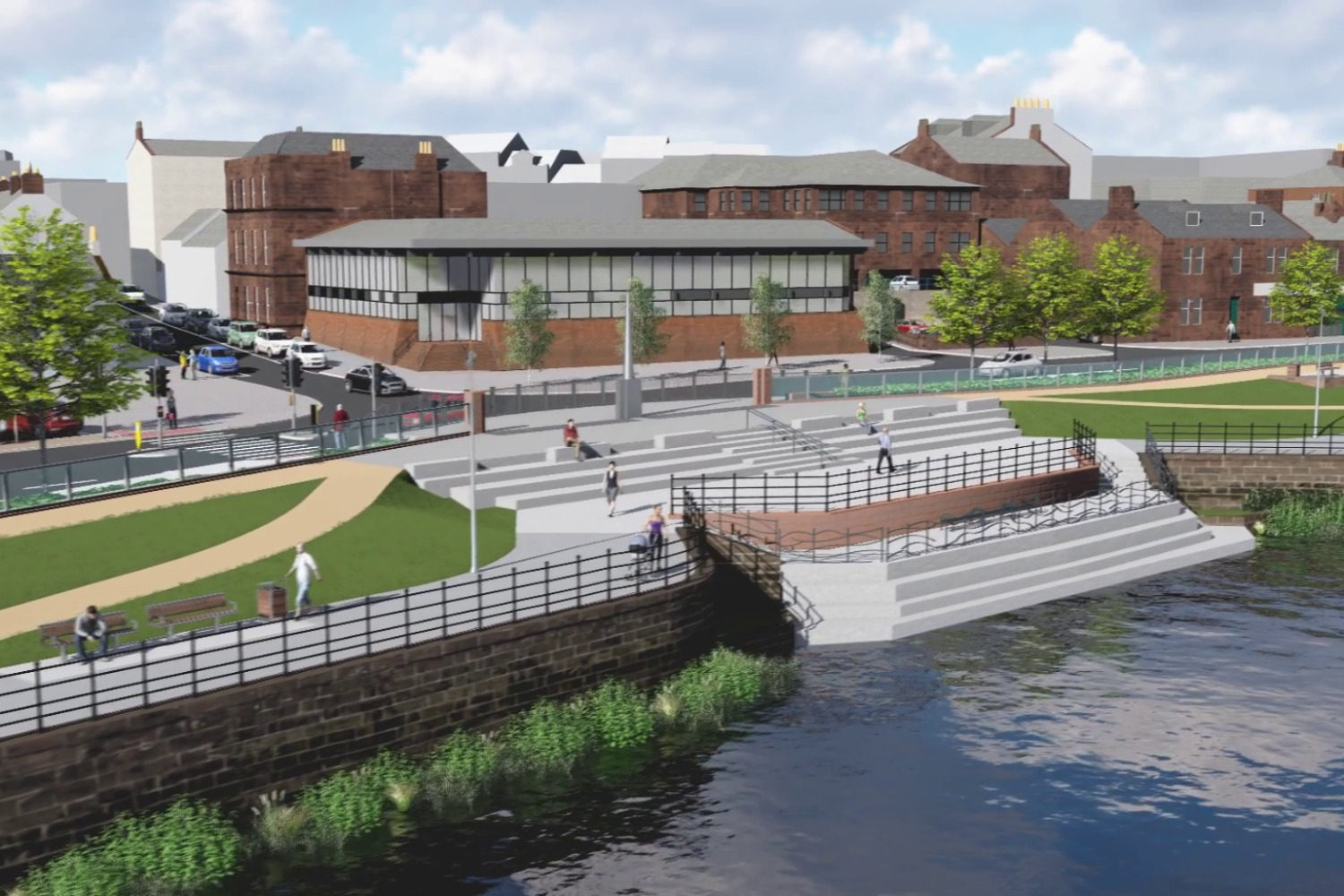
McLaughlin & Harvey has secured the £45.44m contract to deliver Dumfries’ flood protection and public realm improvement scheme, taking on a project that combines hard infrastructure with town-centre renewal along the River Nith.
The work, procured by Dumfries and Galloway Council, is expected to run for 43 months, with start dates due to be confirmed in the coming weeks. The scheme is intended to reduce flood risk in Dumfries town centre from the River Nith while also improving the riverside corridor stretching from Greensands through Whitesands to Dock Park.
That combination of objectives gives the contract more weight than a conventional defence package. It is not simply a wall-building exercise. The project sits at the increasingly busy intersection between flood resilience, public-realm design, and the economic durability of town centres that have to remain accessible and commercially viable while climate risk grows less theoretical and more immediate.
The council has already framed the contract award as the end of procurement and the start of delivery preparation. Lisa Hawkin, executive director of economy and infrastructure at Dumfries and Galloway Council, said: “Agreeing the contract marks the completion of the procurement stage for the main works. The council will continue preparations for delivery, including ongoing communication and engagement with residents, businesses and stakeholders as further information becomes available.”
For McLaughlin & Harvey, the project adds another significant civils package with a strong public-sector profile. It also places the contractor inside a type of work that is becoming more common across the UK: urban resilience schemes that must perform technically while also carrying clear design, access, and stakeholder-management expectations. In practical terms, that makes delivery more complex than a headline contract sum might suggest.
Flood protection in live urban settings rarely allows clean separation between engineering and place. Contractors are expected to manage river-edge works, drainage interfaces, utilities, traffic, access, local business concerns, and public scrutiny, all while preserving the integrity of an eventual public-realm outcome. The closer a scheme gets to a town centre, the less room there is for purely engineering-led delivery logic.
That broader market shift helps explain why projects like Dumfries are attracting attention. Climate adaptation is increasingly becoming part of mainstream construction workload rather than a niche subset of civils. Local authorities and public clients are not only looking to prevent damage; they are trying to justify capital spend through co-benefits such as improved streetscape, better waterfront access, and stronger urban environments. That puts more pressure on design coordination, phasing, and communication during construction, but it also makes schemes easier to defend politically and economically.
The Scottish market has been especially alert to that balance, with river corridors, transport links, and town-centre assets facing growing resilience demands. In that context, Dumfries fits a wider pattern of public investment where defensive infrastructure is being asked to do more than defend. It must also support regeneration, encourage footfall, and avoid creating the sort of hard-edged interventions that solve one problem while imposing another.
For the supply chain, that usually means a broader mix of packages than traditional flood works might imply. Ground engineering, reinforced concrete, drainage, hard landscaping, lighting, public-realm finishes, and temporary works can all become part of the same delivery conversation. Procurement may sit under a civils headline, but execution often moves across several disciplines at once.
There is also the question of programme management. A 43-month duration gives the scheme scale, but it also increases exposure to weather risk, stakeholder fatigue, and cost-management pressure. Contractors that can maintain sequencing discipline and keep the local picture under control tend to do well on projects of this kind. Those that underestimate the operational burden of working in a visible urban location generally do not.
Dumfries is therefore a useful reminder of where public infrastructure work is heading. The days of treating flood schemes as isolated engineering interventions are fading. Increasingly, they are being procured and judged as pieces of urban construction that must protect, connect, and improve places at the same time.