IN Brief:
- Two roof-mounted building maintenance units were replaced on neighbouring Dutch government buildings in The Hague.
- Mammoet selected a 1,200-tonne LTM 11200 mobile crane and one shared setup position to reach both roofs.
- Crash decks, fixed lifting points and tightly managed road and canal closures were used to control urban risk.
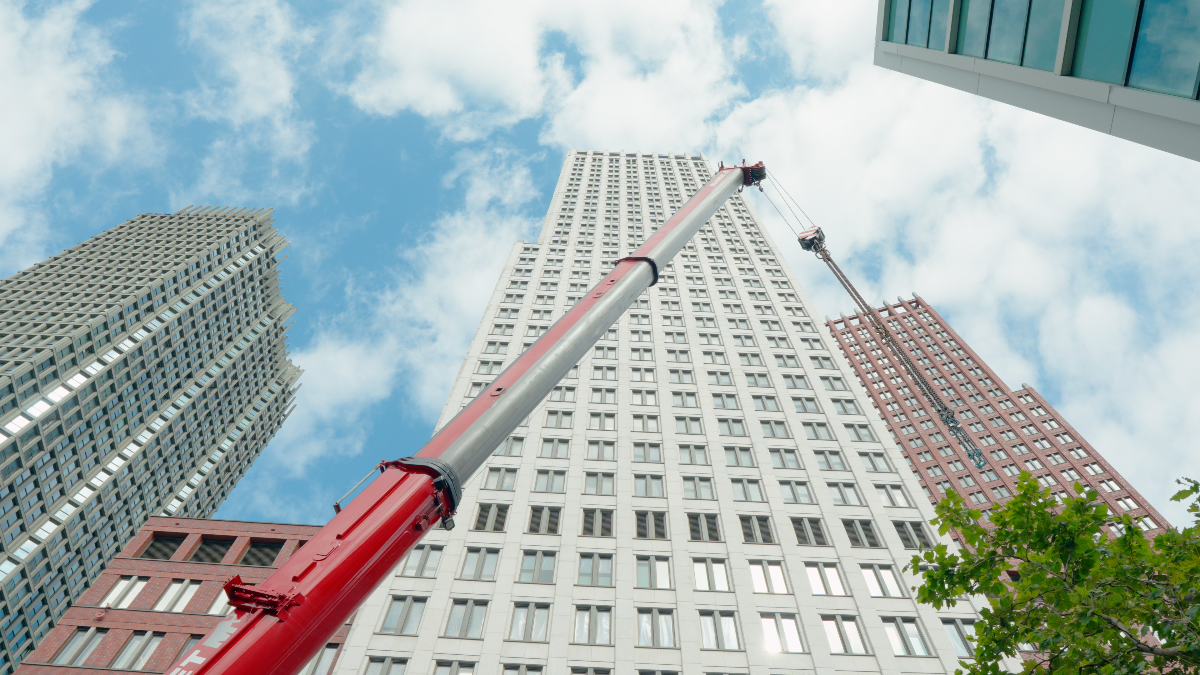
Mammoet has completed the replacement of roof-mounted façade access cranes on two neighbouring government buildings in The Hague, using a lift plan designed around a single crane position and the smallest possible footprint at street level.
The project involved removing the existing building maintenance units and installing new Manntech systems supplied through Façade Access Solutions, part of Alimak Group. Each new BMU arrived in sixteen parts, with components ranging from 200kg winches to 3.5-tonne column and undercarriage sections. The challenge was not the individual weights alone, but the need to lift them to roof level in a dense urban setting with limited assembly space, a nearby viaduct and government buildings on both sides of the operation.
Mammoet rejected a crawler crane because of counterweight clearance risk and instead selected an LTM 11200 mobile crane fitted with a Y Frame. That configuration allowed the team to work from one setup location capable of reaching both roofs, avoiding a second mobilisation and reducing the period of disruption. The crane assembly area was also managed in stages, so a key road needed to be closed for one day rather than three.
On the roofs, the team added crash decks because the structures would not have absorbed the impact of a dropped heavy component. Lift plans also required fixed lifting points, low wind thresholds, defined lifting zones for smaller and larger parts, and only short-term closures of a nearby canal and road during the active lifting phase. The result is a tidy example of how façade access replacement in a live city centre increasingly depends as much on urban logistics as on lifting capacity.