
IN Brief:
- Mainmark treated 77 new foundation locations beneath replacement platforms at Tottenham Hale.
- Teretek resin injection strengthened variable made ground to a depth of two metres without excavation.
- The package was completed in three shifts during restricted railway possession access.
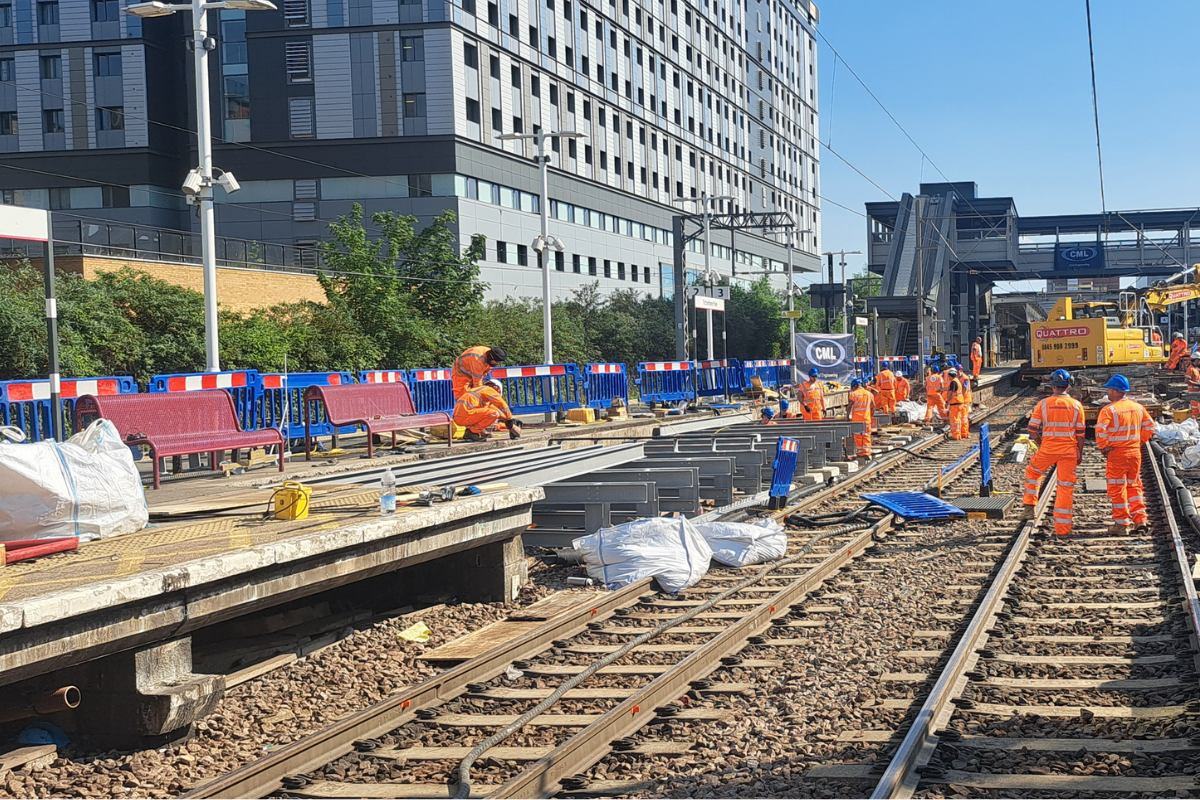
Mainmark UK has completed ground improvement beneath 77 new platform foundation locations at Tottenham Hale station in London, using engineered resin injection to support replacement of deteriorating precast-concrete platforms. Working for CML, a principal contractor to Network Rail and other infrastructure clients, Mainmark completed the treatment in three shifts during a tightly controlled rail possession.
The existing Platforms 3 and 4 had deteriorated over time and were being replaced with lower-maintenance glass-reinforced polymer structures. Before the new platforms could be installed, variable made ground and granular soils beneath the proposed foundations required strengthening. Mainmark used its Teretek engineered resin injection process to treat the ground to a depth of two metres below each foundation.
The process uses small-diameter access points rather than conventional excavation. Resin is injected into the target ground, where expansion is used to compact and strengthen surrounding material. At Tottenham Hale, that approach allowed the ground improvement to proceed without digging out and replacing the formation beneath each of the 77 foundation locations.
Avoiding excavation was particularly important because the works sat inside a possession with several contractors operating across the station. Conventional dig-and-replace treatment would have introduced spoil handling, imported fill, additional plant movements, and open excavations into a programme already constrained by railway access. Resin injection reduced the footprint of the ground works and allowed the platform programme to progress without adding a separate bulk-earthworks operation.
The project was worth more than £150,000 and formed part of a wider station upgrade. Mainmark’s role was therefore relatively small in contract value but tightly linked to the sequence of the platform replacement: if the ground below the new foundations could not be treated within the possession, later installation work would have faced an immediate programme problem.
David Hedley, infrastructure lead at Mainmark UK, said the work showed how engineered resin injection could provide “precise, measurable ground improvement under extreme time and environmental constraints”. The company presents the method as a rapid alternative where excavation would create disproportionate disruption, although suitability still depends on the existing soils, loading requirements, geometry, and the extent of treatment required.
Those limitations are important on rail schemes because access pressure can make fast methods attractive before the ground conditions have been considered in enough detail. Resin treatment is not a universal substitute for piling, excavation, grouting, or other ground-improvement methods. Its value comes where the geology and structural requirement allow targeted treatment to achieve the required improvement with less intervention around live or time-critical infrastructure.
Tottenham Hale provides that type of setting. The station serves Greater Anglia and Stansted Express services alongside London Underground’s Victoria line, so possession planning has to accommodate an operational transport interchange rather than a closed construction site. The more contractors that need the same access window, the greater the cost of an activity that overruns or occupies more space than planned.
The use of glass-reinforced polymer for the replacement platforms also changes the physical construction above the treated ground. GRP platform systems are assembled from lighter components than conventional precast concrete, which can simplify handling in restricted locations, but the finished structure still depends on stable foundation support and controlled platform geometry. Ground treatment therefore sits upstream of the visible platform installation even though passengers are unlikely to see it once the work is complete.
Mainmark’s Tottenham Hale work also comes as the company expands further into rail infrastructure. Current reporting links the business with work through a Balfour Beatty CP7 framework, giving it a route into additional maintenance, renewal, and small civil-engineering packages across Network Rail’s current control period. The Tottenham Hale project offers a practical reference for the type of low-disruption intervention that can be useful when rail access is limited.
For principal contractors, the attraction of specialist ground treatment is therefore largely about programme interfaces. A method that removes excavation can cut the number of sequential operations before a foundation is ready, but only if design verification, installation control, and the handover of treated areas are disciplined enough to let the next trade start immediately. Speed without predictable performance would simply move risk further down the possession.
At Tottenham Hale, 77 foundations were treated to two metres depth and the work was completed in three shifts without excavation. That combination is the relevant construction result: a relatively small specialist package removed a ground-condition constraint from a much larger platform programme while the available railway access remained fixed.

