IN Brief:
- HS2 has begun installing a new cycle bridge linking the Offchurch Greenway to National Cycle Network Route 41.
- The bridge follows earlier opening of the nearby Fosse Way and Offchurch Greenway crossings in October 2025.
- The job shows how local access, structures, and rail formation works are being sequenced together on the route.
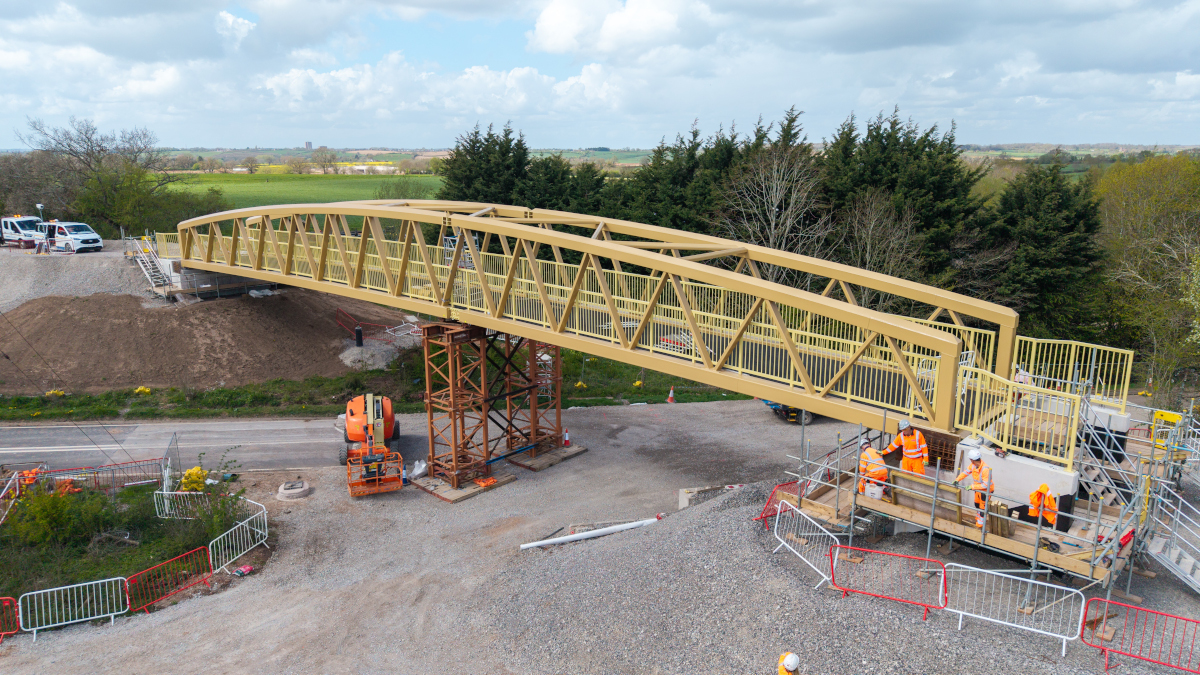
HS2 Ltd has moved into the next stage of bridge works near Offchurch in Warwickshire, with engineers beginning installation of a dedicated cycle bridge that will connect the Offchurch Greenway to National Cycle Network Route 41. The structure sits within a wider local connectivity package around the B4455 Fosse Way and follows the opening of nearby road and greenway bridges in October 2025.
The latest phase is being delivered by HS2’s main works contractor Balfour Beatty VINCI, which has led installation of all three crossings in the area. Work on the new cycle bridge began in July 2025 and has included excavation and replacement of the old embankment, construction of abutments and wingwalls, and the drainage and structural backfill works needed before the bridge deck could be lifted into place. To complete the installation safely, the B4455 Fosse Way is under a temporary closure while the bridge is lowered onto the prepared supports.
Although comparatively modest in scale beside viaducts, tunnels, and major rail systems, this is exactly the sort of structure that reveals how a large infrastructure project is actually stitched together on the ground. A high-speed line does not pass through the landscape in isolation. It has to reconnect roads, rights of way, farm access, cycle routes, drainage paths, and local movement patterns as the corridor is rebuilt around it. That is why secondary bridges and local crossings often carry an importance out of proportion to their size. They are what make the wider alignment workable for surrounding communities while the railway itself is still under construction.
In Offchurch, that sequencing is already visible. The Fosse Way road bridge and Offchurch Greenway bridge were opened last autumn, creating new crossings over the railway line and allowing older alignments to be removed or reworked as excavation continues. The new cycle bridge extends that process by giving a dedicated link into Route 41, which runs across a much longer corridor through the region. HS2 has said the structure will form part of the wider national cycle network linking places including Bristol, Gloucester, Stratford-upon-Avon, and Rugby, placing what could appear to be a highly local job into a broader movement and access framework.
There is a practical lesson here for the wider civils market. Major rail projects are increasingly judged not only on their headline transport outputs but also on how they preserve local connectivity during construction and what legacy they leave behind once the line opens. That pushes more weight onto interfaces between temporary traffic management, permanent structures, public realm, and active travel links. For contractors, it also means that a bridge job is rarely just a bridge job. It sits inside a chain of possessions, diversions, embankment works, surfacing, landscaping, and handover obligations that need to land in the right order.
The Offchurch works also reflect a broader shift in infrastructure design. Active travel is no longer being appended as a late-stage amenity once the major engineering is done. On projects of this scale it is increasingly designed into the corridor from the outset, particularly where existing routes are severed or reconfigured by the main works. That changes expectations around span design, approaches, parapets, surfacing, lighting, and long-term maintainability, and it means smaller structures can still have outsized importance in local acceptance of the wider scheme.
HS2 has indicated that the bridge is forecast to open later in 2026 once the remaining side-wall works, earthworks tie-ins, surfacing, landscaping, and fencing are complete. By then it should stand as another example of the less glamorous but highly necessary side of route delivery: the work required to keep communities connected while one of Britain’s largest infrastructure programmes continues to reshape the ground beneath it.