
IN Brief:
- The £56 million Longbridge upgrade will raise treatment capacity from 734 to 1,261 litres per second.
- Four hydraulic bracing frames and suspended lifting slings support an excavation around the live 1,800mm inlet.
- The existing wastewater route remains operational until the permanent 50m tunnelled connection is ready for cutover.
Groundforce Shorco has designed a temporary works system around a live 1,800mm-diameter wastewater pipeline at Severn Trent’s Longbridge treatment works in Warwick, allowing Mott MacDonald Bentley to continue a £56 million capacity upgrade without interrupting incoming flows. The project will increase treatment capacity from 734 litres per second to 1,261 litres per second. It includes four new final settlement tanks, each 32m in diameter, a 27m-diameter primary settlement tank, and a new tunnelled pipeline feeding the expanded treatment process.
One of the more difficult construction sequences occurs where the new pipeline meets the existing inlet. Mott MacDonald Bentley must form a new concrete structure around part of the existing pipe inside a deep excavation before cutting the old pipeline and diverting flow through a new 50m tunnel. The existing concrete inlet is around 80 years old and has to remain operational throughout the temporary works and permanent construction sequence.
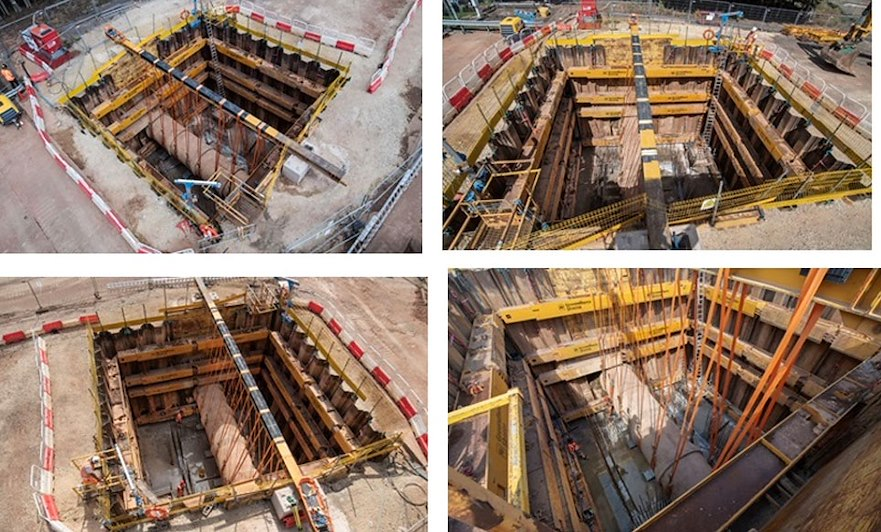
The excavation measures approximately 10.8m by 10.4m and reaches a depth of 8.48m. Weak ground and a high water table increase lateral loading on the excavation support, while the live pipeline crosses the working area and loses the support normally provided by the ground beneath it as excavation proceeds.
Groundforce Shorco joined the project during design development to engineer a support arrangement around those constraints. The excavation is lined with 12m-long L605 steel sheet piles driven with approximately 3m of toe below formation level, while four hydraulic frames formed from Super Mega Brace beams are installed at separate levels to restrain the excavation.
The existing pipeline requires its own temporary support. Eight heavy-duty lifting slings are suspended from a Mega Brace beam above the pipe axis, passing underneath the pipeline to carry its weight after the supporting soil has been removed. Project calculations put the supported pipe load at 49.5kN per metre, with the maximum load on an individual strap around 77.5kN in the adopted arrangement.
The system therefore performs two functions within the same excavation: the hydraulic frames restrain the sheet-piled walls, while part of the bracing arrangement carries the live pipe. Combining those functions reduces the need for a completely separate support structure, but it also makes coordination between temporary works, excavation, pipe protection, and permanent construction more demanding.
Clear working space remains critical. Every brace or prop introduced to resist ground pressure occupies part of the excavation, and temporary support for the inlet has to avoid obstructing the new concrete structure and tunnel connection. The design therefore has to balance structural capacity with access for operatives, lifting, formwork, reinforcement, concrete placement, and the eventual pipe-cutting operation.
Monitoring runs alongside the physical support system. Mott MacDonald Bentley is surveying the live pipeline daily and checking movement at millimetre scale while excavation and construction progress. Once the permanent infrastructure is ready, specialist wire-sawing equipment will cut the existing concrete pipe and transfer wastewater into the new tunnelled route.
Severn Trent’s wider Longbridge programme is intended to increase capacity and improve treatment performance as wastewater loads and environmental requirements increase. The company has identified Warwick Longbridge as an asset requiring further intervention, and the current programme adds new settlement capacity while reconfiguring how incoming flows reach the treatment process.
The project also sits within a much larger period of wastewater construction. Severn Trent recently awarded a £110 million River Mease improvement contract centred on a 23km wastewater pipeline, while treatment works across the sector are moving through expansion and environmental-upgrade programmes under current investment plans.
That workload increases demand for temporary works engineering as much as for permanent civil construction. Deep excavations around live utilities require load assessment, installation sequencing, monitoring, design coordination, and the ability to respond when actual ground or asset conditions differ from historic records. Standardised proprietary equipment can shorten design and installation periods, but only when it can be configured around the permanent works rather than forcing the project sequence to accommodate it.
The Longbridge excavation demonstrates that constraint clearly. Its four bracing levels must restrain weak ground and groundwater loads while keeping enough space for a new connection structure, and the same temporary system must help carry an ageing pipe that cannot be taken out of service. Until the final cutover is made, the temporary works are supporting both a deep excavation and part of Warwick’s live wastewater route.

