IN Brief:
- Grayson’s carbon-neutrality claim has been assessed against the ISO 14068-1 international framework.
- Its measures include electric vehicles and forklifts, onsite solar generation, battery storage, and lower-carbon commercial-vehicle fuels.
- Corporate certification does not replace product carbon data or project-specific embodied-carbon assessment.
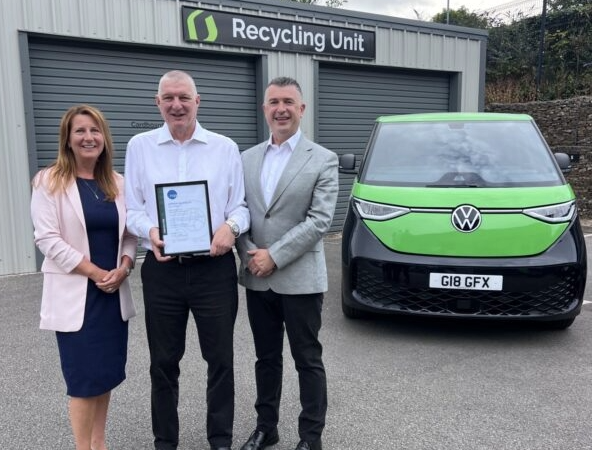
Grayson has secured certification against ISO 14068-1 for carbon neutrality, following third-party assessment of the building-products supplier’s emissions accounting, reduction measures, and treatment of its remaining greenhouse-gas footprint.
The company says it is among the first UK construction suppliers to achieve the certification. Grayson previously used the PAS 2060 framework and achieved UKAS-certified carbon-neutral status under that process in 2024.
ISO 14068-1 provides principles, requirements, and guidance for demonstrating carbon neutrality. Its hierarchy prioritises direct and indirect emissions reductions and improvements to removals within the value chain before residual emissions are addressed through offsetting.
The standard does not prescribe a single emissions threshold that every certified organisation must reach. It provides a methodology for quantifying the relevant footprint, pursuing reductions, addressing the remaining balance, and communicating the resulting claim transparently.
Operational measures support the certification
Grayson’s programme includes the transition of company cars and vans to electric vehicles, the use of electric forklifts powered by onsite solar generation, and the conversion of larger commercial vehicles to lower-carbon biofuels.
The company has also invested in renewable generation and battery storage. Battery systems can increase the proportion of onsite solar energy used by an operation by storing electricity generated outside immediate demand periods, although performance depends on system size, controls, load profile, and maintenance.
Grayson reports that more than 95% of its operational waste is recycled, with the remainder diverted to energy recovery under its Zero Waste to Landfill programme. The classification addresses the destination of operational waste rather than demonstrating that the business produces no waste.
Tony Higson, managing director at Grayson, said: “For us, sustainability isn’t about making claims – it’s about demonstrating measurable progress that has been independently verified.”
Independent assessment can strengthen tender and supplier-prequalification evidence, particularly where contractors and developers are scrutinising carbon-neutrality language. Its practical value depends on access to the certification scope, reporting boundary, assessment period, reduction programme, and evidence supporting the treatment of residual emissions.
A corporate carbon-neutrality certificate should not be treated as a product environmental declaration. Operational emissions from offices, warehouses, vehicles, and purchased energy are different from the embodied impacts associated with manufacturing the products a supplier distributes.
Project teams assessing a cavity tray, wall tie, membrane, insulation product, or site accessory may still require environmental product declarations, product carbon footprints, responsible-sourcing evidence, recycled-content data, and transport assumptions. The corporate certificate answers a different question.
The boundary is especially relevant for distributors whose principal products may be manufactured by third parties. Improvements to fleet and warehouse operations can reduce the supplier’s direct footprint while significant upstream emissions remain within product manufacturing and raw-material supply.
ISO 14068’s hierarchy is intended to prevent offsets becoming the first response to an unchanged emissions profile. Quantification and reductions come first, followed by the treatment of emissions that remain after feasible action within the defined boundary.
Grayson says its certification was independently verified through a UKAS-accredited third-party assessment. That wording should be retained precisely: UKAS accredits certification and verification bodies rather than directly certifying the company’s operational claim itself.
The business has also linked its sustainability strategy to product development. Its reusable aluminium G Board is intended to replace disposable timber mortar boards and remain in service for an extended period before being recycled at the end of its useful life.
Durability can reduce repeated material purchases and the waste generated by damaged or contaminated timber boards. The outcome depends on contractors retaining, maintaining, and reusing the product rather than treating a reusable item as another disposable site consumable.
Supplier-level certification is becoming more relevant as construction businesses introduce carbon requirements into procurement frameworks and subcontract assessments. Buyers increasingly need to separate verified reductions, renewable energy, fleet changes, offsets, and product-level information rather than accepting a single environmental label.
Certification also creates an obligation to maintain the systems behind the claim. Emissions inventories, activity data, energy use, vehicle performance, reduction measures, and residual-emissions treatment need to remain current as the business grows or its operating boundary changes.
Grayson originally announced the ISO 14068 certification on 29 May 2026. Its inclusion in the current commissioning list is an editorial override, but the underlying certification and operational measures remain current on the company’s sustainability information.
The certificate gives Grayson a recognised framework for its organisational carbon-neutrality position. Continued credibility will depend on measurable reductions and transparent reporting — particularly where customers need to distinguish a verified corporate claim from the environmental performance of the individual products delivered to site.