IN Brief:
- GMI has started phase four construction at Park Hill in Sheffield.
- The package includes 125 apartments, public realm works, EV charging, a car club, and cycle storage.
- The latest phase continues the long-running regeneration of one of the UK’s most recognisable listed housing schemes.
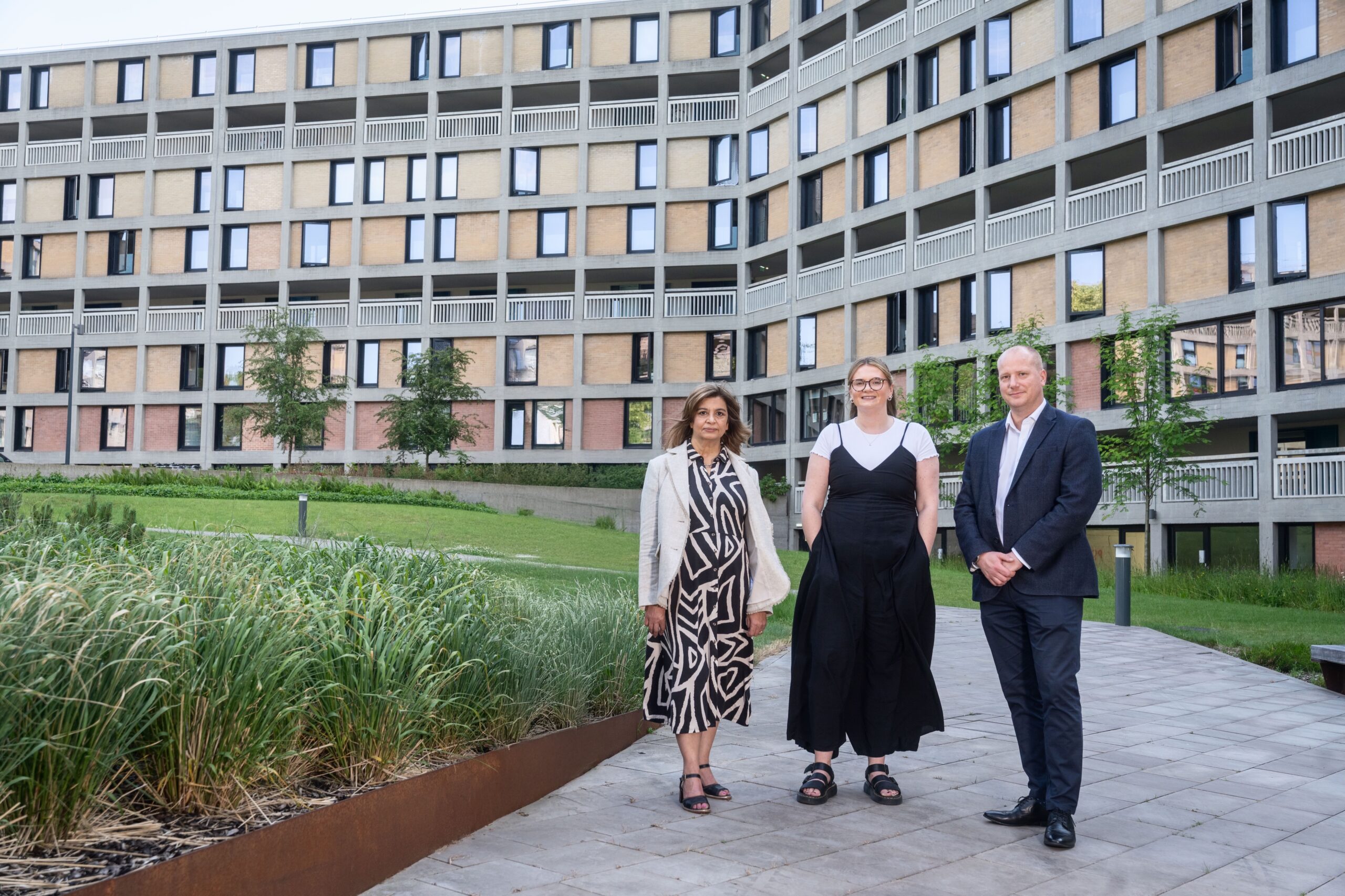
GMI Construction Group has started work on phase four of the Park Hill regeneration in Sheffield, taking forward the next tranche of homes and public-realm works at one of the UK’s most closely watched urban renewal schemes. Appointed by joint venture partners Urban Splash and Places for People, the contractor is delivering 125 new apartments alongside EV charging points, car club facilities, secure cycle storage, and wider external improvements as the long-running transformation of the Grade II* listed estate moves into its next chapter.
The start on site follows a £6.4m funding agreement with Homes England and a separate arrangement that will see Great Places Housing Group deliver 30 of the new homes as affordable housing, equivalent to 24% of the phase. That combination of brownfield funding, mixed-tenure delivery, and heritage-led construction is significant in itself. Park Hill has never been a straightforward residential development. It is a regeneration project that has had to reconcile listed-building constraints, commercial viability, design quality, tenure mix, and public expectations over a period measured in years rather than quarters.
Ed Weston, regional director for Yorkshire at GMI Construction Group, said the company was especially proud to be delivering the refurbishment element of phase four, describing Park Hill as a development of major architectural and cultural importance for Sheffield and the wider region. That heritage context is central to the construction challenge. This is not a clean-sheet housing plot. It is a live intervention in an iconic structure whose reputation depends as much on how it is handled as on how many homes it yields. Delivery therefore has to be sensitive without becoming timid, and practical without losing sight of the design logic that has kept Park Hill culturally relevant.
The scale of what has already been delivered shows why phase four matters. The wider partnership at Park Hill has already produced hundreds of homes, student accommodation, more than 50,000 sq ft of workspace, and extensive landscaping and public realm. In other words, this is no longer a symbolic regeneration story sustained by future promise. It is an evolving piece of city-making with a resident base, commercial activity, and a growing neighbourhood identity. The task now is to extend that momentum while making the numbers work in a residential market still dealing with cost pressure, viability scrutiny, and persistent questions around affordability.
That makes Park Hill an unusually revealing project for the wider industry. Across the UK, brownfield regeneration is routinely described as a policy priority, but the delivery conditions are rarely simple. Funding gaps remain common, heritage constraints complicate design and programme, and the demand for better public realm and lower-carbon transport infrastructure sits alongside the core requirement to build homes at a viable pace. Park Hill phase four brings many of those tensions into a single package. It is listed, design-led, tenure-mixed, mobility-conscious, publicly supported, and heavily scrutinised.
The fact that work is now under way is therefore useful evidence that complex urban regeneration can still move when the funding structure, development partnership, and delivery strategy line up. The next test, as ever, will be execution. Schemes of this type are won or lost on detail: sequencing, access, cost control, and the ability to translate regeneration rhetoric into homes and places that work in everyday use. Park Hill has already shown that the long game can pay off. Phase four is where that argument has to be proved again, this time under a tougher set of market conditions.