IN Brief:
- Plug-in solar is heading to the UK retail market within months as government widens small-scale solar access.
- The Future Homes Standard will push most new homes in England toward on-site renewables and low-carbon heating, with exceptions for some high-rise schemes.
- For housebuilders, the main challenge now is integrating solar, services design, and supply-chain readiness into live delivery programmes.
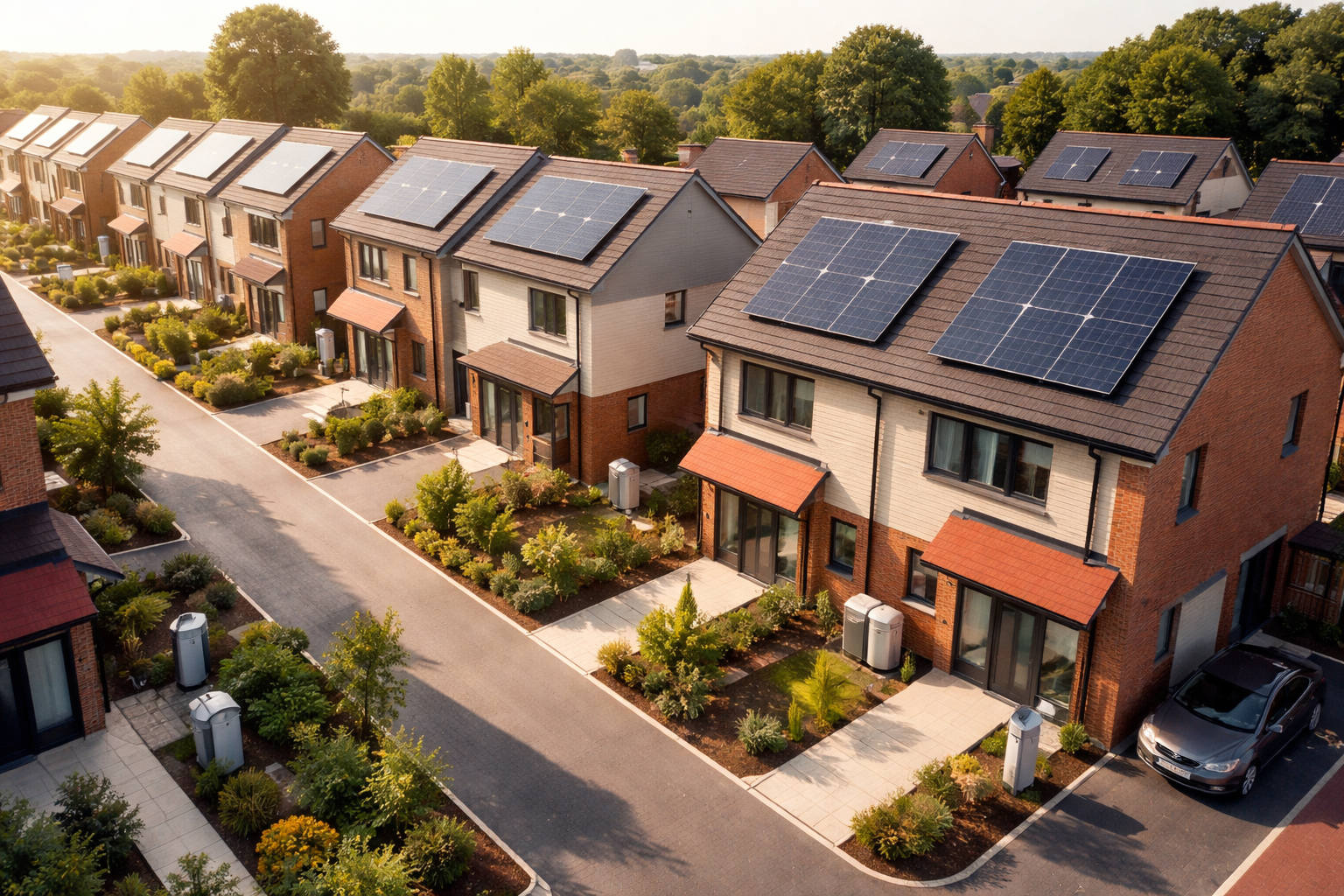
The UK Government has paired a consumer-facing push on plug-in solar with the formal rollout of the Future Homes Standard, creating a two-track solar policy that reaches both existing households and new residential development. For construction, the larger shift sits in the new-build detail, where most new homes in England are expected to include on-site renewable electricity generation, most commonly solar PV, alongside low-carbon heating.
The government says the new rules could cut annual household bills by up to £830 compared with a standard home rated EPC C, while delivering at least 75% lower carbon emissions than homes built to 2013 standards. Guidance published with the consultation response indicates that solar provision equivalent to 40% of a dwelling’s ground-floor area will generally satisfy the requirement, although lower levels may still be acceptable where the building’s design or surroundings limit what can be installed effectively.
That does not mean every scheme will look alike. Higher-risk buildings have separate transitional arrangements, and the government’s own notes make clear that the on-site renewables requirement includes exceptions, including some high-rise buildings. For developers, that pushes solar, roof plant, overheating strategy, MEP coordination, and grid considerations further upstream in the design process, rather than leaving them to be resolved late in technical delivery.
Alongside the new-build changes, plug-in solar panels are set to reach UK retailers within months, with products designed to connect through a mains socket and serve balconies or other outdoor space. The same policy package also includes a discounted-energy trial for windy days in constrained parts of Scotland and the East of England, linking household energy policy more directly to grid-management reform and local renewable capacity.
Lucy Haynes, partner in the residential development team at Shakespeare Martineau, said: “This is a classic case of good policy, bad timing. No one is arguing that making renewable energy more widely available doesn’t cut energy bills and benefit the environment, but this unnecessarily piles the pressure on housebuilders at an already challenging time.” She added that developers, particularly SMEs, should already be reviewing design codes and supply-chain arrangements to work out how the new requirements will be delivered in practice.
The timetable is tighter than the headline politics suggests. For non-higher-risk building work, the Future Homes Standard is due to come into force on 24 March 2027, followed by a 12-month transition period, while higher-risk building work follows a separate route. The argument over whether solar belongs in mainstream housebuilding is effectively over; the live issue now is how cleanly the sector can absorb the cost, design, and programme consequences.