IN Brief:
- The Feronord consortium has been selected for the OL32 Skavsta contract on Sweden’s East Link rail project.
- The package covers about 36km of railway, 28 bridges, three viaducts, and major earthworks.
- A first phase worth €50m has been placed, with the execution phase estimated at €1.2bn.
Infrakraft, Bouygues Travaux Publics, and Colas Rail have been selected by Trafikverket for the OL32 Skavsta contract on Sweden’s East Link rail project south of Stockholm.
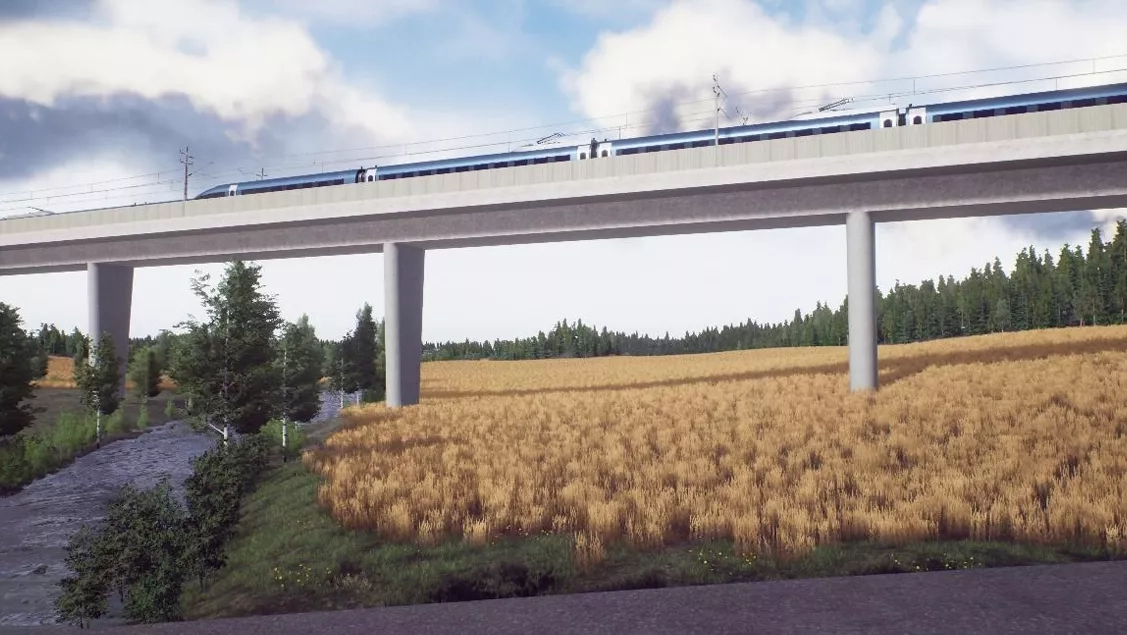
The companies will deliver the package through the Feronord consortium. The scope covers approximately 36km of railway line, including major earthworks, 28 bridges, and three viaducts. One of the viaducts will span 1.4km, making it one of the most substantial structures on the section.
East Link forms part of Sweden’s national transport development programme. The project is designed to increase rail capacity, improve connections between the Stockholm/Mälardalen region and Östergötland, and support lower-carbon mobility across a growing corridor.
The OL32 contract will be delivered under a collaborative partnership model described as a volume contract. The first phase will last four months and establish working arrangements between the client and the delivery partners. A design and planning phase of around 14 months will follow, during which the parties will agree technical solutions, programme, and implementation cost.
The first phase order was placed at the end of March and is worth €50m. The execution phase could begin in early 2028 and is estimated at €1.2bn.
The consortium combines domestic and international rail delivery capacity. Infrakraft holds 47% of the consortium, Bouygues Travaux Publics 41.5%, and Colas Rail 11.5%. The partners were selected for local presence and major rail-project experience across markets including France, the United Kingdom, and Morocco.
The award adds to a significant European rail and transport infrastructure pipeline. IN Site recently covered Stockholm’s €124bn construction pipeline to 2040, covering housing, rail, roads, commercial buildings, education facilities, and energy infrastructure. The East Link package forms part of that broader investment push across Swedish transport and urban development.
The scale of OL32 also reflects the growing use of collaborative contracting on complex infrastructure schemes. Long linear projects carry uncertainty around ground conditions, utilities, environmental constraints, access, interfaces, consents, and stakeholder requirements. Early contractor involvement gives the client and delivery team more time to settle design, cost, and sequencing before full construction begins.
That approach shifts risk into earlier project definition. It requires transparent cost development, strong governance, clear decision-making, and technical depth on both client and contractor sides. Without those controls, early involvement can become a prolonged pre-construction stage rather than a route to stronger delivery.
The engineering scope is substantial. Thirty-six kilometres of new railway, 28 bridges, three viaducts, and large earthworks packages will require careful control of logistics, temporary works, materials movement, environmental mitigation, and rail-systems integration. The 1.4km viaduct will be one of the most visible elements, but delivery risk will sit across the full corridor.
Rail remains one of Europe’s strongest long-term infrastructure markets. Decarbonisation policy, capacity constraints, regional growth, and modal shift are pushing governments towards new lines and upgrades. At the same time, major rail programmes remain exposed to inflation, skills shortages, land constraints, permitting delays, and public scrutiny.
East Link brings those pressures together. It combines high-value civil engineering, collaborative procurement, national transport objectives, and a supply chain drawing on both domestic and international expertise. As the project moves through design towards execution, OL32 will test whether early partnership contracting can provide the cost and programme control now demanded of Europe’s major rail schemes.