IN Brief:
- Esh Construction has completed the £6.4m redevelopment of Bishop Auckland Bus Station for Durham County Council.
- The new transport hub includes accessible passenger facilities, live information, CCTV, toilets, landscaping, and a 124-space car park.
- The project forms part of wider town-centre regeneration backed by Future High Streets Fund investment.
Esh Construction has completed the £6.4m redevelopment of Bishop Auckland Bus Station, delivering a new town-centre transport hub for Durham County Council.
The station has opened to the public on the site of the former facility on Saddler Street, following completion of the main build and £1.8m of associated enabling works. The project forms part of wider regeneration activity aimed at improving local connectivity and supporting Bishop Auckland’s role as a market town and visitor destination.
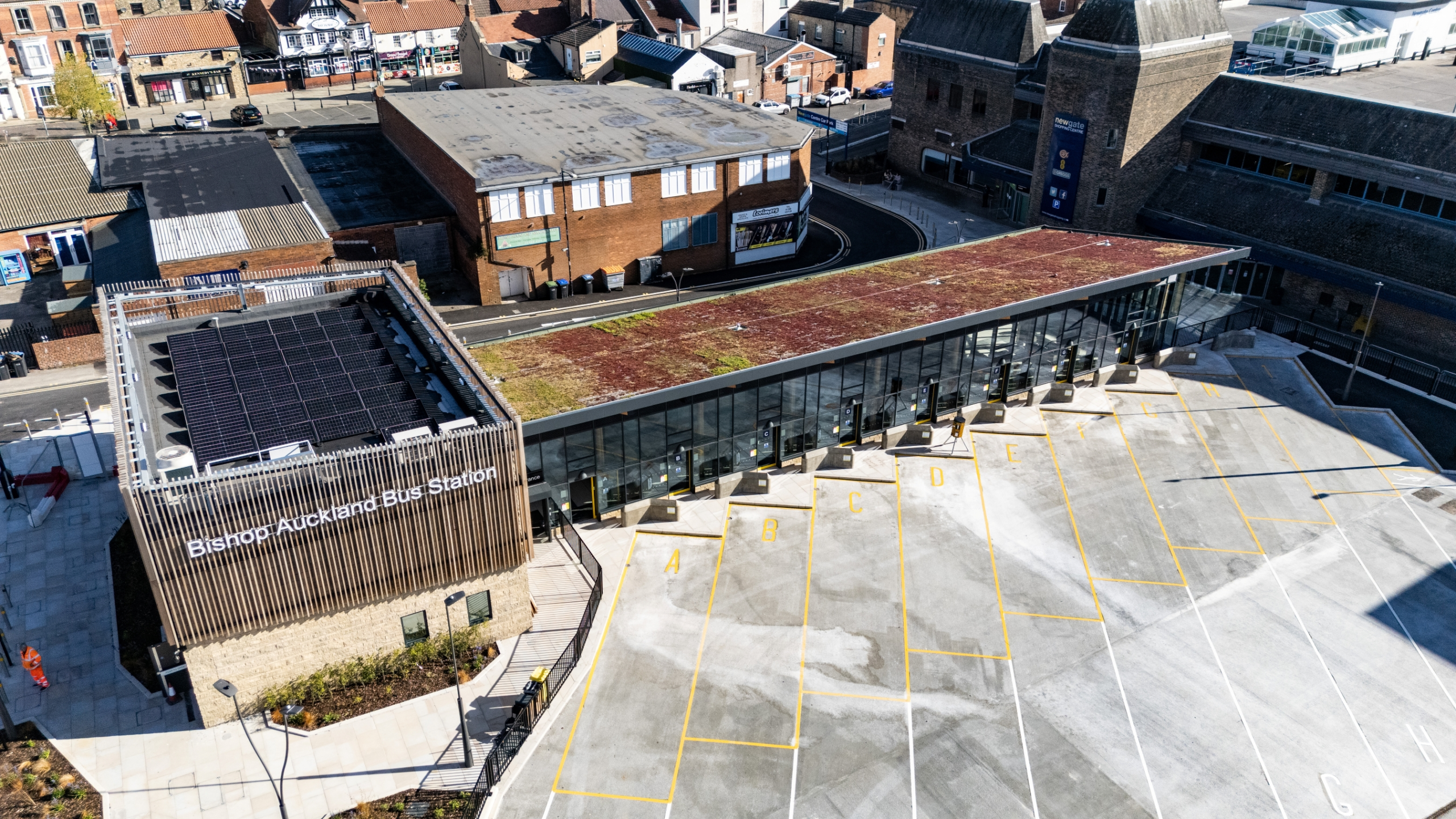
The new hub includes live passenger information, CCTV, toilet facilities, accessible toilets, a changing places unit, parent and child facilities, and a retail kiosk. Accessibility has been built into the passenger areas, with anti-slip flooring, seating, and wheelchair spaces positioned at the front of each waiting zone.
Works around the building have included landscaping, paved areas, drainage systems, and street lighting. A 124-space car park will sit alongside the bus station, including wheelchair and Blue Badge spaces, motorcycle parking, electric vehicle charging points, and bicycle parking.
The build also used local supply-chain capacity. More than 120 hot rolled steel girders, weighing 23.49 tonnes in total, were installed after being fabricated less than two miles from the site by South Durham Structures Ltd.
Sustainability measures include rooftop solar photovoltaic panels, a rainwater harvesting and reuse system, and a sedum green living roof to support biodiversity. Esh’s project information also identifies enabling works including excavation, clearance of existing hard surfaces, a new drainage system, seven attenuation tanks, and a new substation to meet power requirements.
The redevelopment has been supported by £11.8m from the Future High Streets Fund. Esh has reported £2.2m of social value through the project, including work experience and T-Level time for County Durham students, site weeks for veterans and reservists, STEM and employability engagement in schools and education settings, and £2.2m spent within the County Durham supply chain.
Town-centre transport hubs sit between building, infrastructure, and public realm construction. They have to manage passenger comfort, safety, movement, accessibility, security, drainage, highways interfaces, information systems, utilities, and future maintenance, often on constrained sites that remain sensitive to local traffic and business activity.
Bishop Auckland’s new station follows other North East projects where Esh has combined public-sector delivery with regional supply-chain and social value commitments, including its £18m Middlesbrough housing scheme. The two projects sit in different sectors, but both reflect a local delivery model built around civic infrastructure, housing, and measurable community benefit.
Transport interchange projects rarely carry the profile of major rail or highways schemes, yet they often determine whether wider regeneration investment works in daily use. A modern bus station can improve the first point of arrival for visitors, reduce pressure on surrounding streets, and provide residents with safer and more legible access to services, jobs, education, and healthcare.
The local steel fabrication also gives the scheme a stronger economic case. Public infrastructure spending is under pressure to demonstrate value beyond the asset itself, and local procurement can keep more of the project benefit within the surrounding economy when the capacity exists.
The completed bus station now provides Bishop Auckland with a more accessible transport gateway and a better-connected civic asset. Its long-term value will depend on how well it supports footfall, local services, visitor movement, and the wider regeneration programme being assembled around the town’s cultural and heritage offer.