
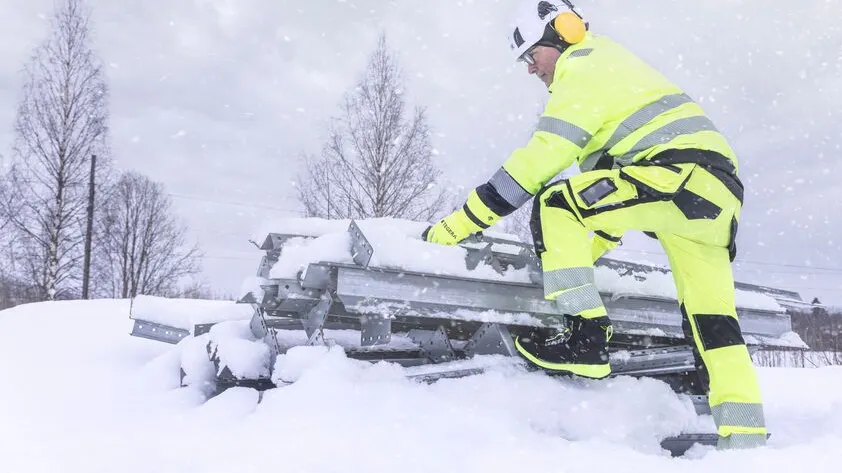
IN Brief:
- The glove targets conductive heat loss when workers grip cold tools, components, and scaffolding.
- Calothan insulation is concentrated in the palm, with a manufacturer-claimed improvement of up to 20% against conventional insulation.
- The product also uses a waterproof membrane, Thinsulate lining, high-visibility back material, and touchscreen-compatible index finger.
Ejendals has introduced a winter safety glove designed to reduce heat loss when workers handle cold metal tools, scaffolding, machinery, and building components. The TEGERA SubZero 6299 concentrates an additional insulating material, Calothan, in the palm rather than distributing the same insulation uniformly throughout the glove. It is intended for outdoor work in which repeated contact with cold objects presents a different challenge from exposure to low air temperatures alone.
Metal conducts heat readily, so gripping a steel tube or handling a cold machine component can cool the contact surface of the hand more quickly than exposure to cold air. That effect becomes particularly apparent during tasks requiring repeated gripping, positioning, and release. Numbness or stiffness can interfere with fine finger movements, while bulky insulation may itself restrict the hand movements needed to operate tools. The new glove is designed around that combination of contact protection and usable dexterity.
Ejendals reports that Calothan can improve insulation against contact cold by up to 20% compared with conventional insulation materials. The comparison concerns the palm treatment, while the conditions encountered on site also depend on the temperature and material being handled, the duration of contact, moisture, and glove fit.
Anna Hedvall, industrial designer at Ejendals AB, said: “When fingers get too cold, workers lose both feeling and precision, which directly affects safety and performance.” She added: “With Calothan™, we focus insulation exactly where contact cold occurs. The result is better warmth without sacrificing flexibility.”
The palm combines Calothan with full-grain cowhide leather, while the back uses high-visibility yellow TEGERA water-repellent textile. Ejendals identifies building and construction, installation, machine operation, and outdoor equipment handling among the intended applications. Pre-curved fingers and reinforcements at the fingers and thumb are intended to support grip and repeated hand movements when cold-weather work involves both manual handling and tool use.
A 150 g Thinsulate winter lining provides the main thermal layer. Ejendals describes the lining as containing up to 78% recycled materials, separately from the additional palm insulation. Its Aquathan membrane provides waterproof and windproof protection, while an extended cuff covers the wrist. The index finger is touchscreen-compatible, allowing workers to operate compatible handheld devices while keeping the glove on.
Repeated handling of scaffold fittings, steel sections, and metal attachments brings the palm into sustained contact with surfaces at outdoor temperatures. Grip pressure compresses the layers between the hand and the object, making the position and construction of the insulation relevant to how a glove is used. Calothan’s placement is intended to address that contact point while leaving the fingers free to flex around tools and components.
Ejendals lists compliance with EN ISO 21420:2020, EN 388:2016+A1:2018, and EN 511:2006. The mechanical protection marking is 2222X, and the EN 511 cold protection marking is 321. Under EN 511, those three digits describe performance levels for convective cold, contact cold, and water penetration respectively. The glove is rated level 3 for convective cold, level 2 for contact cold, and level 1 for water penetration, indicating no water entered during the standard 30-minute test. These ratings allow the separate protective properties to be assessed when selecting equipment for a particular task.
The waterproof membrane and leather gripping surface address different aspects of winter handling. Water resistance helps limit moisture reaching the lining, while the palm leather provides a hard-wearing interface with tools and components. The conspicuous back material improves the glove’s visibility, and touchscreen operation allows digital work instructions or inspection records to be checked without repeatedly exposing the hand. Site-specific glove selection still depends on the mechanical, thermal, and handling hazards of the task.
The 6299 joins Ejendals’ Winter Heroes 2026 range, which also includes the JALAS Zenit Evo 7188 winter safety boot and additions to the TEGERA PRO glove collection. Within the SubZero range, the company distinguishes the 6299 from other winter models through its Calothan palm treatment, waterproof construction, and emphasis on frequent handling of cold objects. Its published size range is EU 7 to 12.
Ejendals’ product specification lists 23% recycled material for the complete glove, a separate measure from the percentage reported for its Thinsulate lining. The specification covers EU sizes 7–12 and classifies the 6299 as a medium-weight glove for work in cold, wet, and windy environments. Its contact-cold palm insulation is the main distinction within the company’s winter range for workers repeatedly handling exposed metal equipment.