IN Brief:
- Environment Agency-supported works have added property flood resilience measures at 100 homes in three East Midlands counties.
- The £1.6m programme includes flood barriers, self-closing air bricks, sump pumps and non-return valves.
- Residents affected by Storm Babet and Storm Henk were eligible to seek grants, alongside wider community preparedness support.
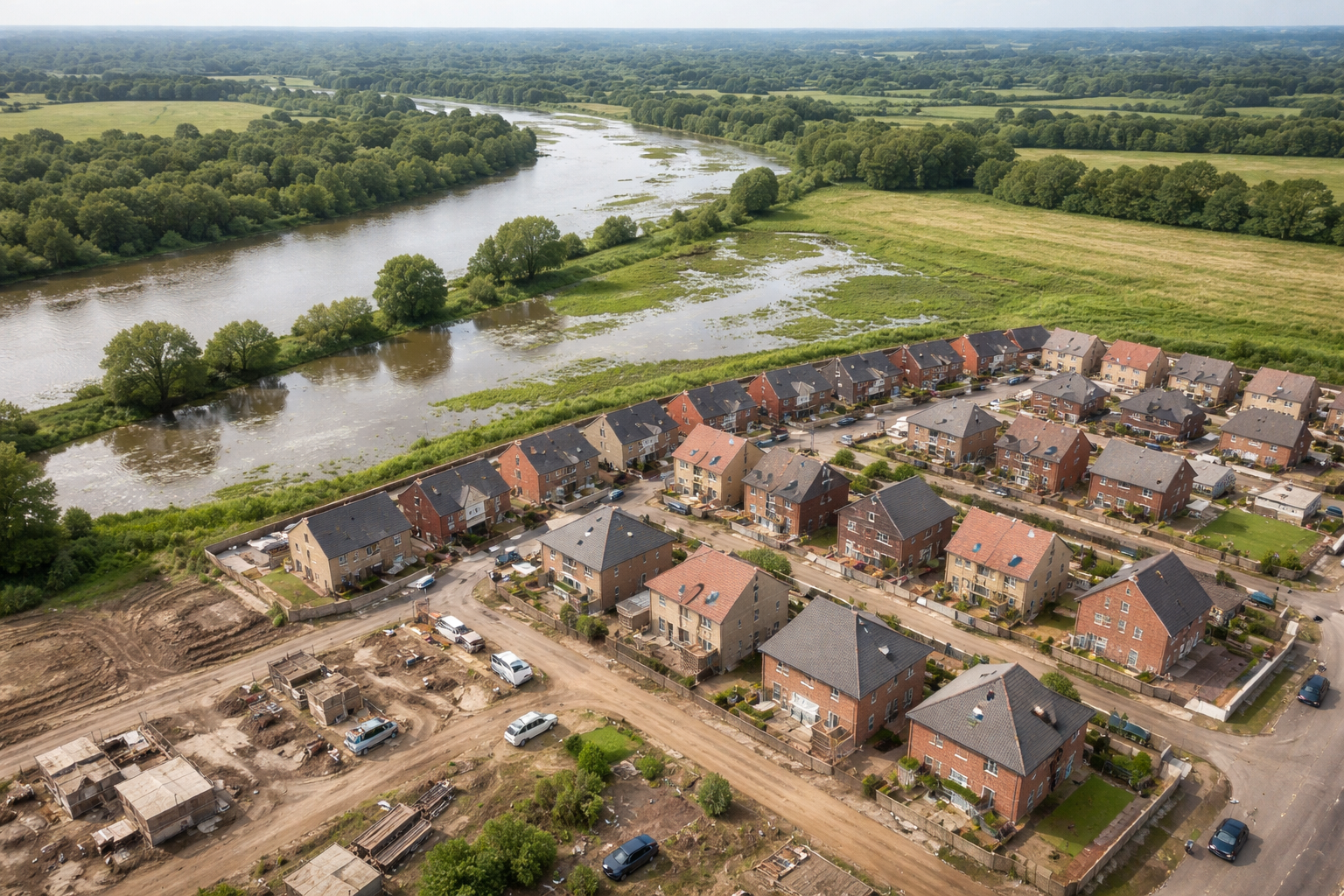
The Environment Agency has confirmed installation of property flood resilience measures at 100 homes across the East Midlands under a £1.6m programme supported by local authorities and government funding. The work follows damage caused by Storm Babet in October 2023 and Storm Henk in January 2024. Rather than relying on a single new flood wall or watercourse intervention, the project equips individual buildings with measures intended to limit water entry, reduce backflow and aid recovery when flooding cannot be prevented across the wider catchment.
The properties are spread among Bradwell and Denby Bottles in Derbyshire; Girton, Collingham and Pleasley in Nottinghamshire; and Redmile, Braunstone and Sileby in Leicestershire. The Agency reports installations including flood-resistant doors or barriers, self-closing air bricks, underfloor sump pumps and self-closing non-return valves on toilets and pipework. These are examples of measures used across the programme, not a statement that every property received every product. The precise mix depends on a building’s exposure, access points, drainage arrangements and existing construction.
A door barrier or purpose-designed flood door aims to resist water passing through an external opening while the seal and surrounding structure remain effective. Air bricks serve a different purpose: they normally ventilate subfloor spaces, but a self-closing design can obstruct floodwater entry at a low-level opening. Sump pumps are intended to remove water collected at a low point, subject to their power supply, discharge route and operating capacity. Non-return valves act on pipes to restrict flow in the wrong direction when external drainage is under pressure. None of those devices provides unconditional protection against every depth or duration of flood.
Protecting a building requires its individual floodwater entry routes to be assessed together. Water may approach through doors and vents, but pressure in drainage systems can also lead to backing up through sanitary connections. A building whose principal entrance is protected may still admit water at another low point unless the relevant pathways are understood. Conversely, relying only on drainage valves does nothing to hold back surface water through an unprotected threshold. The Environment Agency has not published individual property surveys or design flood levels for the installations, so there is no basis to claim a uniform rated protection depth for all 100 homes.
Funding for the £1.6m programme came through a combination of local authority contributions, the Trent Regional Flood and Coastal Committee and the government’s Frequently Flooded Allowance. Homeowners affected by the two named storms were able to apply for support. The stated sum is a total project figure, not a confirmed construction contract awarded to one supplier, and dividing it by the property count would not produce a reliable unit installation cost because the programme also included differing measures and preparedness activity.
The Agency also worked with flood groups and local flood wardens, and encouraged residents to understand their risk and prepare personal flood plans. That organisational work sits alongside the physical alterations to buildings: barriers are useful only if they are correctly maintained and, where manually deployed, put in place with enough warning. Likewise, owners need to understand whether a component operates automatically, whether its moving parts require inspection and how a home can be made safe after inundation. No common inspection frequency or long-term performance dataset has yet been published for the installations.
Flood resilience at the property boundary should be distinguished from catchment-scale flood defence. Embankments, storage areas and river works seek to reduce or manage the amount of water reaching a community, while property measures address the consequences at particular buildings. The Agency’s programme acknowledges that some flood events will exceed what larger defences can prevent. Limiting the entry routes or reducing the time taken to recover can still change the damage sustained, although the extent of that change depends on the event and building.
The completion update coincides with Flood Action Week beginning 12 October and the establishment of a new government flood and drought taskforce. These are separate policy and public-awareness developments rather than additional construction packages within the £1.6m retrofit scheme. The Agency is encouraging households to check published flood-risk information and subscribe to warnings; those steps complement, but cannot substitute for, suitable installation and maintenance of physical building measures.
The reported installations are complete at the 100 homes. No quantified reduction in insurance claims, flood losses or recovery time has yet been published for this group of homes, and the next severe event would be an inappropriate test to assume in advance. The reported outcome is a set of completed resilience measures across eight communities, with future performance dependent on the hazards encountered and the condition and operation of each installation.