IN Brief:
- The Elephant opened its public town centre on 12 November 2026, with residential and retail space brought into use.
- Get Living reports 485 homes, 135,000 sq ft of retail and leisure space, and 55,000 sq ft of workspace.
- Multiplex identifies a £450m construction contract; the new university campus and Underground entrance remain later milestones.
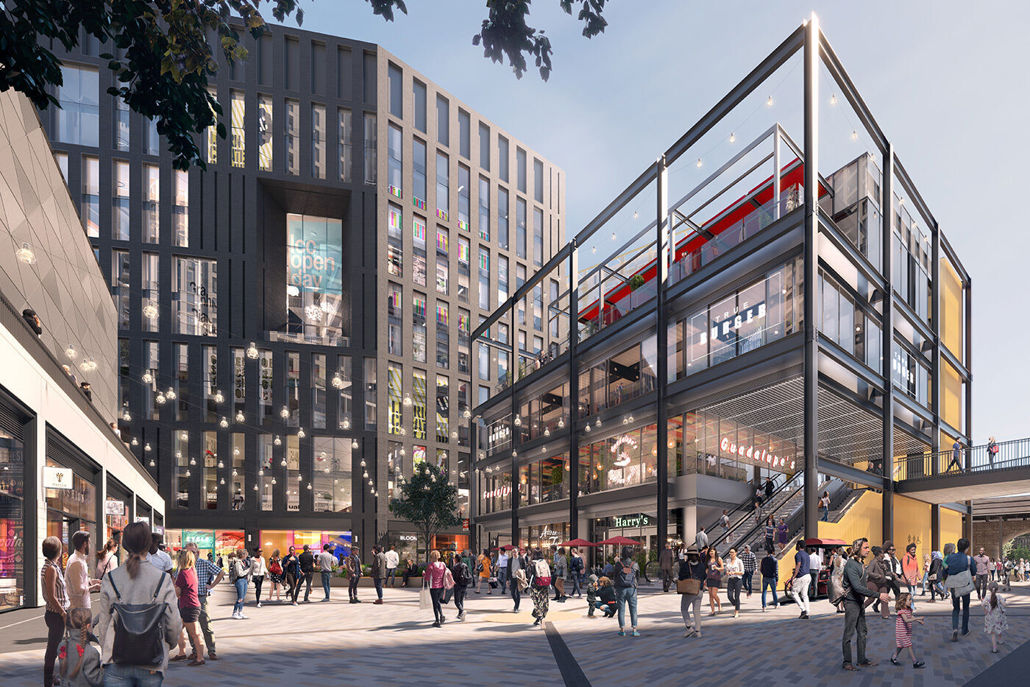
Get Living opened The Elephant town centre at Elephant & Castle on 12 November 2026, bringing a substantial part of the former shopping-centre redevelopment into public use. The £500m mixed-use scheme provides new retail and leisure premises, a public square, routes through the site and 485 homes for market and affordable rent. The opening represents a major handover milestone within a wider construction programme: the new university campus and planned Underground ticket hall are separate elements with later operational dates.
The completed town-centre development is designed to provide 135,000 sq ft of shops, restaurants and leisure space alongside 55,000 sq ft of workspace, according to Get Living and main contractor Multiplex. At launch, 93% of the 116,459 sq ft of commercial accommodation then available was either let or under offer. The smaller availability figure does not replace the total design allocation, and an offer is not equivalent to a trading occupier. Eight retailers opened on 12 November, establishing the first operational phase while additional premises prepare to trade.
Multiplex is the main contractor under a JCT design-and-build arrangement. Its project information records a construction contract value of approximately £450m, whereas Get Living’s £500m figure is the broader development value. Demolishing the former shopping centre, forming new structures and arranging a public realm beside a working transport interchange created interfaces between demolition, major building work, pedestrian access and subsequent operational handovers. Multiplex still describes the wider project as under construction, despite the opening of the town centre.
The residential component, known as Elephant Quarter, contains 485 apartments for market and affordable rent. Project material gives a split of 313 market-rent and 172 affordable-rent homes in this phase. Residents began moving in before the public commercial opening, illustrating how a mixed-use programme can hand over individual components while work continues elsewhere. Housing occupation depends on building systems, access and life-safety arrangements being ready within the occupied areas; it should not be taken as evidence that adjacent construction or transport works have reached their final state.
Public realm and connections through the former shopping centre footprint form an important part of the scheme. The new square, named for Dr Cecil Belfield Clarke, and newly arranged streets introduce alternative routes through a location previously dominated by shopping-centre circulation. The redevelopment team has also outlined a further pedestrian connection through railway arches, scheduled in the project programme for 2027. These links are integral to how the housing, shops and nearby transport facilities operate together, although the final routes will not all be available immediately.
Delivery at Elephant & Castle has been organised into phases so existing businesses, public transport and redevelopment areas can operate around construction. The project team’s timeline identifies demolition beginning in 2020, main building work starting in 2022, and the autumn 2026 commercial opening. Coordinating a mix of residential, retail, institutional and transport uses introduces distinct finishing, commissioning and access requirements. A retail unit handed over for tenant fit-out may have a different completion timetable from the structure above it or the adjoining educational building.
The new campus for the University of the Arts London’s London College of Communication is scheduled to open in September 2027. Multiplex records approximately 370,000 sq ft of university space within the project. Specialist educational fit-out, commissioning and occupation must proceed on a timetable separate from the retail opening. The present college site is earmarked for a later phase of redevelopment, so the university move also affects the sequence in which further land can be released for construction.
The planned new Northern line entrance and ticket hall form another distinct element of the wider scheme. The supporting station infrastructure and transport interfaces are integrated with the development, but the public opening on 12 November did not bring the replacement entrance into operation. The opening-day material points to a later delivery programme for the station improvements, with one contemporary account identifying 2030 as the intended operational milestone. That remains a programme indication, not a completed transport handover or a confirmed opening day.
Construction around established transport links also imposes constraints that differ from a conventional isolated development site. Deliveries, hoarding, workforce access and pedestrian diversions have had to be managed around railway users and neighbours. The project team has previously published permitted working hours and routes around the works. As each finished area becomes public, boundaries between operational premises and remaining construction will need to be maintained without interrupting access to homes and businesses already occupied.
A further development phase is proposed for the existing college site once the institution transfers to its new premises. Get Living’s later scheme proposals include additional rental and student accommodation and public realm, but their delivery depends on the relevant planning and construction programme. The town centre’s opening confirms that residential, commercial and external public spaces on a substantial part of the former shopping-centre footprint are operational. The university and station components will be measured against their own construction, commissioning and occupation milestones.