IN Brief:
- JCB’s 480 and 490 wheeled loaders offer rated payloads of approximately 8,000kg and 9,000kg.
- Both machines use a Cummins X12 diesel engine rated at 250kW, ZF CVT and JCB’s compact loader linkage.
- The machines were shown in pre-production form in June 2026; customer deliveries are expected during 2027.
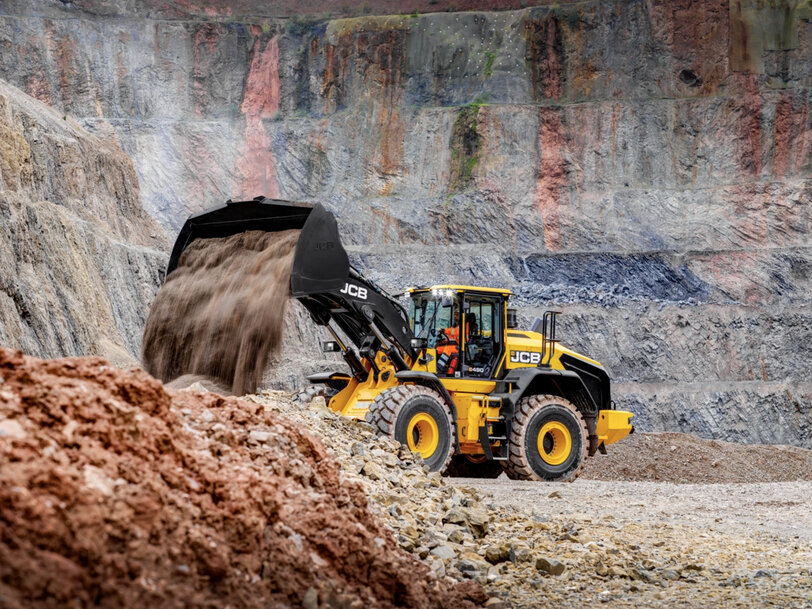
JCB expects its 480 and 490 wheeled loaders to enter customer service in 2027, bringing rated payloads of approximately eight and nine tonnes to its heavy materials handling range. First shown in pre-production form at Hillhead in June 2026, the machines are intended for quarrying, aggregate handling, waste operations, ports and construction work. The design combines a common powertrain with a new loader linkage, configurable controls and site safety equipment.
Both machines use a Cummins X12 diesel engine delivering 250kW, or 335hp, and up to 1,695Nm of torque at 1,400rpm, with EU Stage V and Tier 4 Final emissions compliance specified. A ZF continuously variable transmission transfers power to the wheels and offers adjustable tractive effort without requiring the operator to select mechanical gear ratios for each change in travel speed. JCB describes the arrangement as designed to balance traction and fuel use, but it has not supplied independently verified consumption data from matched site trials.
The 480 is rated for a payload of approximately 8,000kg, with the 490 increasing that figure to 9,000kg and incorporating a larger counterweight. The two machines occupy an operating-weight class of roughly 25 to 27 tonnes. Rated payload is not the same as bucket volume or the total weight of the machine: it defines a material-handling limit within an approved configuration. The final usable bucket size will depend in part on material density, linkage arrangement and the applicable stability and operating limits.
The loader linkage combines elements of a conventional Z-bar mechanism with the visibility and attachment handling of a tool-carrier arrangement, according to JCB. Its compact geometry uses a single bucket ram and keeps the linkage closer to the arms, reducing the amount of hardware projecting forward of the lifting structure. The design is intended to preserve rollback and discharge angles over the lifting range and accommodate larger buckets for lower-density materials. Detailed breakout forces for every available configuration have not been published.
The interaction between bucket geometry and material density has practical implications in quarry operations. An oversized bucket can increase the volume moved per pass where aggregates are light enough to remain within the machine’s rated payload; the same bucket cannot simply be filled to the same level with heavier stone without considering mass. Maintaining an appropriate rollback angle helps retain material during travel, while sufficient discharge rotation matters when tipping into tall hoppers or trucks. JCB has developed bucket options around the linkage, although complete application-specific capacities have not been published in the November coverage.
Standard and higher-reaching loader arms are planned, with maximum lift-pin heights between 4,445mm and 5,000mm depending on configuration. Those measurements describe the pin position, not the absolute tipping clearance of every bucket. Actual reach at the point of discharge will depend on attachment geometry and machine positioning. The arms incorporate heavy-duty castings and sealed, lubricated pins and bushes, components intended to withstand repetitive lifting, loading and bucket breakout operations.
Operators can select four virtual gear modes through the ZF transmission, setting travel-speed and tractive-effort characteristics to suit different loading operations. A kick-down function assists when entering a stockpile, while JCB’s intelligent hydraulic boost adjusts engine response to changing front-end hydraulic demand. Hill-hold, automatic parking brake and engine exhaust braking functions are also specified. These features govern the interaction of vehicle movement and loader hydraulics, but productivity or fuel savings cannot be quantified without comparable test cycles and loading conditions.
Inside the cab, electro-hydraulic joysticks are mounted with the air-suspended seat, and a 10-inch touchscreen allows operators to adjust control response and assign functions such as return-to-dig and preset truck-loading height. The seat can be specified with heating, cooling and electric lumbar adjustment. Different materials and loading areas require differing machine responses, making those settings useful for repeatable bucket work as well as fine positioning around equipment; the effect on output will depend on the application and operator.
A reversing camera is fitted as standard, while a 360-degree camera arrangement is available as an option. Arm sensors can be used to establish electronic height limits where there are overhead restrictions, and JCB lists object detection with automatic braking among the machines’ safety systems. Camera coverage, detection performance and fitment will need checking against the final delivery specification. The equipment does not remove the need to segregate site traffic and set safe routes for large machines working around people and structures.
Customer deliveries are expected during 2027, after the earlier pre-production display. The machines remain associated with specifications first shown at Hillhead, with final pricing, application-specific bucket selections and independently measured operating figures still to be established. The 480 and 490 will add two payload options to JCB’s heavy loader offering once production machines become available, with operating data from quarries and construction sites needed to establish their performance over sustained duty cycles.