IN Brief:
- Bridgestone Construction and Rotheo have secured Gateway 2 approval for 208 build-to-rent homes at Trafford Waters.
- The scheme will provide one, two, and three-bedroom apartments across two buildings with resident amenities.
- Approval gives the project a route into construction within Peel Waters' wider 3,000-home Trafford Waters development.
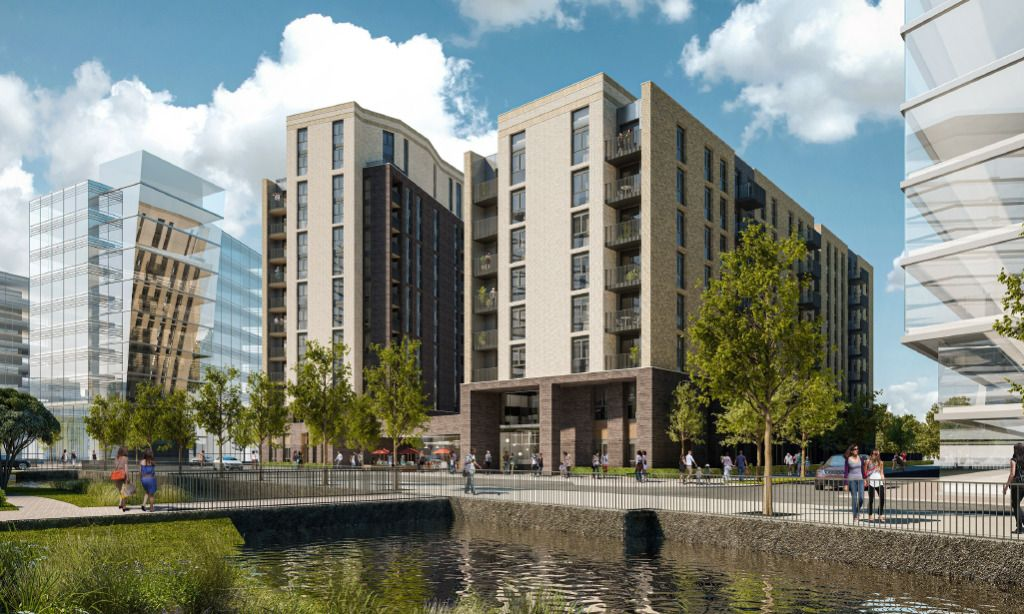
Bridgestone Construction and Rotheo have secured Gateway 2 approval for Anchor Residency at Trafford Waters, giving the 208-home build-to-rent project clearance to move towards construction within the emerging Greater Manchester waterfront district.
The development will provide a mix of one, two, and three-bedroom apartments across two buildings together with resident amenity space. Leach Rhodes Walker is leading the architectural design, with Thomas Consulting acting as structural engineer and Artec providing fire engineering input.
The project forms the third residential development at Trafford Waters and was granted planning permission in 2024. Earlier plans set out an eight-storey and a 13-storey building beside Trafford Way, with commercial and amenity space at lower levels.
Gateway 2 approval represents the statutory point at which a new higher-risk residential project can progress from design and pre-construction into relevant building work. The Building Safety Regulator has to be satisfied that the proposed design complies with building regulations before construction can begin.
That creates a more demanding pre-construction process than the approach traditionally used on many residential schemes. Structural, fire, architectural, and building services information has to be coordinated to a level that allows the regulator to assess the building before site work overtakes unresolved design decisions.
Bridgestone has attributed the approval to early collaboration between the development, design, and construction teams. That coordination becomes particularly important where decisions involving structure, escape, fire strategy, services, and facade design interact with one another.
The contractor and Rotheo have recently completed the same regulatory step on Nexus House in Salford, a separate student accommodation project. The two developments serve different markets, but progressing multiple higher-risk schemes through Gateway 2 gives the delivery team experience of working within the same regulatory framework.
For Anchor Residency, the approval transfers the emphasis from producing the regulatory submission towards maintaining the approved design during procurement and construction. Product substitutions, contractor proposals, and detailed package development cannot be treated solely as commercial decisions if they affect the agreed compliance position.
The project sits within Peel Waters’ 53-acre Trafford Waters masterplan beside the Manchester Ship Canal. The wider development is intended to deliver around 3,000 homes, more than 100,000 sq ft of amenity space, public open space, and a new waterside park.
Residential delivery across the district is becoming more established. The first care development has already opened, while an 83-home affordable housing scheme has progressed through construction. Anchor Residency adds a larger open-market residential package to that emerging neighbourhood.
The 208-home project will therefore be built within a district already moving from masterplan into occupation. Contractors have to work around evolving roads, utilities, completed buildings, active neighbouring sites, and increasing numbers of residents rather than treating the plot as part of an isolated greenfield development.
That has implications for logistics and programme control. Construction traffic, deliveries, lifting operations, temporary access, and public routes have to be coordinated with the wider Trafford Waters programme as separate plots progress at different speeds.
The build-to-rent model adds further emphasis to common areas and operational systems. Resident amenities, communal circulation, management space, building services, and commissioning are part of the completed product rather than secondary elements behind individually sold apartments.
Handover consequently depends on more than finishing the individual homes. Life safety systems, access control, lifts, mechanical and electrical services, communal areas, and the management infrastructure needed to operate the building have to be ready for occupation as a coordinated package.
Bridgestone has expanded its residential workload across Greater Manchester and the North West, reporting involvement in more than 1,500 completed homes. Recent schemes include Worrall Street in Salford and a later living development in Waterloo, Sefton.
Its involvement at Anchor Residency before construction is particularly relevant under the Gateway 2 regime. Buildability decisions made during design need to remain practical when transferred into trade procurement, otherwise changes intended to solve a site problem can create additional regulatory work.
The regulatory approval also gives the project greater programme certainty than it had during design. Gateway 2 was a statutory barrier to construction, whereas the remaining programme risks increasingly concern procurement, site mobilisation, sequencing, and maintaining compliance as work proceeds.
Approval does not conclude the building-safety process. Evidence has to be maintained through construction and the completed development will subsequently have to satisfy the requirements associated with completion and occupation of higher-risk residential buildings.
That puts greater value on information management throughout the build. Drawings, approved changes, product information, inspection records, and commissioning evidence have to remain aligned with the physical building rather than being reconstructed late in the programme.
For Trafford Waters, Anchor Residency adds another major residential package to a district where homes and infrastructure are increasingly becoming occupied assets. For Bridgestone and Rotheo, the next test is whether the design coordination that secured Gateway 2 can be carried through procurement and site delivery without creating avoidable regulatory changes.