IN Brief:
- Lings Park will provide 38 two-bedroom temporary accommodation apartments in Weston Favell.
- Boost TA is delivering the modular homes alongside groundworks contractor Glympton Construction.
- The EPC A scheme includes solar PV, battery storage, and a fabric-first construction approach.
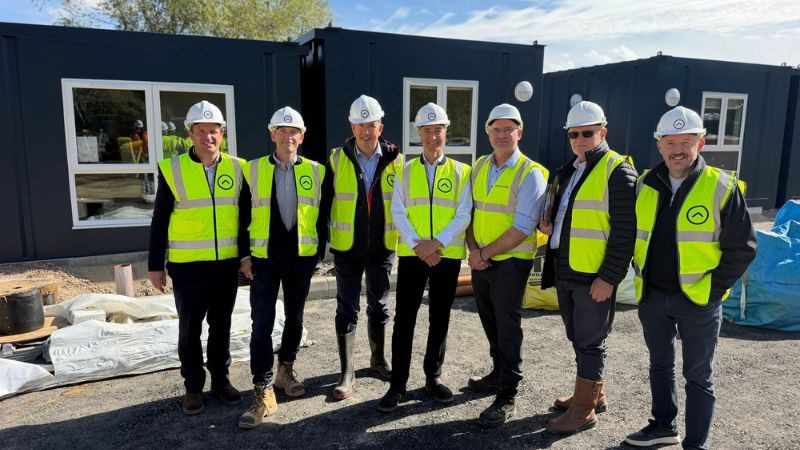
West Northamptonshire Council is approaching completion of a 38-apartment modular temporary accommodation development at Lings Park in Weston Favell, Northampton, as the authority expands its own housing capacity for households facing homelessness.
The purpose-built scheme will provide 38 two-bedroom apartments together with a community hub, children’s play area, management office and laundry facilities. Modular housing specialist Boost TA is delivering the homes alongside groundworks contractor Glympton Construction.
Completion is expected later this autumn. The development has been designed specifically as temporary accommodation rather than adapting an existing hotel or other building after construction, forming part of the council’s strategy to reduce reliance on emergency placements.
Lings Park is targeting an EPC A rating and includes solar panels and battery storage. West Northamptonshire Council says the scheme has also adopted a fabric-first approach intended to reduce energy demand before renewable generation and storage are taken into account.
The project has incorporated measures intended to reduce waste and emissions during construction, making the manufacturing and site-delivery process part of the environmental strategy rather than relying solely on operational technology installed once the homes are complete.
Modular construction changes the sequence of the job but does not remove conventional site activity. Foundations, drainage, utilities, access, external works and landscaping still have to be completed to suit the manufactured components, while tolerances and connection details must be controlled before units arrive for installation.
The main programme advantage comes from overlapping factory production with work on site. Instead of waiting for the superstructure to be assembled before most internal trades begin, significant portions of the homes can be manufactured in controlled conditions while foundations and infrastructure progress separately.
That creates its own logistics requirement. Modules or major assemblies have to arrive in the correct order and at the point the site is ready to receive them. Delays in groundworks can leave completed units waiting, while manufacturing slippage can leave cranes and site teams without the components needed to maintain installation productivity.
At Lings Park, the method is being used to address a particular pressure on the council’s housing service. Authorities across England have faced rising demand for temporary accommodation and significant expenditure on hotels and bed-and-breakfast placements when suitable local housing is unavailable.
Building a dedicated asset changes that cost structure. The council takes responsibility for the capital development and long-term operation of the scheme, but gains accommodation designed around the intended use rather than continuing to purchase rooms from commercial providers night by night.
The specification therefore has to work operationally as well as technically. A management office, laundry facilities and community hub are part of the development because temporary accommodation requires support and estate-management functions that would not necessarily be included in a conventional apartment scheme.
Energy performance has similar long-term implications. Solar generation can offset imported electricity, while battery storage can retain part of that generation for use at other times. The eventual savings will depend on actual output, occupancy and the way communal and individual loads are managed once residents move in.
The fabric-first element is important because generation technology cannot compensate efficiently for excessive heat loss. Improving the building envelope reduces baseline demand, after which photovoltaic generation and battery storage can address a larger share of the electricity the development actually requires.
Lings Park is the first of two Boost TA developments within the council’s current programme. A second project at Claret Park in Northampton is expected to provide another 70 homes and is also scheduled for completion later in 2026.
Together, the schemes will provide 108 temporary homes, giving West Northamptonshire sufficient scale to assess the modular approach across more than one site. That should provide a clearer operational comparison than a single demonstration project, particularly around energy costs, maintenance and resident management.
Repeat programmes also matter to the modular supply chain. Factory-based production benefits from predictable demand because manufacturing capacity has to be maintained between projects, while councils generally want confidence that systems, components and maintenance support will remain available throughout a building’s life.
The final months at Lings Park will centre on completion, commissioning and handover rather than proving the structural concept. Energy systems, apartments, external works and communal facilities all need to be ready together before the site can function as intended.
Occupation will then provide the more useful measure of performance. The council will be able to compare actual running costs and management requirements with the emergency accommodation the development is intended to replace, while lessons from commissioning and early use can feed into the larger Claret Park scheme following behind it.