IN Brief:
- Forge 44 doubles Beaver Bridges’ stated UK fabrication capacity from 20,000 sq ft to 40,000 sq ft.
- The Irlam facility includes heavy fabrication space and a dedicated area for trial bridge erection before delivery.
- The investment supports larger bridge packages while retaining design and fabrication capability in Britain.
Beaver Bridges has doubled its stated UK fabrication capacity with Forge 44 in Irlam, Greater Manchester, expanding the space available to manufacture, trial assemble, and prepare bridge structures before they are transported to site.
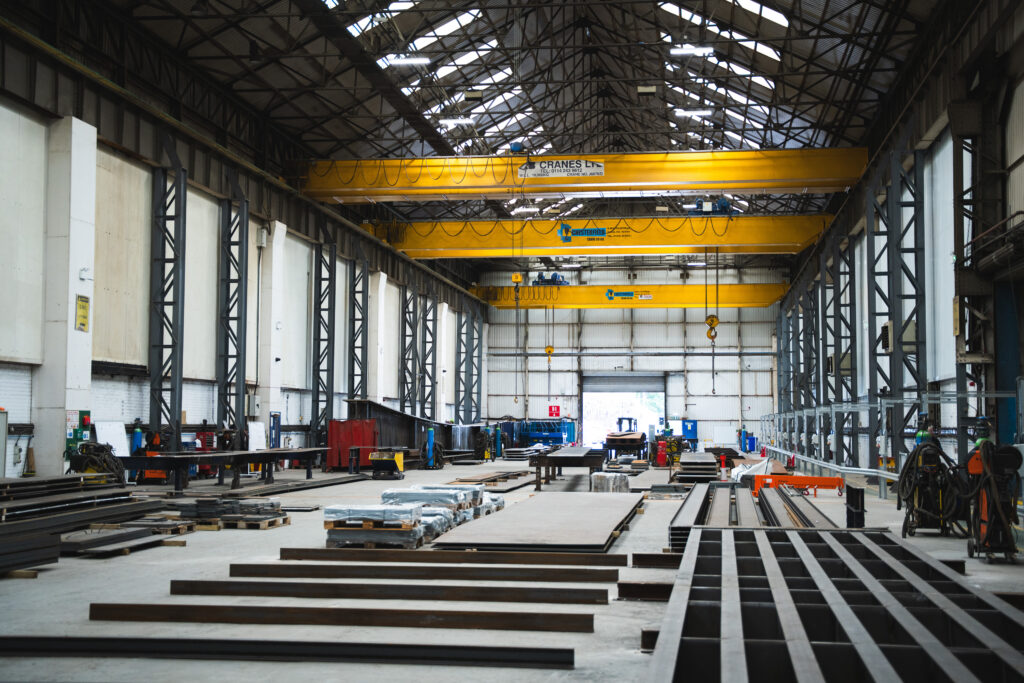
The refurbished industrial facility increases the company’s fabrication capacity from around 20,000 sq ft to 40,000 sq ft and introduces a dedicated trial erection area. Complete or partial bridge structures can be assembled inside the works before delivery, allowing dimensional, connection, and finish issues to be identified away from the installation site.
Modernisation began in March and was completed in June. Instead of constructing a new factory, Beaver Bridges adapted an existing heavy-engineering building, installing cranes, renewing floors, recladding the structure, and upgrading welfare provision.
The site continues a long industrial history in Irlam, which was formerly associated with the Partington Steel & Iron Company and later British Steel. Steelmaking ended locally in 1979, but the scale and infrastructure left by heavy industry helped make the location suitable for structural fabrication.
Forge 44 takes its name from the manufacturing operation and its M44 postcode. The facility also carries the Made in Britain trademark, reflecting Beaver Bridges’ continued design and fabrication activity in the UK.
John Pearce, CEO of Made in Britain, said: “This is what ‘good growth’ in every industrial postcode looks like. The new Beaver Bridges facility is an embodiment of the future-facing British manufacturing story, connecting optimism, skilled, meaningful work in a vibrant and dynamic business that’s built on foundations that are centuries strong. It proves that manufacturing is as vital to our collective future as it was to our industrial past.”
The additional floor area has been configured around heavy bridge manufacture rather than simply adding storage. The main production bay provides high-clearance space for lifting, rotating, positioning, welding, and assembling large steel components, while a second bay gives the business further capacity for fabrication and finishing operations.
The trial erection area is one of the more significant changes for project delivery. Bridge structures frequently have to be installed during tightly controlled possession, closure, or lifting periods, leaving little tolerance for dimensional problems first becoming apparent after components reach site.
Assembling sections beforehand allows connection details, alignment, tolerances, and access to be checked in a controlled environment. Clients can also inspect finishes, colours, and interfaces before components are separated for transport.
Richard Hinckley, Business Director at Beaver Bridges, said: “Forge 44 represents far more than additional manufacturing space. It gives us the capacity to take on larger and more technically demanding projects while giving clients the opportunity to see their bridge assembled before it ever reaches site.”
Trial erection does not eliminate installation risk. Structures still have to be dismantled where necessary, loaded, restrained, transported, lifted, and reassembled under site conditions, often beside live roads, railways, or waterways.
It does, however, move some of the uncertainty to a location where cranes, tools, access, and fabrication personnel are already available. Correcting a connection inside the factory is generally less disruptive than resolving the same issue while a mobile crane, road closure, or rail possession is in use.
The location has also been selected around transport requirements. Forge 44 sits close to the A57, with onward connections to the M60 and M6, reducing the distance abnormal loads must travel on local roads before reaching the strategic network.
For large fabricated structures, that access forms part of the production system. A workshop can manufacture larger assemblies only if those components can physically leave the site and reach their destination within the restrictions imposed by bridges, junctions, road geometry, weight limits, and traffic management.
The company is also maintaining engineering capability alongside workshop production. Keeping designers close to fabrication teams shortens the feedback loop between a drawing and the practical consequences of making the detail it contains.
That can be particularly important in bridge work, where projects often combine one-off geometry, existing infrastructure constraints, restricted installation windows, and transport limitations. A detail that satisfies structural calculations may still introduce unnecessary fabrication or erection difficulty if buildability is considered too late.
Beaver Bridges has grown from a six-person operation established a decade ago to more than 120 employees across several UK locations. Annual turnover has moved beyond £30 million, with the company targeting £50 million by 2028.
The business was also named UK Bridge Contractor of the Year at the 2026 New Civil Engineer Bridge Awards, its second win in that category in three years. Its Forge 44 investment gives that growth a larger physical manufacturing base rather than relying solely on outsourced capacity.
Offsite preparation is already central to bridge installation because many projects allow only short periods for disruptive work. Increasing the proportion of fabrication, finishing, and checking completed before delivery can reduce the range of activities that have to take place beside the live asset.
The benefit depends on design information being stable enough for production to start and on logistics being coordinated with the installation programme. Additional manufacturing capacity has little value if completed structures cannot be transported or if site conditions are not ready when they arrive.
Forge 44 therefore expands more than workshop output. Its trial erection space, lifting capacity, external yards, engineering accommodation, and motorway access collectively increase the size and complexity of the bridge packages Beaver Bridges can prepare under factory conditions before site operations begin.
The company’s next measure of the investment will be how effectively that capacity translates into project delivery. Fabricating more steel is straightforward to quantify; reducing installation uncertainty on constrained bridge sites is the harder result, and the one clients are likely to notice first.