IN Brief:
- Phase one provides 1,014 mixed-tenure homes, with 20% designated as affordable housing.
- The consent includes a western railway-station entrance, hotel, innovation hub, retail space, parkland, and new public realm.
- Site investigations will precede the planned 2027 construction start, with first occupations targeted for early 2029.
Detailed planning approval for the first major phase of York Central has moved one of England’s largest city-centre brownfield schemes closer to building delivery after years of enabling work.
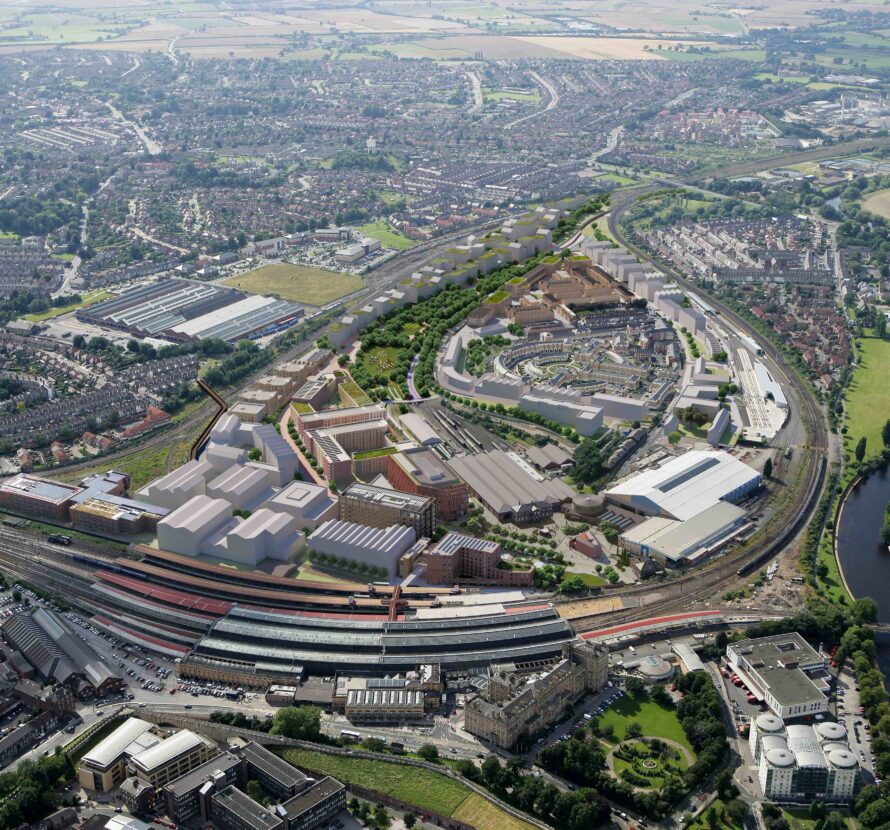
The approved phase provides 1,014 mixed-tenure homes, including 20% affordable housing, alongside a new western entrance to York railway station and an adjoining civic square. It also includes a 213-bedroom hotel, extensive parkland and public realm, a 99,190 sq ft innovation hub, and 67,447 sq ft of retail and leisure space.
McLaren Regeneration, working with Arlington Real Estate, is bringing the development forward alongside the wider York Central partnership. Site investigation work is expected to begin first, with construction scheduled to start during 2027, the first completed buildings targeted for occupation in early 2029, and completion of the approved phase expected during 2030.
The decision changes the delivery status of a project that has required substantial enabling infrastructure before large-scale vertical construction could proceed. York Central occupies more than 110 acres of former and underused railway land immediately west of York station, constrained by operational rail infrastructure and separated for decades from surrounding parts of the city.
Road, pedestrian, cycle, utility, and public realm works have already been used to open the site and establish infrastructure for later phases. That programme has included new access through the development and connections around the National Railway Museum, reducing some of the physical constraints that would otherwise leave residential and commercial plots dependent on further major infrastructure packages.
The new consent sits alongside elements approved elsewhere within the first phase, including Museum Square and a Government Property Agency office hub of about 134,000 sq ft designed to accommodate up to 2,600 civil servants. Housing, transport access, employment space, visitor uses, and public realm are therefore being advanced as connected packages rather than isolated plots.
The western station entrance is central to that sequence because the railway is both the scheme’s main transport asset and one of its defining physical constraints. A new access point changes pedestrian and cycle movement across the western side of the city centre, while the adjoining civic space is intended to create a direct urban connection between the station and the new quarter.
The residential component gives the first phase substantial scale in its own right. More than 1,000 homes represents a significant construction programme before the wider York Central masterplan is considered, while the mix of apartments, affordable provision, public realm, and commercial uses will require coordination across contractors, designers, utilities, transport bodies, and public agencies.
Brownfield ground conditions, interfaces with live railway infrastructure, utilities, logistics, and the sequencing of public realm works alongside neighbouring occupied sites will all affect the construction programme. As procurement develops, those constraints will shape work-package boundaries, temporary access, site compounds, and the timing of individual plots.
The approved mix also spreads delivery risk across several asset types. Residential blocks, hotel construction, innovation space, station access, retail units, and landscaped public areas will not all follow the same procurement or completion sequence, so the first phase will have to maintain common infrastructure and logistics while individual plots progress at different rates.
The wider development is intended to deliver at least 2,500 homes and more than one million square feet of commercial space, while supporting an estimated 6,500 jobs when fully developed. City of York Council describes York Central as a multi-phase programme extending well into the next decade, reflecting the scale of both the site and the infrastructure required to integrate it with the existing city.
That long programme leaves several delivery risks unresolved. Market conditions, infrastructure interfaces, investment decisions, and the sequencing of later phases will continue to influence build-out, while plots closest to operational rail land will demand careful coordination throughout construction.
Detailed approval nevertheless gives the first phase a defined set of buildings and public spaces large enough to establish the new quarter physically, rather than leaving York Central primarily as an infrastructure and masterplanning exercise. Site investigations now become the immediate construction precursor before the planned 2027 start.
The first occupations are scheduled for early 2029, with the approved phase due to complete during 2030. By then, York Central should have moved from an enabling-led programme into a mixed-use district with housing, employment space, public realm, and a second station entrance operating together.