IN Brief:
- B&O Developers and director Sanjay Swaminarayan were fined following unsafe roof work in King’s Cross.
- Required fall-prevention measures were absent despite earlier HSE interventions and a subcontractor risk assessment specifying scaffolding.
- The prosecution exposes the gap between written safety controls and conditions maintained on an operating site.
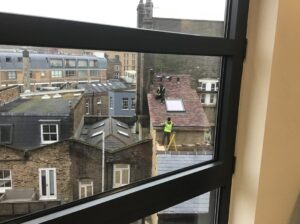
B&O Developers Ltd and one of its directors have been fined after workers were repeatedly exposed to falls from height during the extension and refurbishment of a hotel in King’s Cross, London. The Health and Safety Executive investigated after members of the public supplied photographs showing people working on the roof without adequate edge protection or a safe means of access.
The work took place at what is now the Kings Cross Express Inn on Kings Cross Road. Photographs sent to the regulator in January 2024 showed workers on the roof without appropriate protection against falling, while another image showed an operative using a makeshift platform balanced on a stepladder to gain access.
HSE found that workers employed by a roofing subcontractor had been exposed to fall risks on at least two dates. The subcontractor’s risk assessment had identified scaffolding around the roof as a control measure, but the specified protection was not in place when the unsafe activity was observed.
The prosecution followed a lengthy history of concern at the project rather than one isolated photograph. The construction programme ran from October 2020 until March 2024, initially with Hubb Construction Ltd acting as principal contractor before that role transferred to B&O Developers in March 2023.
Sanjay Swaminarayan remained involved as director after the principal-contractor change. HSE had already responded to several concerns raised by members of the public and people in neighbouring buildings between November 2021 and September 2023, taking enforcement action against both Hubb Construction and B&O Developers.
Inspectors also met Swaminarayan to discuss management arrangements and the measures required to achieve sustained compliance. Another report in January 2024 nevertheless resulted in photographs showing unsafe roof work continuing, giving the later prosecution a history of previous intervention that went beyond a first-time failure.
B&O Developers pleaded guilty to breaching Regulation 4(1) of the Work at Height Regulations 2005. At City of London Magistrates’ Court on 22 July 2026, the company was fined £4,020 and ordered to pay a £1,608 surcharge.
Swaminarayan also pleaded guilty to an offence under the Health and Safety at Work etc Act 1974. He was fined £2,300, ordered to pay a £1,108 surcharge, and told to pay £8,000 in costs.
HSE inspector Lucy Ellison-Dunn said: “The working practices of both the company and Swaminarayan put lives at risk.” The regulator’s evidence shows why the case was concerned with management as well as the immediate condition of the roof: the required controls had been identified, previous concerns had been raised, and enforcement activity had already taken place.
Falls from height remain one of the construction sector’s most persistent hazards. HSE says falls accounted for more than a quarter of all work-related deaths across industries in 2025/26, despite the control principles around roof access, edge protection, platforms, scaffolding, and supervision being long established.
The photographs in this case expose a familiar difference between producing a risk assessment and maintaining the controls it specifies. A document identifying scaffolding does little for an operative standing on an exposed roof if the scaffolding has not been installed, while a safe method of work cannot compensate for improvised access that introduces another fall risk before the worker reaches the workface.
Subcontracting does not make that management problem disappear. A principal contractor needs sufficient oversight to know whether the agreed method is being followed, particularly during short-duration or apparently routine tasks that can develop outside the main production sequence and receive less attention than larger work packages.
The involvement of neighbours and passers-by is also uncomfortable for site management. Unsafe work should normally be identified through supervision, inspections, worker reporting, or management systems inside the project. Where people outside the site repeatedly recognise a hazard serious enough to photograph and report, the failure has already become visible beyond the hoarding.
Work at height is rarely an area where the industry can claim the required precautions are novel or technically obscure. Edge protection, safe access, suitable work platforms, supervision, and adherence to the agreed method have been standard controls for years. The difficulty lies in making them remain standard when a programme is busy, a task is brief, or somebody believes an improvised arrangement will save a few minutes.
The fines arrive more than two years after the hotel project ended, but the prosecution records the consequences of failing to turn written controls and repeated regulatory intervention into sustained site practice. By the time the final photographs reached HSE, the question was no longer whether the risks were understood. They plainly were; the problem was that the controls still were not being maintained.