IN Brief:
- Deliveries of Volvo-branded machines rose by 14%, while order intake increased by 8%.
- Organic sales grew by 13% and the adjusted operating margin improved from 13.1% to 14.4%.
- European demand was supported by infrastructure investment, machine utilisation, and fleet-replacement activity.
Volvo Construction Equipment increased deliveries, order intake, organic sales, and adjusted operating profit during the second quarter of 2026 as infrastructure and fleet-replacement demand supported equipment markets.
Deliveries of Volvo-branded machines rose by 14% compared with the same period in 2025, while order intake increased by 8%. Organic sales grew by 13%, comprising a 14% increase in machine sales and 9% growth across services.
Reported net sales fell by 6% to SEK21.603bn from SEK22.906bn, principally reflecting the divestment of SDLG. Adjusted operating income increased to SEK3.114bn from SEK2.993bn, lifting the adjusted operating margin to 14.4% from 13.1%.
The figures separate the reported top line from the trading performance of Volvo CE’s continuing branded operation. Removing a substantial business reduced headline revenue even as the remaining machine and service activities expanded.
Order intake grew in North America, South America, Africa, and Oceania, but declined in Europe and Asia. European sales nevertheless reached SEK9.07bn, compared with SEK7.356bn during the corresponding quarter.
Volvo CE attributed European market demand to continuing infrastructure investment, healthy machine utilisation, and replacement purchasing. North American activity remained supported by data centres, energy infrastructure, and manufacturing investment, while mining and heavy civil work contributed to growth in several other regions.
The 9% increase in service sales offers a broader indication of fleet activity than new-equipment orders alone. Parts, maintenance, repair, connectivity, and service agreements tend to grow when machines are working regularly and owners place greater emphasis on uptime.
A stronger aftermarket contribution can also stabilise earnings during uneven replacement cycles. Contractors may postpone a machine purchase when confidence weakens, but they cannot indefinitely defer the work needed to keep existing equipment safe and productive.
The result sits alongside weaker confidence among European rental companies, showing that manufacturer performance and fleet sentiment can diverge. Large infrastructure and mining demand may sustain deliveries even while smaller rental businesses remain cautious about general construction workloads.
Equipment markets are becoming increasingly segmented by customer type and project. Energy, water, data-centre, industrial, and transport infrastructure programmes can support heavy-machine utilisation, while residential and smaller commercial work may generate a weaker pipeline for compact and general-purpose assets.
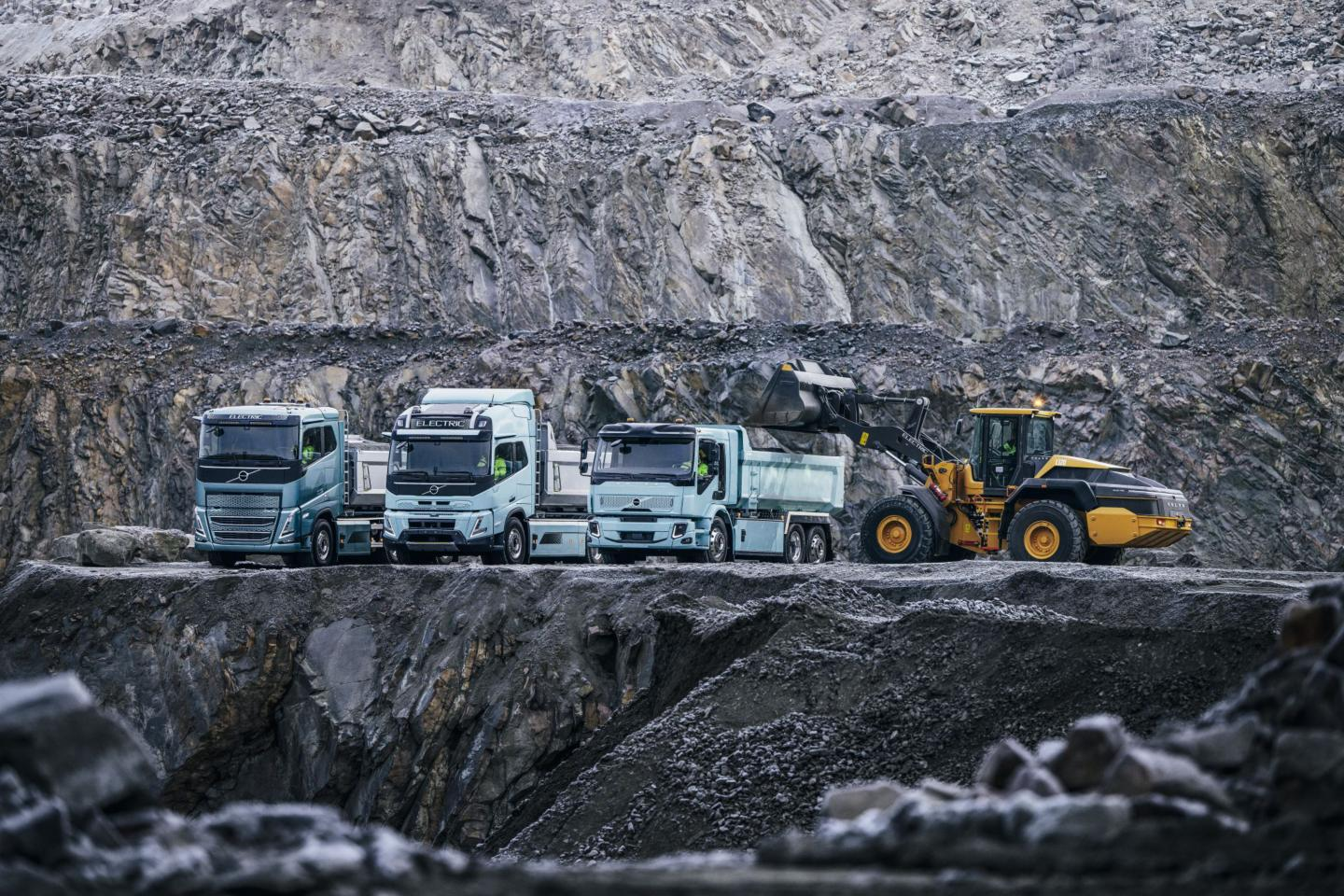
Volvo CE continued to invest in manufacturing and low-emission equipment during the quarter. Construction began on a new excavator factory in Eskilstuna, Sweden, supported by SEK700m of investment, while the first serial-produced A30 Electric articulated haulers were delivered to a customer in Norway.
Those commitments show electrification moving from isolated prototypes into production, although fleet adoption remains tied to charging capacity, power availability, duty cycle, utilisation, residual value, and the ability to redeploy an asset between sites.
Electric articulated haulers have a clearer early route into controlled projects such as quarries, mines, and major infrastructure sites, where haul roads, shift patterns, loads, and charging locations can be planned. Mixed fleets moving between short construction projects face more variable power and logistics.
Manufacturing investment must also be judged against the cyclical nature of equipment demand. New production capacity improves competitiveness where it can respond flexibly without creating excessive fixed cost during a downturn.
Factory utilisation and product mix will therefore remain important to margins. A plant designed around one machine class or regional demand profile may struggle if the market shifts more quickly than production can be adjusted.
The divestment of SDLG simplifies the interpretation of future results but changes Volvo CE’s regional and segment exposure. Comparisons with earlier periods will need to separate portfolio changes from underlying market movement.
European order intake falling while regional revenue rose may reflect timing between orders and deliveries, together with different demand across machine classes. A strong current quarter does not guarantee the same delivery rate later in the year if order books continue to soften.
Contractors and rental companies are also facing higher finance, insurance, labour, parts, and transport costs. Purchasing decisions increasingly rest on total cost of ownership rather than initial price, giving greater weight to fuel or energy use, uptime, service response, telematics, resale value, and attachment utilisation.
Volvo CE’s service growth suggests that the manufacturer is capturing more lifecycle activity. Connected machines and maintenance data can help schedule interventions and reduce unplanned stoppages, although owners will expect subscriptions and service costs to produce measurable availability gains.
The 14.4% margin gives Volvo CE capacity to continue product and factory investment despite uncertainty across parts of construction. The next reporting periods will show whether infrastructure-backed demand and service growth can offset weaker European order intake and changing conditions across Asia.
For the second quarter, the continuing business delivered higher machine volumes, stronger aftermarket growth, and improved operating returns, even though portfolio restructuring reduced the group’s reported sales figure.