IN Brief:
- Stevens Equipment Rental has taken two Cat 980 wheel loaders fitted with automatic emergency braking.
- Sensors and cameras can identify people or obstacles and apply the service brakes when the operator does not respond.
- Motion Inhibit prevents gear selection from stationary when a person or object is detected within the critical zone.
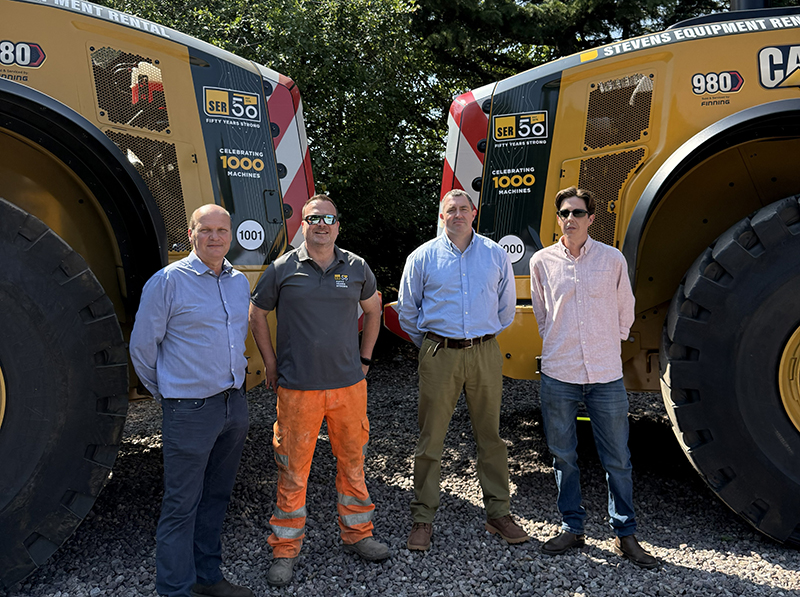
Stevens Equipment Rental has added two Cat 980 medium wheel loaders equipped with automatic emergency braking, becoming the first UK operator to deploy the safety system on Caterpillar’s 30.9-tonne model.
The machines mark the 1,000th and 1,001st new equipment purchases made by the company and have been finished in commemorative livery. Finning supplied both loaders with Cat Detect Automatic Emergency Braking, surround-view cameras, object and people detection, collision mitigation, payload weighing, and motion-inhibit technology.
Automatic emergency braking combines sensor data with camera recognition to identify a person or obstacle within a critical zone behind the loader. Where the operator does not respond, the system can apply the service brakes to reduce the likelihood or severity of a collision.
Motion Inhibit provides an additional layer of protection when the machine is stationary. If a person or object is detected within the defined risk area, the system prevents gear selection, reducing the chance of the loader moving into an occupied space as work restarts.
Stevens selected the package after operating a Cat 972 fitted with object detection and collision-mitigation technology during 2025. Experience from that machine informed the decision to extend the more advanced configuration across the two larger loaders.
The Cat 980 is designed for high-output loading and material-handling duties, where repeated reversing, restricted visibility, variable stockpile geometry, and interaction with other vehicles create persistent risks. The new machines will combine those applications with on-board payload measurement, allowing operators and site teams to monitor loading more accurately.
Weighing systems can reduce overloading and unnecessary passes while improving production records, although their value depends on calibration, operator use, and integration with wider site data. When paired with camera and detection systems, the loader becomes both a production asset and a source of information about movement, utilisation, and risk.
Heavy mobile plant remains one of the most hazardous elements of construction, quarrying, recycling, and materials operations. Segregated routes, exclusion zones, competent banksmen, lighting, and disciplined traffic plans remain the primary controls, but active systems can intervene when a person enters a danger area or an operator’s attention is divided.
The deployment follows a wider shift towards electronically assisted plant displayed across recent plant and technology launches at Hillhead, where manufacturers placed greater emphasis on machine control, connected fleets, operator assistance, alternative power, and safety systems.
Such equipment is moving beyond warning-only devices. Earlier proximity systems alerted the operator but left the response entirely to human judgement; newer platforms can restrict movement, reduce speed, or apply braking where defined conditions are met.
Intervention introduces its own engineering and operational questions. Sensors must perform in dust, rain, glare, darkness, vibration, and changing temperatures, while cameras need to distinguish people and objects without generating so many false alarms that operators lose confidence or attempt to bypass the system.
Sites will also need clear procedures for testing and maintaining the equipment. A camera obscured by mud, a damaged sensor, or an incorrectly configured detection zone can undermine protection, so daily inspections and planned maintenance must cover electronic safety systems alongside tyres, brakes, steering, and hydraulics.
Operator training remains essential because assistance technology does not remove responsibility for observation or safe manoeuvring. Drivers need to understand what the system can detect, how it behaves at different speeds, where blind areas remain, and what action to take after an intervention or fault warning.
For hire companies, the introduction of advanced safety packages creates both a commercial opportunity and a support obligation. Customers may increasingly specify active collision avoidance for busy sites, but machines must be handed over with suitable instruction, documentation, and settings for the intended application.
Standardisation will influence how quickly those requirements spread. Contractors operating mixed fleets face different interfaces, terminology, and capabilities across brands, making it harder to write consistent site rules or transfer operators between machines. Common expectations around testing, data, alarms, and intervention could reduce that variation.
Connected safety systems can also produce records that help managers identify repeated near misses or poorly designed traffic routes. Used carefully, those data can support changes to site layout and work planning, although employers will need proportionate policies covering monitoring, access, retention, and the interpretation of events.
The capital cost of the technology will be weighed against utilisation, insurance, client requirements, and the potential consequences of a collision. Larger quarry, infrastructure, and logistics sites are likely to adopt it first, particularly where loaders operate for long shifts in areas shared with vehicles and personnel.
By specifying the full package on two production machines rather than conducting a limited trial, Stevens is placing active intervention into day-to-day fleet use. Performance under real operating conditions will provide a practical measure of whether automatic braking can deliver dependable protection without disrupting the output expected from a high-capacity wheel loader.