IN Brief:
- Develon’s Real-X autonomous excavator has entered practical operation with KIBAG in Switzerland.
- The DX225LC-7X crawler excavator is working at a former quarry site in Tuggen without an operator in the cab or remote control.
- The deployment moves autonomous excavation from controlled demonstration toward repeatable use in live site conditions.
Develon has put its Real-X autonomous excavator into practical operation with KIBAG in Switzerland, moving driverless earthmoving from demonstration into a live quarry restoration environment.
The machine, a Develon DX225LC-7X crawler excavator fitted with the AI-powered Real-X system, is working at a former quarry site in Tuggen in the canton of Schwyz. KIBAG is using the excavator to dig a trench that will be filled with rocky material to stabilise the foot of a hillside.
The deployment is notable because the excavator is operating without an operator in the cab and is not being controlled remotely. Real-X has been developed by Develon in partnership with Gravis Robotics, a Swiss robotics company spun out from ETH Zurich.
KIBAG is one of Switzerland’s major building materials and construction companies, with operations across gravel pits, quarries, concrete plants, construction services, recycling, and waste management. Its fleet includes around 2,000 machines, with about 200 replaced each year to keep equipment current.
The current application is taking place on private land, allowing the autonomous machine to work under controlled supervision. That operating environment gives Develon and KIBAG a defined route to gather practical data while avoiding the regulatory complexity of autonomous machinery in public spaces.
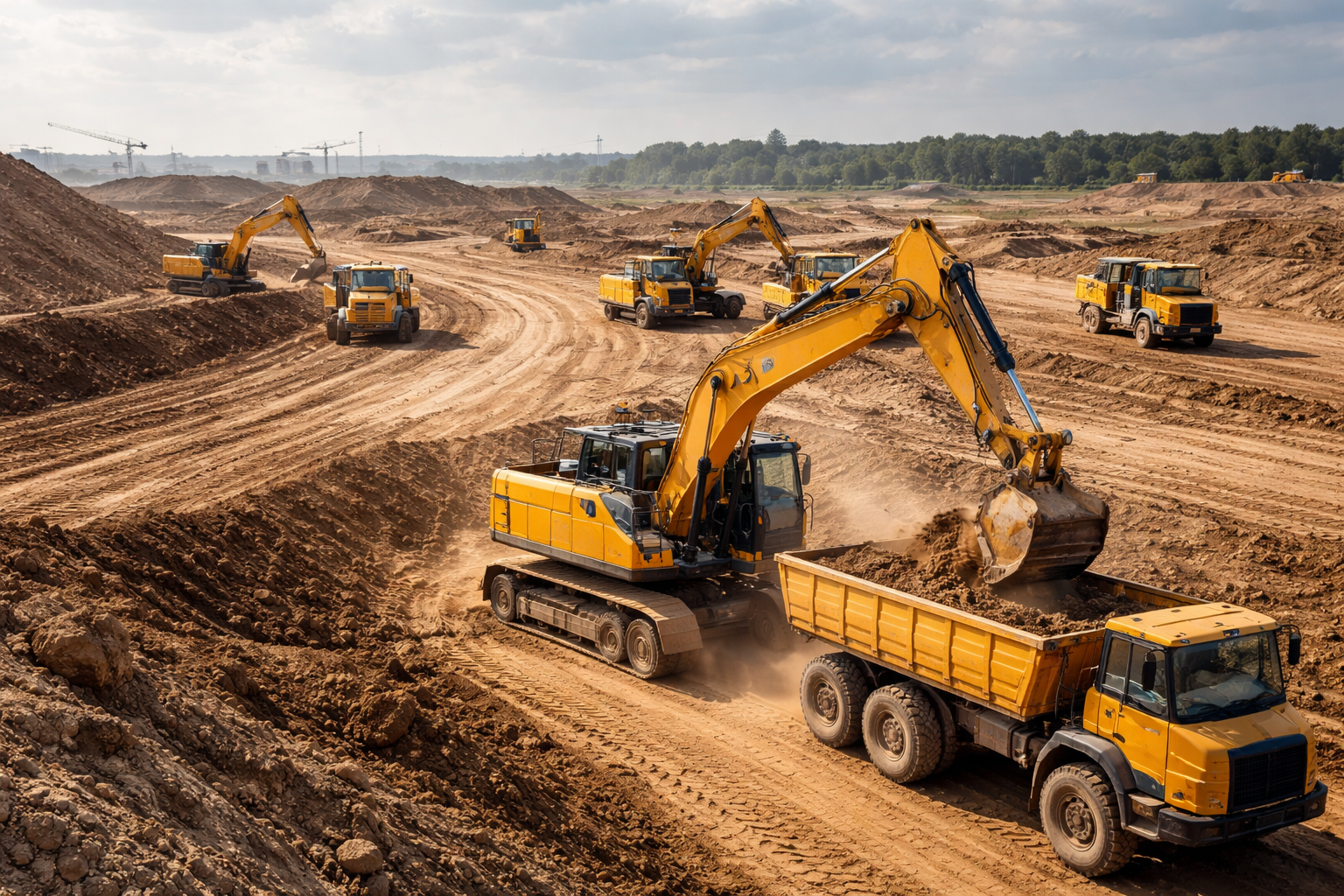
The excavator has been assigned to dig a trench around 300m long, six metres wide, and three metres deep. The work is repetitive, clearly bounded, and suited to autonomous control, making it a logical early use case for the system.
Autonomous excavation has progressed slowly because construction sites are difficult environments for robotics. Ground conditions change, people and machines move unpredictably, temporary works evolve, weather affects visibility and traction, and design information can change during the programme.
Early deployments are therefore likely to concentrate on defined, repeatable operations. Quarrying, bulk excavation, trenching, embankment work, and material loading offer more controlled conditions than dense urban sites. They also involve tasks where consistency, cycle time, and reduced operator exposure can produce measurable gains.
Develon’s development route began with Concept-X in 2019, when the company demonstrated an unmanned construction site using 5G, drone surveying, and autonomous machine control. Concept-X2 followed in 2023, before Real-X was introduced at bauma 2025.
The system was also demonstrated at Develon Demo Days in the Czech Republic, where the company launched new smart excavator models and showed autonomous trenching to customers, dealers, and media. That European demonstration sat alongside the launch of Develon’s smart excavator line, while the Swiss deployment places the technology into a working operational setting.
The commercial test will extend beyond removing an operator from the cab. Contractors and fleet owners will assess productivity, safety, fuel use, supervision requirements, uptime, training, maintenance, insurance, and compatibility with existing site management systems. A machine that requires constant intervention will struggle to justify its cost; one that can repeat defined tasks under light supervision could change fleet planning.
Safety will remain central to adoption. Autonomous earthmoving systems need reliable positioning, perception, obstacle detection, exclusion-zone management, supervision, and fallback procedures. Those requirements point toward controlled work zones, technical supervisors, private sites, and clearly defined tasks during early deployment.
The KIBAG project also sits within a broader evolution of construction equipment. Manufacturers are adding machine control, AI assistance, telematics, electric powertrains, visibility systems, collision avoidance, digital service tools, and semi-autonomous functions alongside traditional measures of power, reach, hydraulic performance, and fuel efficiency.
Fleet selection is becoming more technology-led as a result. Contractors are no longer choosing only between machine size and attachment options; they are weighing data, automation readiness, digital support, operator availability, and long-term productivity. That shift will be gradual, but it is already changing how plant manufacturers present their next generation of equipment.
For Develon, Real-X gives the company a visible position in one of the most closely watched areas of construction technology. For KIBAG, the project provides a controlled route to test autonomy within a large active fleet. For the wider market, the deployment shows that autonomous excavation is beginning to move from exhibition halls into practical, task-specific site work.