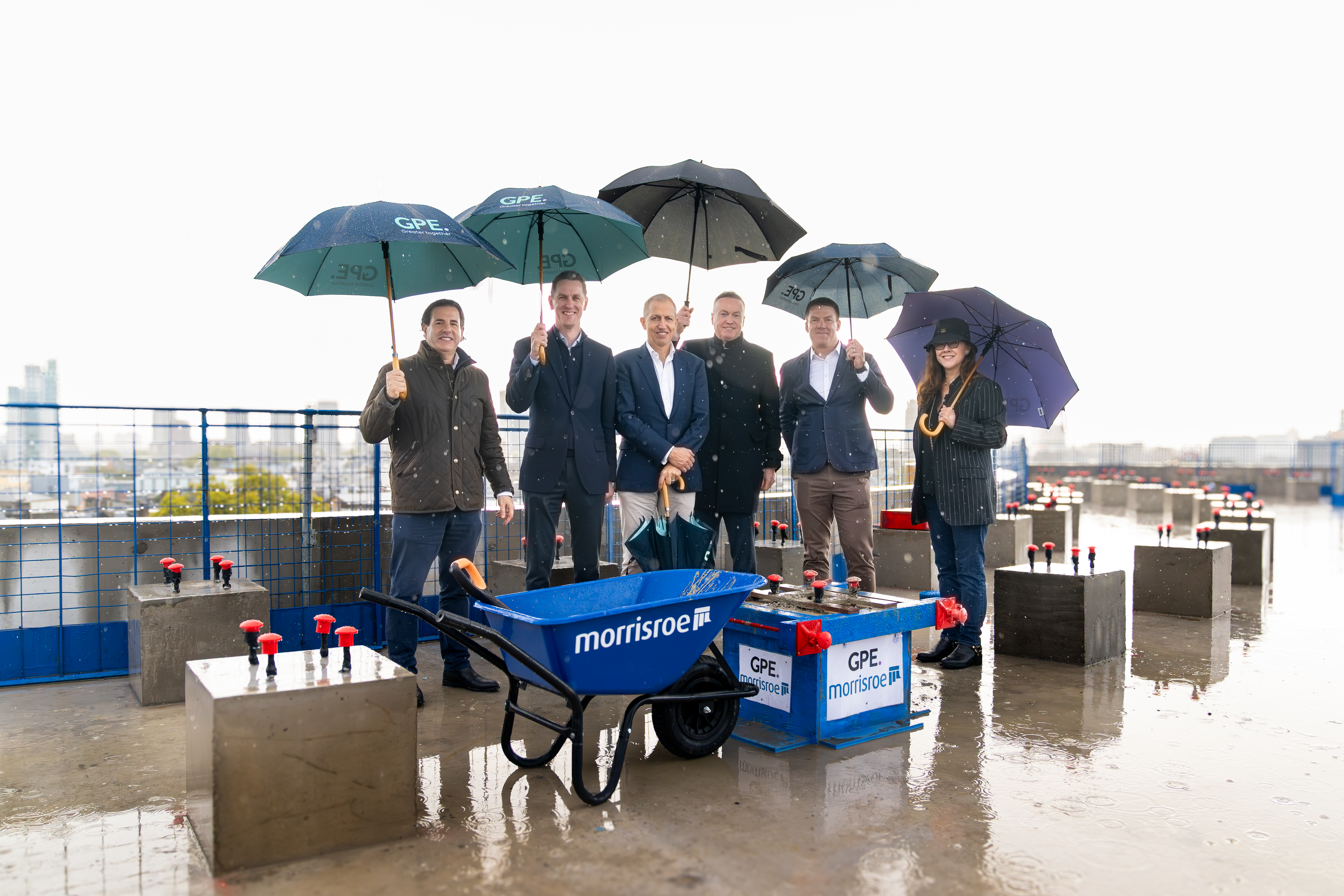
IN Brief:
- GPE has reported a £14 million cost increase on the Minerva House refurbishment in London.
- The increase has been attributed to site complexities and supply chain failures.
- The scheme remains part of a wider push to deliver premium, lower-carbon office space through major refurbishment.
Great Portland Estates has reported a £14 million cost increase on its Minerva House refurbishment in London, with site complexities and supply chain failures adding pressure to one of its major committed development schemes.
The project, also known as The Delft, is a comprehensive refurbishment of the former Minerva House building on the South Bank. It is designed to deliver around 143,000 sq ft of premium office space, increasing the building’s previous area by approximately 56% while retaining a substantial portion of the existing structure.
GPE has previously said the scheme will retain and reuse more than 70% of the existing fabric. The project also incorporates circular economy measures, including the salvage of 20 tonnes of glass for reuse in new products. Once complete, the building is intended to make better use of its Thames frontage, with additional storeys, terraces, amenity space, and improved public realm around the site.
The cost movement puts a familiar pressure point back in view. Deep refurbishment can reduce embodied carbon and support planning arguments in dense urban locations, but it also changes the delivery risk profile. Retained structures carry hidden conditions, awkward interfaces, uncertain tolerances, and sequencing constraints that are often harder to resolve than a conventional new-build frame.
Supply chain performance adds further exposure when major refurbishment relies on tightly connected packages. Demolition, structural intervention, façade replacement, M&E installation, fit-out, logistics, and public realm works often need to move through restricted sites with limited programme slack. A failure in one package can quickly move into preliminaries, resequencing, design coordination, and cost forecasts.
London’s premium office market continues to support high-quality refurbishments, particularly where occupiers want energy performance, amenity, location, and ESG credentials without moving into entirely new stock. The commercial case can be strong, but it depends on unusually disciplined delivery. Developers are trying to reuse buildings while upgrading them to a standard that often exceeds their original structural and services assumptions.
Large South Bank schemes are already showing how much coordination that shift requires. At Vista, the former ITV Studios redevelopment, constrained-site delivery, public realm, commercial specification, and city-centre logistics are all part of the construction equation. Minerva House sits in the same broad market of complex urban renewal, where location value and delivery difficulty rise together.
The refurbishment agenda is now central to London’s commercial construction market. Planning pressure, embodied-carbon concerns, occupier expectations, and limited prime sites all favour reuse where a viable route can be found. Yet reuse still demands the controls of a major new-build programme, from early intrusive surveys and supply chain selection to contract risk allocation and contingency planning.
Minerva House demonstrates the difference between a low-carbon strategy and a low-risk project. Retaining fabric can be the right answer, but it rarely removes uncertainty. It often moves that uncertainty into hidden connections, old structures, procurement sequencing, and specialist interfaces, where the cost plan has to be strong enough to absorb what the existing building reveals.