IN Brief:
- OPDC has agreed heads of terms for a public land agreement covering around 70 acres at Old Oak.
- The west London scheme is planned around 8,000 homes, 200,000 sq m of commercial and community space, public realm, parks, and canal improvements.
- A two-stage procurement process will seek a private sector partner, with selection expected by spring 2027.
Old Oak and Park Royal Development Corporation has begun the search for a private sector partner to deliver one of the UK’s largest brownfield regeneration programmes, after securing agreement on a major public land deal in west London.
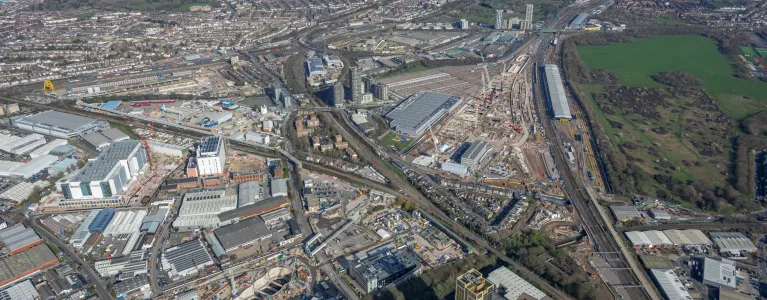
The heads of terms bring together land owned by OPDC and the Department for Transport into a single development platform of around 70 acres. The site sits around Old Oak Common station, which will connect HS2, the Elizabeth line, the Great Western Main Line, and Heathrow Express, giving the district one of the strongest transport positions of any regeneration zone in the capital.
Plans for the area include around 8,000 homes, including affordable homes, alongside up to 200,000 sq m of commercial and community space. OPDC is also planning new public realm, two parks, green space, and improvements to around 1km of canal frontage, with the wider programme projected to support 11,000 jobs.
A two-stage procurement process will now be used to select a long-term development and investment partner. The tender notice is expected to be made available through the Old Oak procurement page and the government’s Find a Tender Service, with a preferred partner due to be selected by spring 2027.
The agreement follows £340m of Ministry of Housing, Communities and Local Government funding used by OPDC to assemble privately owned sites across Old Oak. That land assembly work is central to the delivery proposition, as fragmented ownership would have made infrastructure, phasing, utilities, public realm, housing, and commercial development harder to sequence across a site of this scale.
Old Oak will demand a long sequence of enabling works, remediation, logistics planning, transport interfaces, utilities coordination, and plot-by-plot development. The location brings the advantage of major rail connectivity, but it also carries the complexity of building around live railway assets, infrastructure corridors, existing industrial land, canalside edges, and neighbouring communities.
The scale of the procurement follows a wider push by public-sector landowners to use strategic frameworks and partnership models to improve delivery certainty. LHC Procurement Group’s £1bn housing, regeneration, and demolition framework has taken a similar route in a different part of the market, connecting housing delivery with demolition, remediation, enabling works, and estate renewal rather than treating those activities as separate preparatory packages.
Old Oak’s governance and land structure give it a different profile, although many of the same pressures are present. Housing targets, infrastructure upgrades, construction inflation, planning complexity, and skills constraints will all shape the speed at which the opportunity moves from partner appointment into live work packages. A single joint-venture partner should give the site clearer commercial accountability, but the physical delivery will still depend on sequencing dozens of interdependent packages over many years.
The commercial element also broadens the construction mix. OPDC is positioning Old Oak as a hub for technology, research, business, and community uses, rather than simply a housing extension around a new station. That brings offices, public buildings, ground-floor uses, highways, utilities, and social infrastructure into the programme alongside residential development.
The next milestone will be the procurement launch and the level of market appetite it attracts. Strong bids will need to demonstrate financial capacity, delivery experience, placemaking credibility, and the ability to manage long-term development risk in a location where infrastructure and real estate will have to advance together.