IN Brief:
- Tilbury Douglas says it has deployed a humanoid robot on a live construction site.
- The machine is being used for 360-degree imagery, progress reporting, and support for health and safety monitoring.
- The trial extends the shift toward mobile, task-based site automation beyond drones and fixed cameras.
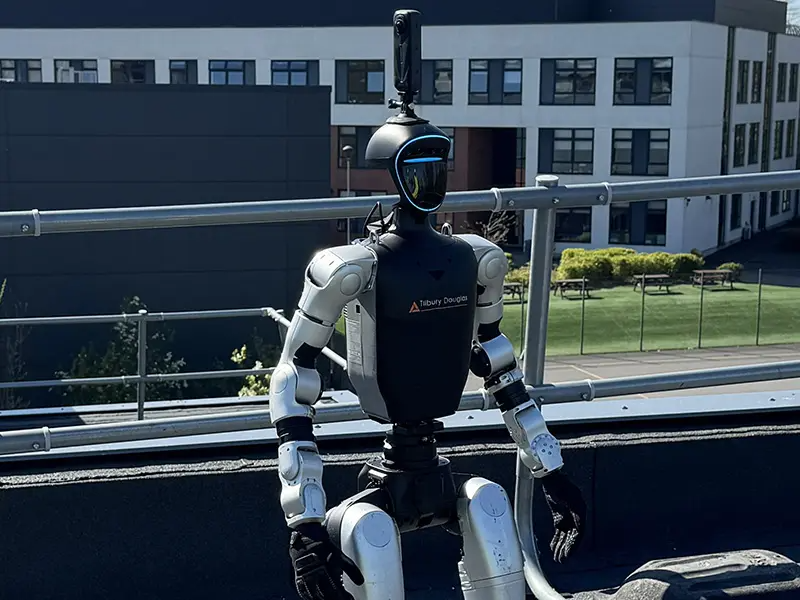
Tilbury Douglas has introduced a humanoid robot on a live construction site, using the machine to handle routine data-collection tasks such as progress imagery and site reporting in a move that pushes site automation into a more visible phase.
The robot, named Douglas, is being used to navigate site environments autonomously and capture 360-degree imagery alongside detailed progress information. The same data stream is also intended to support health and safety monitoring and associated reporting processes. Tilbury Douglas has said the trial could save around 40 hours a month by taking repetitive administrative tasks away from site teams.
The trial is focused on a practical set of tasks rather than an attempt to automate trade work. That makes it easier to see where the potential sits. Construction sites generate a constant flow of information, and gathering it consistently can be difficult when teams are already stretched across coordination, logistics, client reporting, quality, and compliance. A mobile device that can follow regular routes, capture structured imagery, and feed repeatable records into project systems addresses a familiar operational gap.
Construction has already absorbed drones, progress cameras, digital snagging tools, mobile inspection software, and common data environments into everyday use. A humanoid robot is more conspicuous, but it sits within the same pattern: the steady push toward cleaner operational data and less manual site administration. If the technology proves reliable, its appeal is likely to rest on consistency and integration rather than novelty.
Reliability will decide whether the trial progresses. Sites remain dynamic, cluttered, and difficult environments for autonomous systems. Weather, access restrictions, changing layouts, temporary works, and variable lighting all complicate autonomous movement and repeatable capture. Any robotic platform deployed in that environment will be judged on whether it performs safely and predictably without adding more supervision burden than it removes.
The next challenge is integration with site workflows. Capturing images and progress data is only useful if teams can retrieve that information easily, trust the output, and use it without duplicating work elsewhere. That means the success of systems like this depends as much on software links, reporting structures, and site management practices as on the robot itself.
Scale is the other test. A single-site trial can demonstrate whether the technology works in principle, but portfolio-wide adoption requires a stronger case on maintenance, hardware resilience, training, cost, and measurable time savings across different project types. That is where many construction technology pilots either mature or fade away.
Tilbury Douglas’s deployment still stands out because it places a mobile robotic platform directly into a live production environment for routine project tasks. Site digitisation has long been discussed as a software story. Increasingly, it is becoming a physical one as well.