IN Brief:
- Planning approval clears a £16.5m overhaul of the Grade II* market hall and surrounding public realm.
- The scheme combines heritage restoration with a new mix of permanent and demountable trading space.
- Temporary relocation and site preparation now move into focus ahead of main refurbishment works.
Kirklees Council has secured planning approval for a £16.5m overhaul of Huddersfield Market, advancing one of the most visible pieces of town-centre regeneration now moving through Yorkshire. The approved plans cover the Grade II* listed market hall and surrounding streetscape, with the scheme intended to modernise the operation of the market while protecting the historic structure that gives it much of its character.
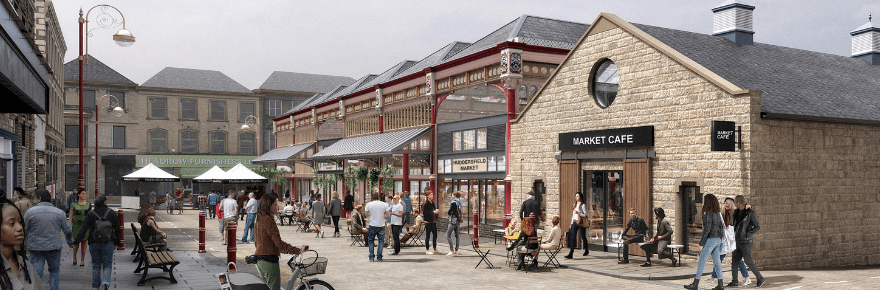
The project has been developed with Greig & Stephenson Architects and is designed to change how the market trades through the week, not simply how it looks. The revised layout provides more than 87 indoor pitches, including 12 permanent stalls with built-in services and more than 75 larger demountable units, while the external trading arrangement expands into the Market Yard and surrounding streets. That combination points to a more flexible operating model, with the council trying to give traders more usable space while also creating room for events, temporary uses, and a wider programme through the year.
The external arrangements are equally significant. The Market Yard is set to accommodate 52 demountable pitches, with additional provision on Brook Street and Byram Street. For a local authority scheme, that signals a move away from treating the market hall as a single enclosed asset and towards a broader public-realm trading environment, one that can respond more directly to seasonal footfall, food-led events, and changing demand for smaller retail units.
On the building side, the approval also opens the way for substantial restoration work to the market’s decorative cast-iron frame and roof. Reinstating the original colour palette is a heritage detail, but it is also part of the commercial proposition. Councils are increasingly using restoration not as a separate conservation exercise, but as a way to reset the identity of older civic assets and make them legible again within a crowded town-centre offer. In Huddersfield, that is especially relevant because the market sits within a wider programme of change rather than as a standalone refurbishment.
The next phase is expected to focus on site preparation and the setup of a temporary market, with traders due to be relocated before the main refurbishment begins. That transition phase will be one of the more delicate parts of delivery. Market projects rarely fail on design intent; they fail when continuity of trading is lost, tenants drift away, or the build programme severs the relationship between traders and passing footfall. The temporary arrangement therefore matters almost as much as the permanent one, because it will shape whether the market returns from the works with momentum or with gaps to refill.
There is also a broader construction story behind the approval. The sector has seen a steady flow of civic regeneration schemes built around libraries, markets, food halls, and other public assets that once looked operationally obsolete. What distinguishes the stronger examples is not nostalgia but adaptability: more flexible services, a more mixed day-to-evening economy, and a layout that can host trading, events, and short-term uses without repeated physical alteration. Huddersfield follows that pattern closely.
For contractors and suppliers, the scheme sits at the intersection of heritage repair, fit-out, public realm, and phased occupation planning. That usually means tighter coordination, more interfaces, and less tolerance for disruption than in a clean new-build programme. It also means projects like this tend to reward teams with experience in occupied environments and civic stakeholders, where logistics, communication, and sequencing carry as much weight as the visible construction package. If the delivery phase holds together, Huddersfield Market will become a useful test of how far local authorities can push heritage-led trading spaces into a more commercially resilient model without stripping away the qualities that made them worth saving in the first place.