IN Brief:
- Esh Construction has installed the first timber frames at the Amberley & Harrogate development in Sunderland.
- The £23m scheme for Thirteen Group will deliver 96 affordable homes, including houses and bungalows.
- The programme combines brownfield regeneration, timber-frame delivery, and solar-equipped homes in a part of the market still under pressure to accelerate output.
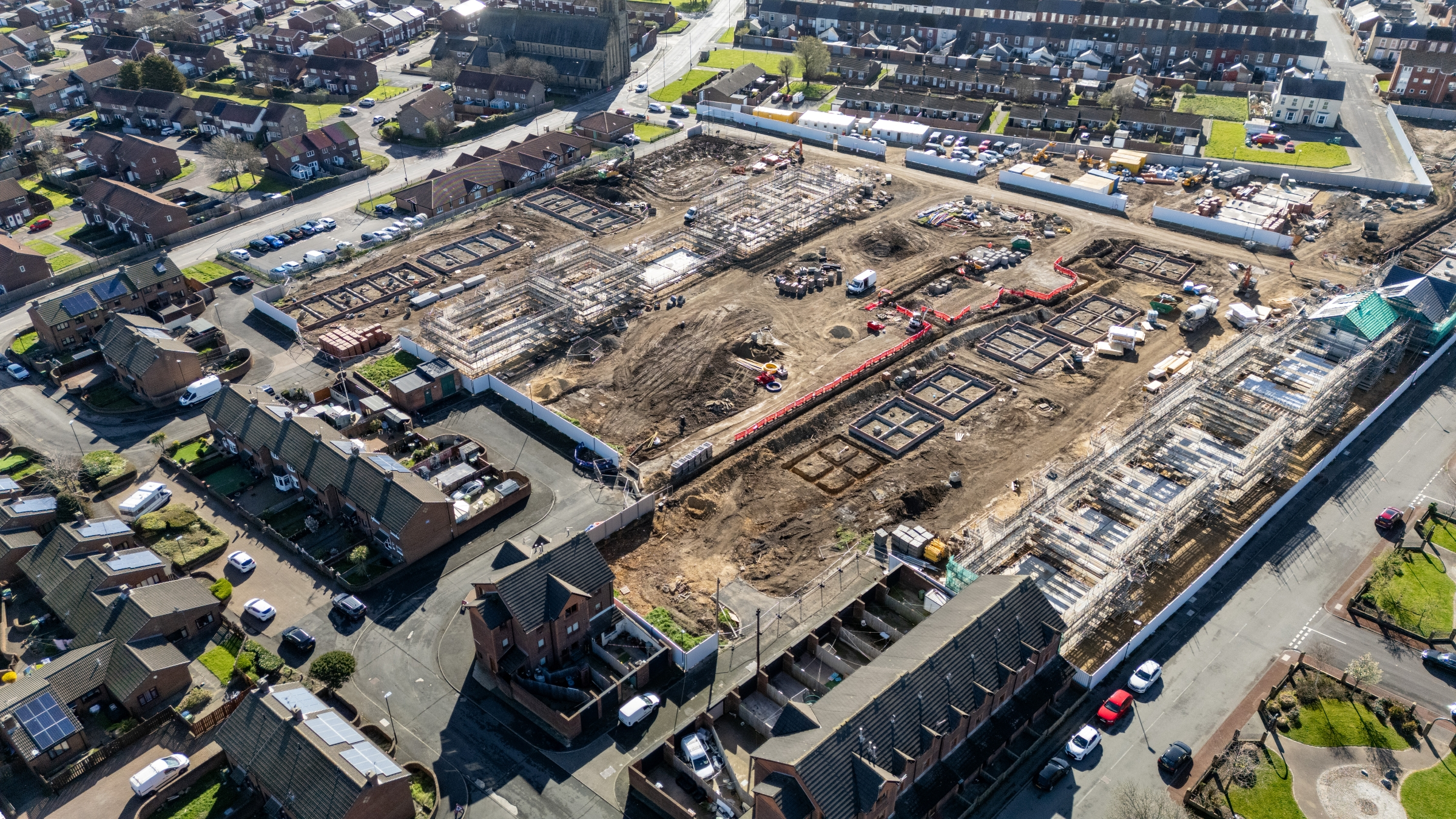
Esh Construction has installed the first timber frames at the Amberley & Harrogate affordable housing scheme in Sunderland, marking a visible step forward on a 96-home development being delivered for Thirteen Group.
The Hendon project will provide 75 two-, three-, and four-bedroom houses alongside 21 two-bedroom bungalows, with the first homes due to be handed over from October 2026 and the full scheme scheduled for completion in spring 2028. Timber frames and roofs have now been installed on four plots, while a further 65 foundations have been slabbed and poured as the contractor works towards completing all foundations this summer.
Site activity is expected to intensify over the coming weeks. Infrastructure works are nearing completion, first-fix trades are due to begin, windows are being installed, and plumbers, electricians, and bricklayers are moving further into the programme. The development is entering the stage where progress becomes more visible on site and where the benefits and risks of the chosen build system start to show themselves more clearly.
Every home on the scheme will be fitted with solar panels, reflecting the extent to which lower operational energy demand is now being built into affordable housing delivery as standard rather than treated as an optional extra. The project is also being supported by Homes England, the North East Mayor, Sunderland City Council, and the charity Back on the Map, pointing to the multi-agency model that increasingly underpins urban housing regeneration of this type.
That wider context matters. Affordable housing delivery has become more demanding for registered providers, local authorities, and contractors alike. Build-cost pressure has eased in some areas compared with the sharp inflation seen in recent years, but programme certainty, funding assumptions, labour availability, and compliance costs all remain live issues. Against that backdrop, projects that have moved through land, funding, design, and pre-construction hurdles into active delivery carry more weight than their headline value alone might suggest.
The use of timber frame is part of that story. Off-site and panelised systems are not a cure-all, and they still depend on strong design coordination, moisture control, logistics planning, and experienced installation teams. But they continue to attract attention in affordable housing because they can support faster enclosure, more predictable sequencing, and better control over fabric performance when the site set-up is right. At Amberley & Harrogate, the move from foundations into frame erection marks the point where those advantages can begin to influence the live programme.
There is also a place-based dimension. The site has stood vacant for years, and its redevelopment carries an obvious regeneration value beyond simple housing output. Brownfield housing is often discussed in strategic terms, but on site it still comes down to whether land can be unlocked, serviced, and delivered at viable pace. Projects like this show how that process often depends on collaboration between housing associations, funding bodies, local authorities, and contractors prepared to deal with the constraints that cleared urban land can still present.
The mix of homes is worth noting too. Output is often measured in total unit numbers, but product mix matters, particularly where local demand includes older residents, smaller households, or people who need more accessible accommodation. Combining family housing with bungalows broadens the scheme’s usefulness and reflects a more grounded reading of local need than a uniform house-type schedule would provide. For now, the immediate story is one of momentum. Foundations are well advanced, the first frames are up, and the site is moving into the stage where delivery intent starts to become visible stock.