IN Brief:
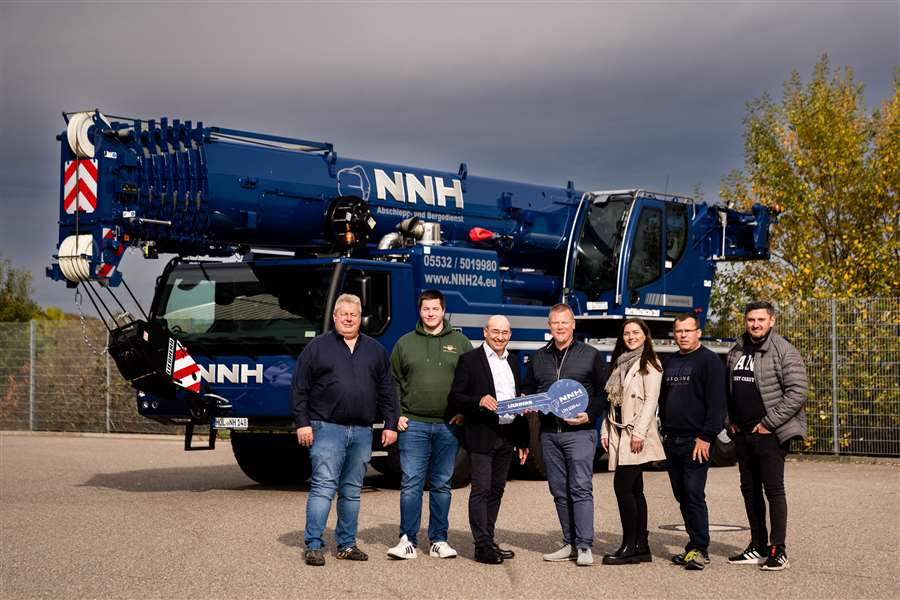
- NNH has taken delivery of a Liebherr LTM 1120-4.1 to strengthen its position in the 120-tonne class.
- The crane replaces an older 100-tonne unit and is intended for industrial assembly, steelwork, precast installation, and machine relocation.
- Its 66-metre telescopic boom and compact four-axle design are intended to widen job access where space and transport efficiency matter.
NNH Niedersächsischer Nutzfahrzeug-Handel has added a Liebherr LTM 1120-4.1 to its fleet, pushing the business into a stronger position in the 120-tonne segment as demand grows for higher-capacity lifting on industrial and space-constrained sites.
The new crane sits in a part of the market where operators are increasingly looking for the reach and performance once associated with larger machines, but without the transport and access burden that comes with moving up another axle class. For NNH, that calculation appears central. The LTM 1120-4.1 replaces an older 100-tonne crane, giving the company more lifting capacity and a longer working envelope without sacrificing the compact footprint of a four-axle carrier.
Liebherr says the crane was selected for its 66-metre telescopic boom, high load capacity, and compact design. That boom length is a standout figure in its class and helps explain the machine’s likely workload. NNH says the crane will mainly be used for industrial assembly, steel and hall construction, precast concrete installation, and machine relocation — all applications where reach, set-up flexibility, and quick repositioning matter as much as headline tonnage.
The model is also designed for difficult site geometry. Liebherr’s VarioBase and VarioBallast systems allow the crane to adapt outrigger and ballast configuration to restricted working conditions, improving flexibility where full-width set-up is not possible. That is particularly relevant on live industrial premises, urban infill work, and projects where surrounding structures or traffic management limit available operating space.
Performance-wise, the LTM 1120-4.1 was developed to stretch the four-axle class upward. Liebherr has previously described it as the most powerful four-axle all-terrain crane it had built at launch, and says it can lift nine tonnes on the full 66-metre telescopic boom. With lattice extensions, the machine can reach hook heights of up to 94 metres. Those characteristics make it suitable for duties such as erecting tower cranes, installing steelwork, and handling heavier components at height without immediately defaulting to a five-axle machine.
That shift is part of a wider fleet logic seen across the crane market. Operators are under pressure to keep transport, permitting, and mobilisation costs under control, especially for shorter-duration jobs. A high-performance four-axle crane can therefore become a useful compromise — large enough to tackle more demanding lifts, but still compact enough to access sites where a bigger machine becomes a problem before it even starts work.
For NNH, the fleet move is straightforward: more reach, more flexibility, and a stronger offer in a busier capacity band. For the wider market, it is another sign that compact high-performance cranes continue to take work that might once have been reserved for heavier, less agile plant.