IN Brief:
- Polypipe Building Services has invested across automation, moulding, and extrusion at its Aylesford plant.
- The programme includes six-axis and Cartesian robots, plus AI-based vision inspection for parts counting and defect detection.
- Output has increased on a 24-hour, five-day production cycle, with the company keeping staffing levels unchanged.
Polypipe Building Services has stepped up automation at its Aylesford production site in Kent as UK building product manufacturers continue to look for higher throughput, tighter quality control, and more stable domestic supply in a market still shaped by labour pressure and variable demand.
Recent investment at the plant totals £7 million, made up of £1.5 million in automation technology, £3 million in moulding machinery, and £2.5 million in extrusion equipment. The scale of that spend suggests a capacity and process-control project rather than a narrow line upgrade, with the manufacturer aiming to improve responsiveness as site demand shifts between sectors and programmes.
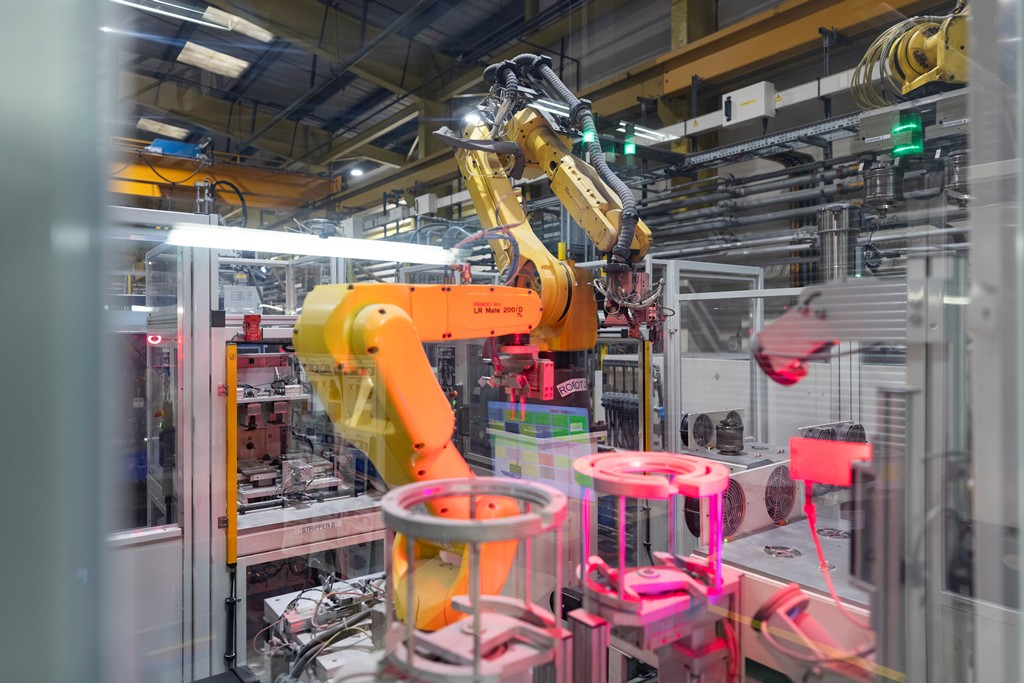
The operational changes are specific. Aylesford now uses six-axis and Cartesian robots to automate elements of production and packaging, while an IV4 AI vision camera has been added to inspect output before dispatch. The system is used to count parts and identify dimensional variation, ovality, and moulding defects, bringing inspection closer to the production line rather than relying solely on downstream checks.
That matters because plastic pipe and ventilation products sit in a category where consistency, repeatability, and lead-time performance are critical. Small deviations in geometry or finishing can create installation issues later on site, particularly where systems need to align precisely with fittings, brackets, or prefabricated assemblies. Automated inspection is therefore doing more than replacing manual counting — it is also tightening process discipline and reducing the chance of defective product moving into distribution.
The plant is operating on a 24-hour, five-day production cycle, and the company says the latest investment has allowed output to rise without increasing staffing levels. That is a notable detail in a manufacturing market where skills shortages remain stubborn and where labour constraints can cap expansion even when demand is present. In this case, the automation push appears aimed at using existing labour more effectively, shifting staff away from repetitive handling and basic inspection toward more technical and supervisory tasks.
There is also a supply chain aspect to the development. For UK construction, domestic capacity still matters in categories exposed to freight volatility, imported resins, and fluctuating lead times. Greater throughput at a UK plant does not remove those pressures altogether, but it can reduce reliance on long logistics chains and improve a manufacturer’s ability to respond to sudden demand changes across projects or merchant networks.
The broader significance is that automation in building products is moving beyond isolated robotic cells and into joined-up production, packaging, and quality systems. At Aylesford, Polypipe is using that model to build more output and more control into the same footprint. In a market where availability, consistency, and speed still shape purchasing decisions, that is a practical industrial upgrade rather than a cosmetic technology story.