IN Brief:
- Groundwater drilling in Yeosu is moving beyond typical 50–150 m wells as demand rises.
- A 30 bar portable compressor is being used to maintain airflow and hammer performance in hard rock.
- Faster deep-well cycles are tightening programmes without increasing hourly operating costs.
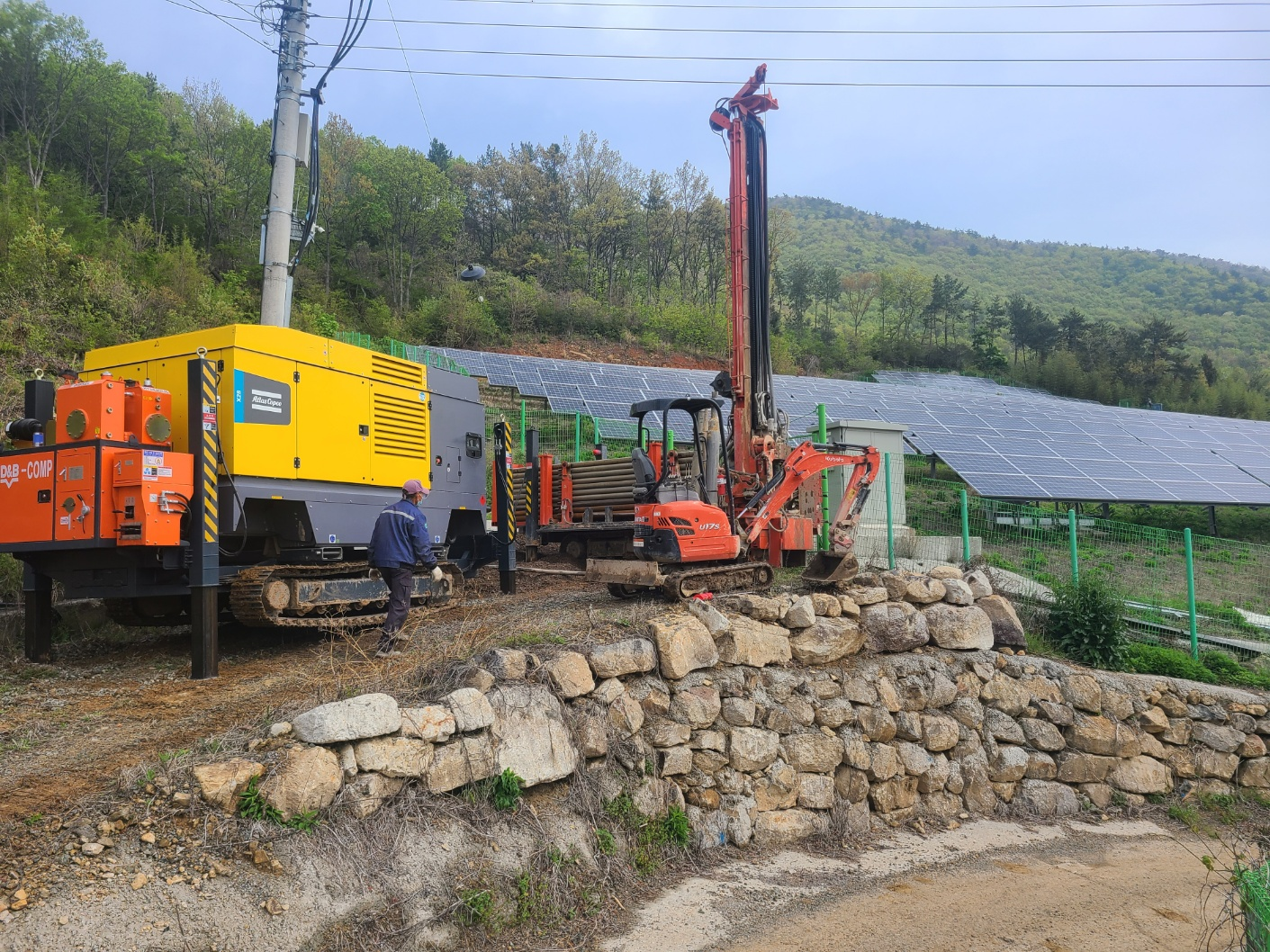
Securing reliable groundwater is pushing waterwell contractors in South Korea towards deeper boreholes, particularly in regions where shallow wells are no longer providing stable yield across domestic, agricultural, and industrial demand. In Yeosu, where mountainous topography and hard rock layers are common, local drilling specialist Yeosu Jonghap Jihasu has introduced Atlas Copco’s X28 portable air compressor to support deeper work while keeping equipment manoeuvrable on constrained sites.
In the Yeosu area, waterwell depths are commonly cited in the 50–150 m range, but contractors are increasingly asked to drill beyond that — often through abrasive formations where pressure loss and reduced flushing can slow penetration rates. Yeosu Jonghap Jihasu previously operated a 25 bar, 900 cfm compressor, but said losses in hard rock extended drilling time and made deeper wells harder to programme with confidence.
The company’s changeover is centred on moving to 30 bar operation for down-the-hole hammer drilling and cuttings evacuation at depth. Atlas Copco’s DrillAir X28 is rated for a 16–30 bar working pressure range, with a nominal flow of 29.04 m³/min (484 l/s) at 30 bar, and is offered in towable and support-mounted configurations for drilling logistics. Yeosu Jonghap Jihasu said the higher pressure has translated directly into cycle time: “With the X28, our drilling speed nearly doubled even in deep, hard-rock layers,” said Hongseok Yeom, CEO of Yeosu Jonghap Jihasu.
That performance shift is being measured in metres per shift rather than incremental gains, with the contractor indicating that reaching 300 m has become a routine target in its current workflow. Alongside pressure capability, the contractor has pointed to stable airflow as a practical limiter in deep rock, where inefficiencies show up quickly as slower hammering, poorer cuttings lift, and longer periods spent cleaning the hole.
Site access remains a constraint in the coastal, mountainous terrain around Yeosu, where drilling rigs and support equipment often need to be positioned on narrow roads, slopes, or agricultural plots with limited turning space. In that context, Yeosu Jonghap Jihasu has linked productivity gains to a combination of pressure headroom and site practicality, reporting that drilling 100 m now takes around 2.5–3 hours, compared with roughly five hours previously.
The company has also highlighted the role of the compressor’s electronic control system in long drilling runs, particularly for monitoring operating conditions and reducing unplanned stops caused by overheating or instability during sustained high-load operation. Atlas Copco framed the package as purpose-built for deep-well use: “With its high pressure and smart controls, the X28 is designed for exactly these types of deep well applications,” said Jaehoon Ahn, Product Marketing Specialist, Atlas Copco Korea & Japan.
For contractors running extended borehole programmes, reliability is often as valuable as peak performance, especially when deep wells tie up rigs for longer and breakdown recovery can be slow in remote terrain. “Contractors depend on equipment that performs reliably in the field,” said Moosun Park, Business Line Manager, Atlas Copco Korea & Japan. In Yeosu, the contractor’s focus is now on treating >300 m drilling as standard scope, with the compressor’s pressure capacity and monitoring features positioned as core tools for maintaining predictable drilling rates in hard rock.