IN Brief:
- Aviva analysis links a share of new homes to mapped flood risk.
- MHCLG says policy requires developments to be safe over their lifetime.
- Government points to planning tests, flood defences, and updated guidance.
The Ministry of Housing, Communities & Local Government (MHCLG) has responded publicly to an insurer report that claimed a significant proportion of new UK homes are at risk of flooding, disputing both the framing and the underlying assumptions used in the analysis.
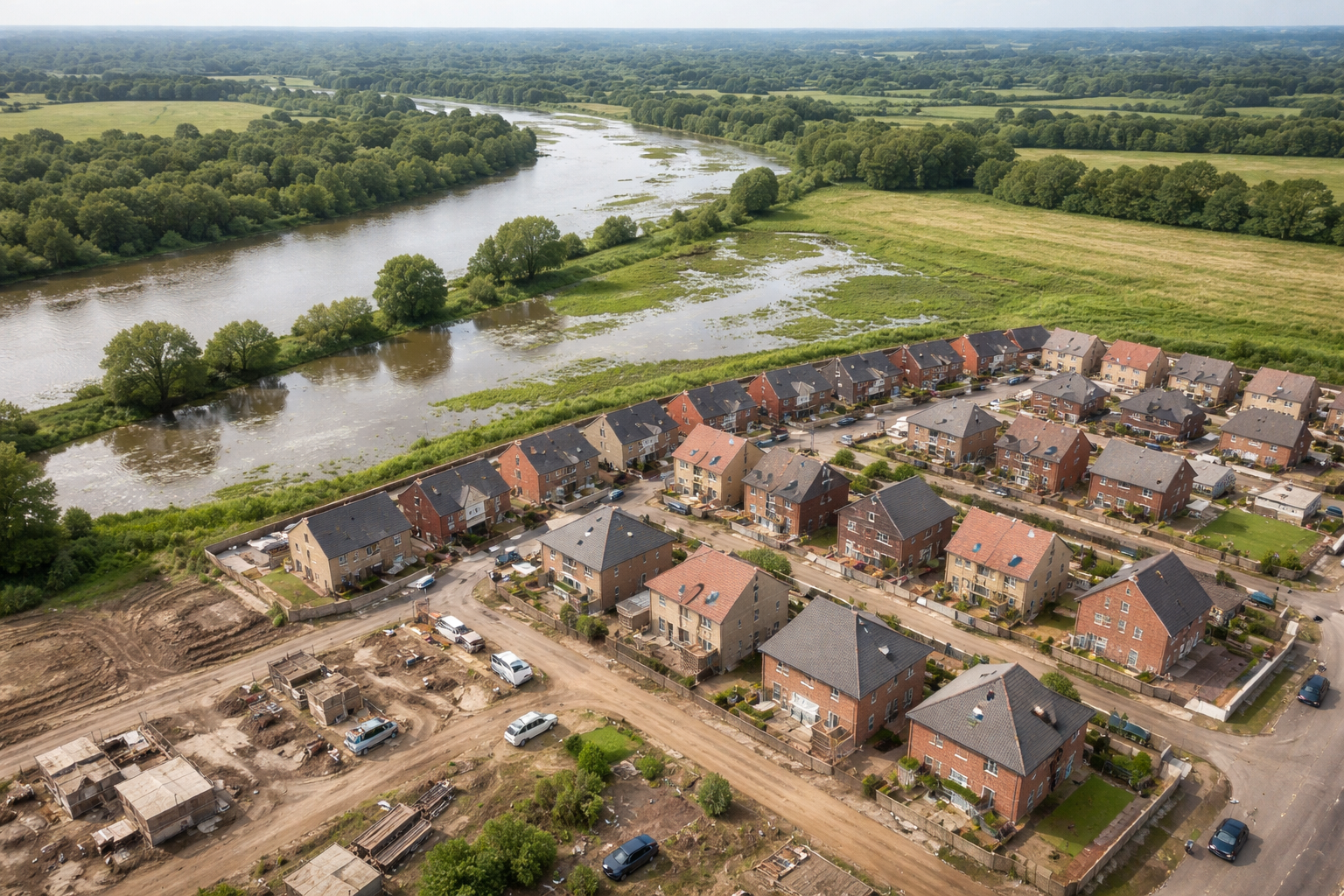
Aviva has stated that one in nine newly built homes are in areas at risk of flooding, based on its analysis of new addresses and flood mapping, and has argued that future risk under climate change scenarios could increase that exposure by mid-century. The insurer’s published material also references differences in regional exposure and notes limitations in the availability and pricing of household flood insurance, including the position of newer properties outside the scope of Flood Re.
MHCLG said planning policy does not allow development to proceed unless it can be demonstrated that the site will be safe for its lifetime, without increasing flood risk elsewhere. The department argued that the insurer’s methodology did not reflect installed and maintained flood defences, and that mapped risk is not, by itself, determinative where site-specific mitigation and protective infrastructure are in place.
In its response, MHCLG pointed to the role of flood risk assessments, the sequential approach to locating development away from higher-risk areas, and the expectation that drainage and mitigation measures are designed into schemes where flood exposure is identified. The department also referenced updated flood risk guidance published in September 2025, including material focused on surface water flooding and planning considerations.
The exchange lands amid the government’s wider housing programme and its target to deliver 1.5 million homes, putting renewed attention on how local plans, site allocations, and detailed applications handle flood risk in practice. While the debate often centres on headline counts, the technical hinge is whether residual risk is reduced to acceptable levels through defence standards, drainage design, exceedance routing, and long-term maintenance arrangements that remain robust over the life of the development.
MHCLG also highlighted its stated investment programme for flood and coastal erosion risk management, citing a long-term funding commitment aimed at protecting hundreds of thousands of properties by 2036. Aviva, meanwhile, has called for stronger alignment between planning and flood risk outcomes, and for wider consideration of how changing climate patterns are reflected in local decision-making and household protection.