IN Brief:
- Major tech groups signed a “Ratepayer Protection Pledge” on 4 March 2026.
- Commitments include new generation, grid upgrades, and special rate agreements with utilities.
- Backup generation and local hiring are included in the pledged terms.
A group of major technology and AI companies has signed a voluntary commitment to fund new electricity generation and power delivery upgrades needed to serve new data centres, shifting a larger share of grid reinforcement and capacity spend directly onto developers rather than regulated rate bases.
The pledge was signed at the White House on 4 March 2026 and includes Google, Microsoft, Meta, Amazon, Oracle, OpenAI, and xAI. The stated terms link new data-centre capacity to new or expanded power supplies, covering either the construction of new generation or the procurement of output from existing plants with expanded capacity. Alongside supply, the commitment extends to the physical network required to connect and operate high-load facilities, including upgrades to power delivery systems.
The pledge also anticipates structured commercial arrangements with utilities, including special electricity rate agreements intended to reflect the scale and operational profile of data-centre demand. The approach reflects a broader shift in the way data-centre projects are being positioned in front of regulators and local communities, with electricity affordability and grid resilience increasingly central to planning and permitting debates.
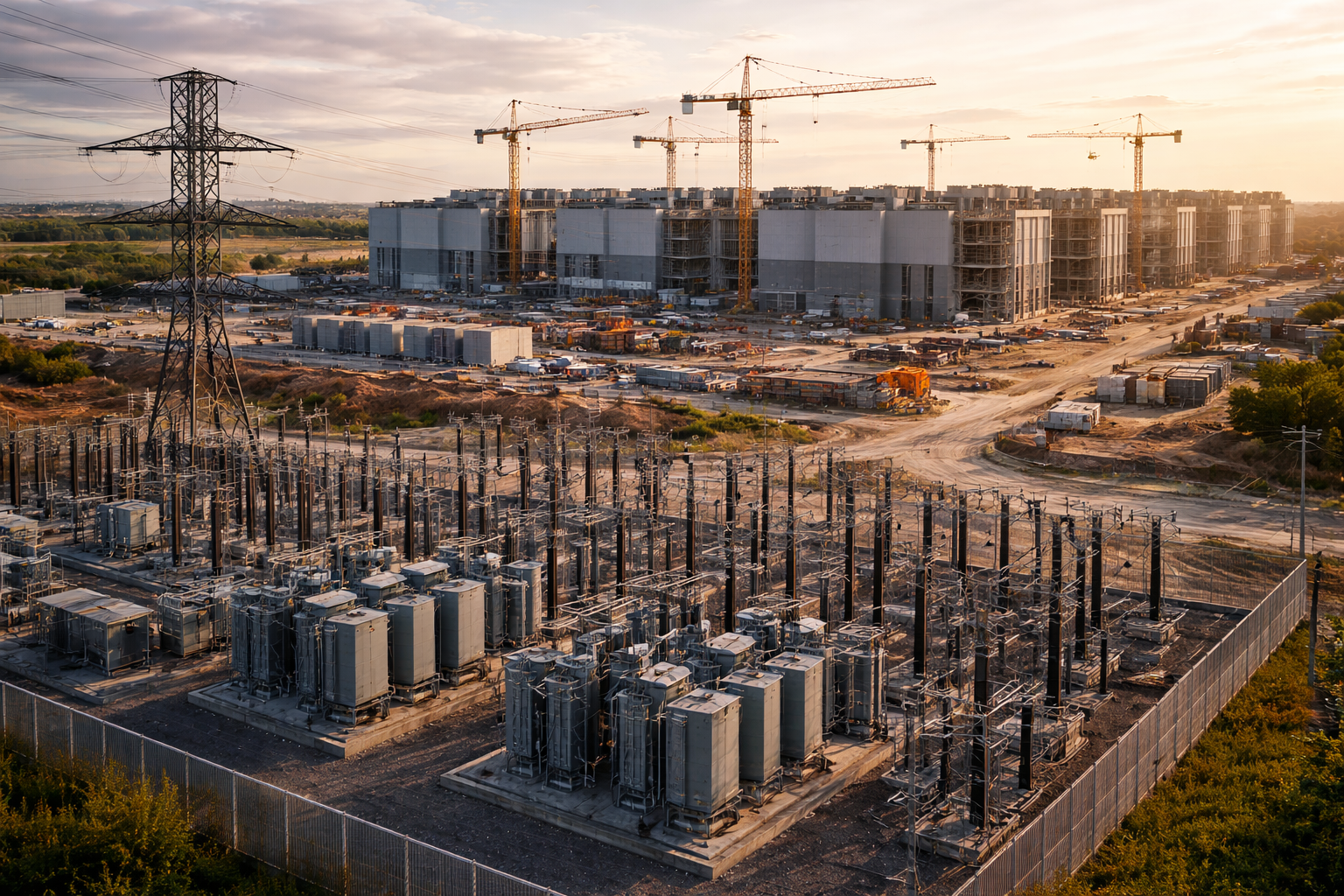
The pledged terms include provisions for data-centre operators to make backup generation available during periods of grid stress, framing on-site generation as a potential emergency resource rather than a purely private resilience measure. In practice, that points towards a growing pipeline of work around standby generation, switchgear, control systems, fuel logistics, and connection infrastructure, as well as the civil works that sit under substation build, cable routes, and plant installation.
For project delivery, the clearest near-term consequence is that power strategy is being pulled earlier into scheme definition. New data centres are already constrained by connection queue timelines in many US regions, and the pledge formalises a direction of travel in which developers are expected to underwrite more of the enabling works, whether through utility-directed upgrades, self-build generation, or hybrid solutions that combine both.
The commitment has drawn scrutiny over enforceability and timing. Electricity supply and utility regulation in the US sit largely at state level, and critics have questioned how compliance could be verified and how quickly new capacity can be delivered, even where funding is available. The pledge nonetheless places grid and generation scope firmly inside the developer cost envelope for a category of projects that continues to expand in both size and electrical intensity.