IN Brief:
- The former 21-home sheltered housing development has been reconfigured into 16 refurbished general needs properties.
- Insulation, high heat-retention storage heating, solar panels and battery storage have been installed, with every home achieving EPC Band A.
- All 16 properties are allocated, including six homes occupied by residents returning after the refurbishment.
Trust Housing Association has completed the regeneration of Manse Gardens in Strachur, Argyll and Bute, converting an underoccupied sheltered housing development into 16 refurbished general needs homes with improved building fabric, heating and renewable energy systems.
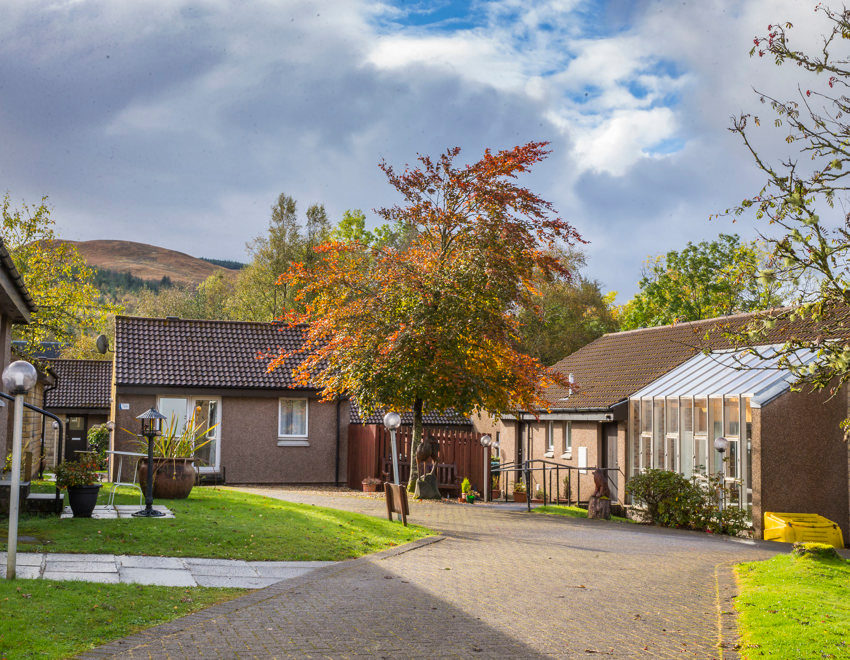
The project, originally valued at £3.6 million, has retained and extended the existing bungalows while removing five former studio properties to create an open space within the development. All 16 completed homes have achieved Energy Performance Certificate Band A.
The finished accommodation comprises 13 one-bedroom properties, two two-bedroom homes and one three-bedroom family home. All have been allocated, with six former residents returning after the building works and other households moving into the redeveloped properties.
Manse Gardens previously consisted of 21 predominantly small studio bungalows and communal facilities associated with its sheltered housing function. The development became increasingly underoccupied after revenue funding was withdrawn in 2017, with Trust ceasing to re-let vacant properties in 2019.
The landlord began working with residents, Argyll and Bute Council and the Scottish Government on redevelopment options in 2022. Retaining and adapting the existing buildings was selected as a means of preserving affordable accommodation while changing the internal layouts and the balance of property sizes.
Construction began in spring 2025. The works included demolition of five studio bungalows and redundant communal accommodation associated with the former sheltered housing arrangement, including office, lounge, assisted bathroom and laundry facilities.
The retained 16 bungalows were extended to provide more suitable living accommodation. Altering the existing properties required the new construction to connect with their retained walls, roofs, foundations and building services while creating layouts appropriate for independent households.
Extensions to existing buildings must accommodate the structural and thermal performance of both the retained and new elements. The position of new openings and connections can affect how loads are transferred through the original construction, while changes to the external envelope create junctions that require appropriate weatherproofing and insulation.
The refurbishment also introduced new kitchens and bathrooms, allowing the properties to operate as general needs accommodation rather than small sheltered housing units dependent on shared facilities. The completed development includes resident parking and communal landscaped areas.
Energy efficiency formed a substantial part of the works. Insulation was upgraded, while high heat-retention electric storage heaters, solar photovoltaic panels and battery storage were installed to improve the energy performance of the homes.
Thermal insulation reduces heat transfer through the building envelope. The effectiveness of the installation depends on the materials used, continuity around structural junctions and the treatment of openings and other areas where heat can bypass the principal insulated surfaces.
Where existing buildings are extended, the junction between old and new fabric requires particular attention. Differences in construction and insulation arrangements can create thermal bridges, while inadequate sealing may allow unwanted air movement and compromise the expected performance of the finished building.
The choice of heating system must be considered alongside the building’s revised heat demand. High heat-retention storage heaters are designed to store energy and release heat in a controlled manner, with their operation affected by charging arrangements, controls and patterns of occupation.
Photovoltaic panels generate electricity from sunlight, while battery storage allows some electricity to be held for use at a different time. The balance between on-site generation, storage and imported electricity will vary throughout the year according to weather conditions and household consumption.
The combination of these measures helped all 16 properties achieve EPC Band A. EPC ratings provide an assessment of energy performance under the applicable methodology, rather than a guarantee of identical running costs or measured annual energy use across households.
Trust has identified a lower carbon impact from retaining and upgrading the existing housing compared with replacing the complete development through demolition and new construction. A quantified whole-life carbon comparison has not been released, so the precise scale of avoided emissions cannot be established.
Retaining the bungalows allowed much of the original built structure to remain, although the extensive alterations required new materials, services and construction activity. The environmental outcome therefore depends on the balance between retained fabric, replacement components, construction impacts and subsequent building operation.
The works were delivered by Argyll and Bute-based TSL Contractors, with support from a team covering architecture, engineering, cost consultancy, energy performance, landscaping and building services. Project partners included ABC Architects, NBM Construction Cost Consultants, Carbon Futures, Mike Hyatt Landscape Architects, McDonald & Cameron and Green Home Systems.
Funding came from Trust Housing Association, the Scottish Government’s Affordable Housing Supply Programme, Argyll and Bute Council’s Strategic Housing Fund and ECO4 support. The original funding arrangements included £1.6 million from the Scottish Government and £192,000 from the council’s housing fund.
The redevelopment required existing residents to leave their homes temporarily while construction proceeded. Trust arranged alternative accommodation, including at Hunter’s Quay Holiday Park, and coordinated the transition back to Manse Gardens for the six households that returned.
Resident relocation was a significant part of delivering the refurbishment because the construction involved alterations to occupied housing rather than works on an empty development site. The programme had to allow residents to move away from the construction area before substantial demolition and reconstruction activities began.
The completion brings an existing rural housing development back into full residential use with a different accommodation mix. Manse Gardens now provides 16 general needs homes for social rent, with the former sheltered housing facilities replaced by self-contained refurbished properties.
The project has been shortlisted for the Excellence in Regeneration and Sustainability category at the 2026 CIH Scotland Housing Awards. Its completed construction programme combines retention of existing housing, extensive retrofit measures and a revised mix of affordable homes.