IN Brief:
- Demand for zero-emission plant is rising on regulated urban and residential sites.
- The ZX135-7EB combines a 198 kWh battery pack with a wired grid-assist option.
- Hitachi is positioning the model for daily-duty work with remote monitoring and camera safety systems.
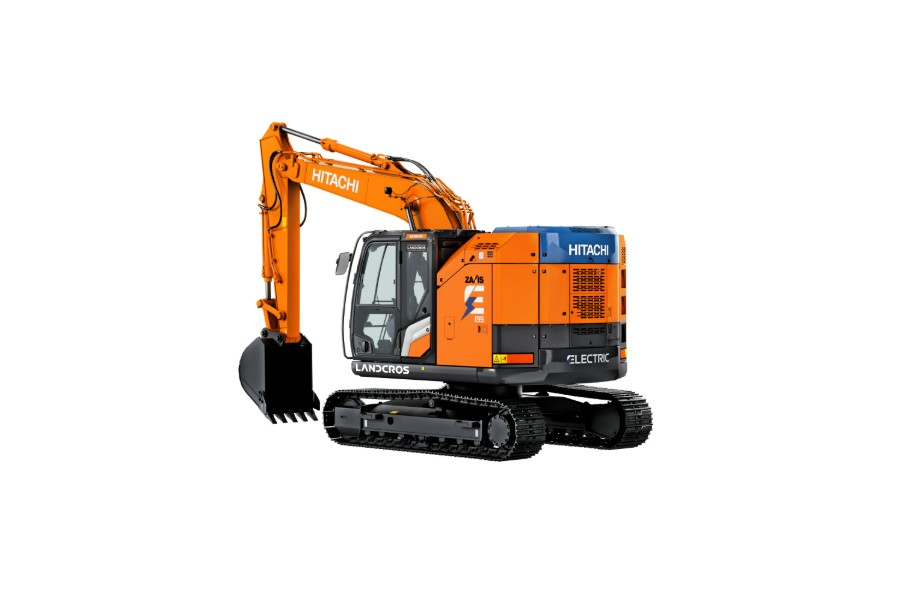
Hitachi Construction Machinery has introduced the ZX135-7EB, a 13-tonne battery-electric excavator that it describes as the largest battery-powered machine in its European electric line-up.
The manufacturer is targeting projects where exhaust emissions and noise limits constrain diesel operation, stating that the ZX135-7EB is intended to deliver emission-free performance while maintaining output comparable to the diesel ZX135-7. Hitachi also points to reduced maintenance requirements and lower downtime associated with electric drive systems versus internal combustion powertrains.
The ZX135-7EB is configured for dual-mode operation. In battery mode, it runs on 198 kWh lithium-ion batteries. In wired grid assist mode, the excavator can continue operating while connected to a CEE 400 V AC three-phase power supply, supporting extended working hours and continuous operation where grid access is available.
Operating data for the electric drive system — including battery status and motor load factor — can be monitored remotely. Hitachi has also specified its Aerial Angle camera system, providing a 270-degree bird’s-eye view of the working area, as part of the safety package.
Norihiko Kinugawa, product manager at Hitachi Construction Machinery (Europe), said: “Our largest battery-powered excavator is capable of working productively and efficiently on urban and residential construction projects.”
Electrification at this weight class is increasingly being used to bridge the gap between compact electric machines and larger diesel fleets, particularly where access, working hours, and site constraints make noise and local emissions a procurement issue rather than a sustainability add-on. Dual-mode designs also reflect the practical constraint that charging access varies sharply by site, even within the same urban area.
Hitachi has positioned the ZX135-7EB as part of a wider expansion of its electric portfolio, with the model aimed at contractors and plant owners needing a mid-size excavator capable of routine duty cycles without exhaust emissions at the point of use.