IN Brief:
- Deconstruction began in September 2025 and is expected to take around two years.
- The pause affects disputed stairwell sections between the 12th and 14th floors.
- The decision lands as government pushes memorial funding legislation and wider building-safety reforms.
The UK government has paused deconstruction works in parts of Grenfell Tower after bereaved families warned they would take legal action over the loss of stairwell walls bearing handprints they believe belong to victims or survivors. The pause follows a pre-action letter seeking a judicial review of a decision not to preserve any sections above the ninth floor.
During pre-demolition visits, families identified multiple handprints on blackened stairwell walls, and an Arabic inscription reading “Allahu Akbar” (“God is greatest”) elsewhere in the building. Both the handprints and the inscription were above the ninth floor — a threshold a government official said would not be preserved, citing the sensitivity of the site and the loss of life.
“Due to ongoing legal action, we have paused deconstruction works in the relevant areas,” a spokesperson for the government ministry responsible for Grenfell said. Government lawyers added that sections between the 12th and 14th floors would be cordoned off while deconstruction continues elsewhere, pending a response to the pre-action letter.
Families, supported by advocacy group Grenfell Next of Kin (GNK), argue the markings should be protected while discussions continue with memorial planners. “These sections on the walls in the stairwell hold the voices of that night — and we will not let them be erased, silenced, or this tragedy be sanitised,” said Karim Khalloufi, who lost his sister in the fire. GNK has also pointed to assurances given in 2025 that parts of the tower could be preserved for a memorial if the community wanted it.
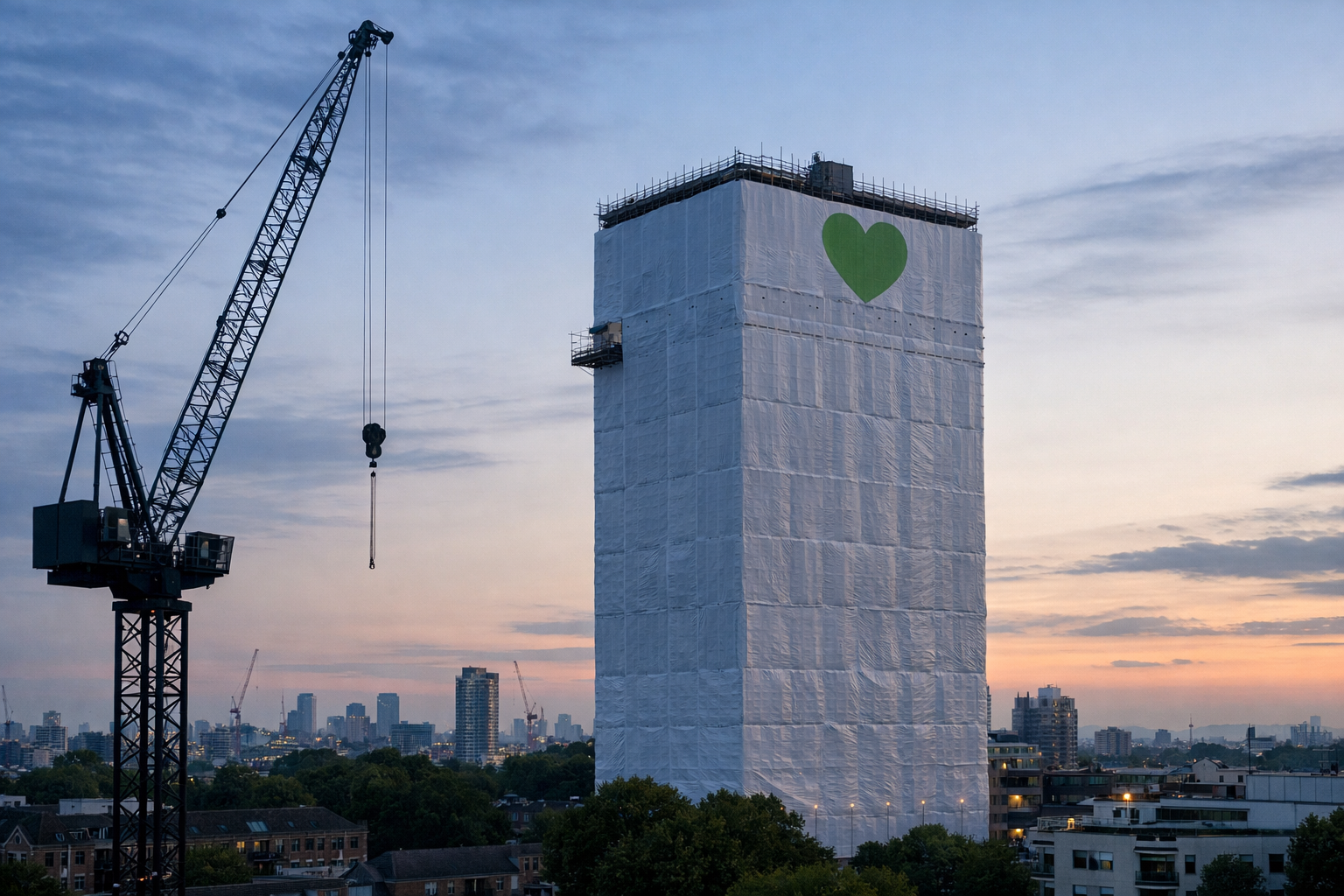
The operational reality is that Grenfell’s dismantling is not a conventional “smash and grab” demolition. A government community update sets out a floor-by-floor approach, starting at the top and progressing down, with each floor expected to take around a month, and the work carried out behind the tower’s external wrapping. Smaller elements are to be dismantled internally, with larger components — including external columns — removed in sections and lifted out by crane in covered containers.
Deconstruct UK (DUK) is confirmed as the principal contractor responsible for the work, having been on the site since 2017 as part of day-to-day safety and maintenance. The same update says the structure will continue to be monitored via a 24/7 system and floor-by-floor checks by structural engineering specialists, with Health and Safety Executive oversight under Construction (Design and Management) regulations.
The legal pause lands amid renewed political focus on Grenfell’s legacy. In late February, the government set out plans for legislation to fund a permanent memorial to the 72 people who died in the June 2017 fire, alongside updates on cladding remediation progress and incoming requirements for emergency evacuation plans for high-rise buildings. For the deconstruction programme itself, the immediate question is whether contested internal sections will now be treated as potential memorial artefacts, rather than waste to be quietly removed in covered loads.