IN Brief:
- UK construction entered 2026 with activity still fragile while regulatory reform accelerates.
- European infrastructure continued expanding, but major schemes exposed delivery vulnerabilities.
- In the US, funding disputes, power supply, and permitting increasingly dictated project pace.
February’s construction story was less about cranes on skylines and more about the conditions under which those cranes are allowed to move.
Across the UK, Europe, and the United States, the industry encountered a familiar but increasingly dominant set of pressures: regulatory expansion, programme fragility on megaprojects, and enabling infrastructure — power, permits, specialist equipment — dictating whether schemes advance or stall. None of these are new themes. What changed during February was their visibility, and the extent to which they shaped decisions at project, programme, and policy level.
In the UK, policymakers pushed further into the post-Grenfell reform agenda, expanding oversight of construction products and signalling tighter accountability across the supply chain. At the same time, contractors continued operating in a market that remains uneven — new work showing resilience while repair and maintenance softened.
Across Europe, the macroeconomic picture for infrastructure remained comparatively positive, yet the month’s most telling story came from the Fehmarnbelt tunnel, where a two-year schedule slip forced the cancellation and retendering of key contracts. Even Europe’s most industrialised civil engineering projects remain vulnerable to narrow technical constraints.
Meanwhile in the US, February delivered a reminder that construction schedules can be rewritten overnight by funding disputes, court decisions, or the availability of power. Large industrial developments — particularly data centres — continue to break ground at scale, but increasingly run into grid capacity and permitting limits long before construction capability becomes the issue.
The pattern is straightforward. Construction demand remains substantial across developed markets. Yet the factors determining whether projects progress are shifting steadily away from materials and labour shortages, and towards governance, infrastructure readiness, and regulatory scope.
With that backdrop in mind, February’s key developments are best understood region by region.
United Kingdom
The UK construction sector spent February navigating a delicate balance between tentative activity improvement and expanding regulatory oversight.
Economic indicators suggested the industry may be stabilising after a difficult end to 2025. The S&P Global/CIPS construction PMI improved compared with December’s sharp downturn, although it remained below the 50 mark that separates expansion from contraction. Contractors also reported the fastest rise in input costs since early autumn, reflecting continued wage pressure and material price volatility.
Official statistics offered a similarly mixed picture. Data from the Office for National Statistics showed total construction output falling again in December, but with a notable divergence beneath the headline: new work increased while repair and maintenance activity declined. That split reflects the uneven structure of the market, where infrastructure and selected large projects continue to move forward while smaller-scale work remains sensitive to economic conditions.
More consequential than the output figures, however, were developments in the regulatory landscape.
The government published its annual response to the Grenfell Tower Inquiry recommendations, outlining further steps towards a consolidated construction regulator. This includes governance changes to strengthen the Building Safety Regulator and the longer-term transfer of safety functions into a new arm’s-length body under the Department for Levelling Up, Housing and Communities.
Alongside institutional reform came a significant policy move affecting the entire supply chain. Late in the month, the government opened consultation on the Construction Products Reform White Paper, alongside proposals for a General Safety Requirement covering products that currently fall outside designated standards.
The scale of the regulatory gap is striking. Government analysis suggests that as little as 29% — and at most 61% — of construction products currently fall within recognised regulatory standards. The proposed General Safety Requirement would bring the remainder into a formal safety regime, placing enforceable obligations on manufacturers, importers, and distributors.
For contractors and designers, the practical implications are that product selection, traceability, documentation, and installation guidance are likely to move into legally enforceable requirements, adding further compliance complexity to project delivery.
Meanwhile, the planning system remains another pressure point. February saw consultation open on reforms intended to accelerate planning decisions in England, part of an ongoing attempt to unblock development pipelines that have slowed significantly in recent years.
Overall, the UK’s February developments suggest a construction sector entering a new operational phase — one defined as much by regulatory architecture as by market demand.
Europe
Across Europe, the economic backdrop for construction — particularly infrastructure — remained comparatively robust, yet February exposed how fragile delivery programmes can still be.
Eurostat data showed construction output across the euro area rising month-on-month in December, with civil engineering recording the strongest growth. Infrastructure continues to provide a stabilising force for the sector, particularly as residential construction in several European markets remains subdued.
Yet the most instructive story came from one of the continent’s most ambitious infrastructure schemes.
The developers of the Fehmarnbelt tunnel — the immersed road and rail link connecting Denmark and Germany — cancelled two major tenders during February after the project’s overall schedule slipped by approximately two years. The contracts affected include tunnel track and catenary works, along with tolling infrastructure.
The cause was not financial instability or political opposition, but something far more specific: difficulties with the specialist vessel required to install the tunnel’s massive prefabricated elements.
It is a striking reminder that even Europe’s most technologically advanced civil engineering programmes ultimately depend on a handful of highly specialised capabilities. When one of those components falters, entire procurement strategies must be recalibrated.
Elsewhere, public clients continued pushing forward with large infrastructure programmes despite cost pressures.
Turkey secured preliminary financing agreements for the proposed Northern Ring Railway around Istanbul — a $6.75bn project expected to become the country’s largest foreign-funded rail development.
Infrastructure financing, once again, is proving just as critical to construction momentum as engineering capability.
United States
In the United States, February illustrated how infrastructure projects can swing rapidly between acceleration and uncertainty.
The most prominent example came from the Gateway rail tunnel project linking New York and New Jersey. A federal funding freeze triggered legal action from state authorities before a judge ultimately lifted the suspension, allowing the project to proceed.
For contractors and suppliers, the episode underscored a persistent vulnerability in US infrastructure delivery. Large projects often depend on complex federal funding mechanisms that can become entangled in political or legal disputes, introducing sudden disruption into otherwise stable construction programmes.
Elsewhere, federal agencies continued strengthening programme management structures on large government-led construction initiatives. The Department of Homeland Security, for example, awarded a substantial programme management contract linked to border infrastructure delivery — an indication of growing emphasis on centralised oversight and schedule control.
Meanwhile, the country’s industrial construction boom continued, particularly in the technology sector.
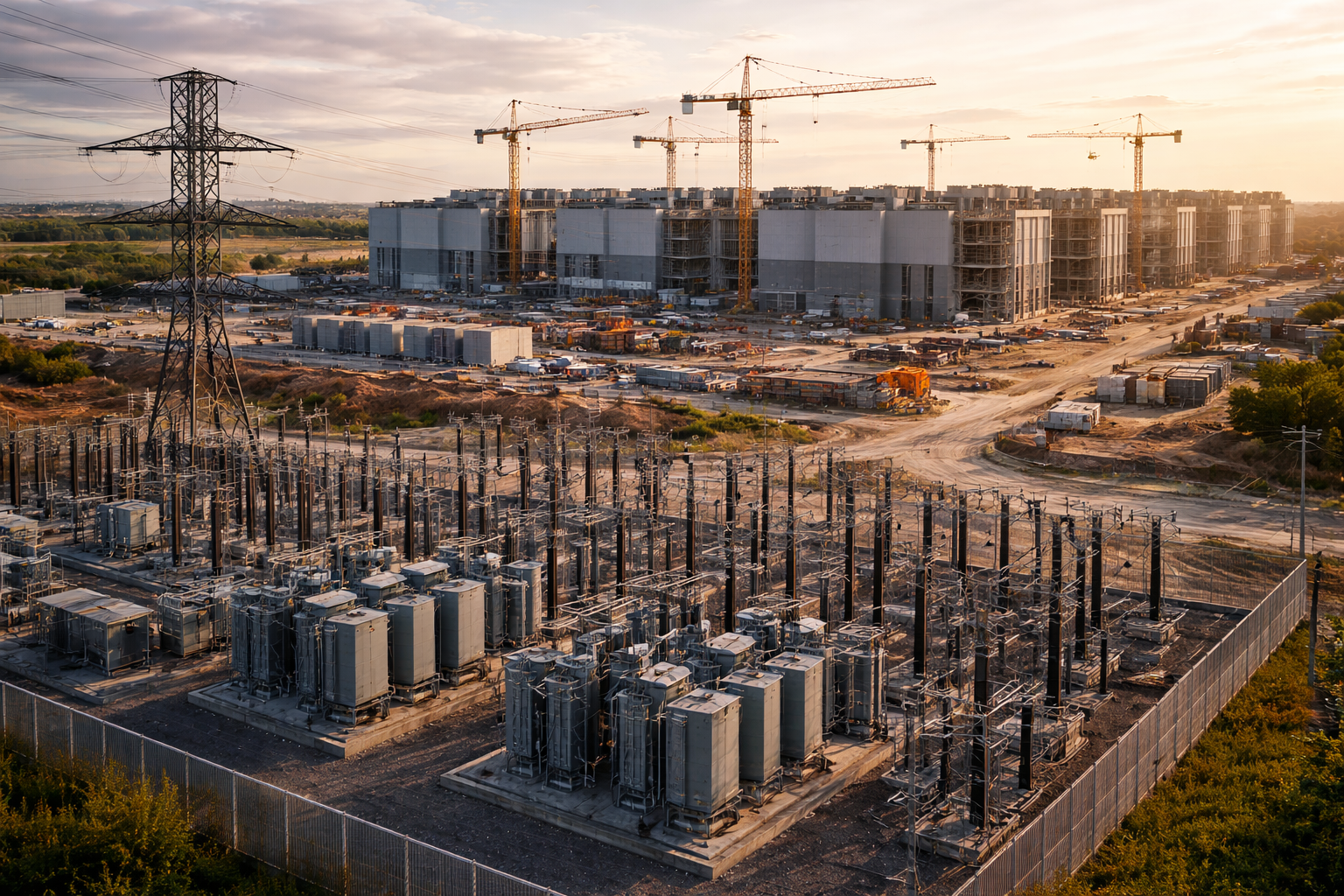
Meta began construction of a major data centre complex in Indiana, a facility expected to require around one gigawatt of electrical capacity once operational. Similar developments are underway across several US states as technology companies expand artificial intelligence infrastructure.
Yet these projects are encountering a new constraint: electricity supply.
Across several regions, power availability and permitting timelines are emerging as the primary limiting factors for data centre construction. Developers may have the capital, land, and contractors ready to mobilise, but grid capacity and regulatory approval increasingly dictate how quickly facilities can actually come online.
It is a dynamic likely to shape US construction activity throughout the remainder of the decade.
Outlook
February offered a useful snapshot of the forces currently shaping the global construction industry.
Demand for infrastructure and major projects remains strong in most advanced economies. Yet the constraints determining delivery have shifted decisively away from materials shortages and towards regulatory frameworks, political processes, financing structures, and the readiness of enabling infrastructure.
For contractors and project sponsors alike, managing those variables is becoming just as critical as managing the build itself.